Ticket to Ride Longest Route Calculator
Estimate your continuous train path with graph segments, connected cities, branch penalties, loop handling, remaining trains, and route bonus comparison.
Enter the shape of your claimed network rather than every city name. The calculator treats the main trunk as the likely longest path, adds valid loop value once, discounts branch-only spurs, and compares the result against the rival route length.
| Map Variant | Common Train Pool | Longest Route Award | Route Shape Pressure |
|---|---|---|---|
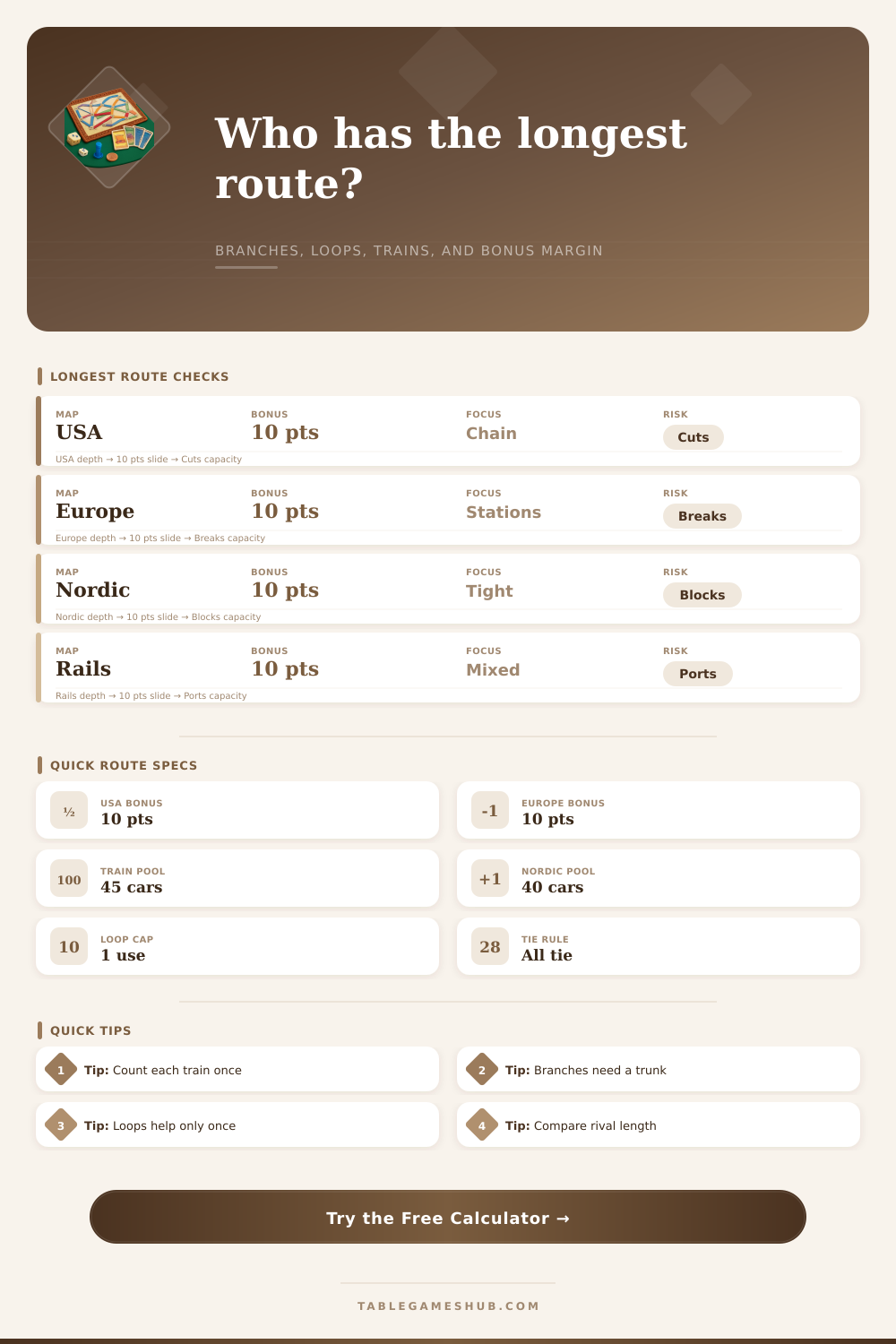
| USA / Classic | 45 train cars | 10 point Longest Route | Open cross-country chains and major cut points |
| Europe | 45 train cars | 10 point Longest Route | Stations can help tickets but should be reviewed for route awards |
| Nordic Countries | 40 train cars | 10 point Longest Route | Tight routes, fewer players, and scarce long corridors |
| Switzerland | 40 train cars | 10 point longest route style bonus | Mountain loops and destination clusters matter |
| India | 45 train cars | 10 point longest route style bonus | Mandala loops can reshape the main path |
| Rails and Sails | Mixed pieces | Scenario dependent | Ports and ship routes create separate bridge decisions |
| Graph Feature | How It Counts | Calculator Treatment | Counting Warning |
|---|---|---|---|
| Main trunk | Best end-to-end continuous chain | Counts at full value | Do not double back over the same claimed segment |
| Side branch | May replace one weak end or extend through a junction | Discounted by branch profile | Most branches cannot all count at once |
| Loop or cycle | Can add flexibility through alternate paths | Partial capped credit | Each physical route is counted once |
| Disconnected cluster | Separate claimed network | Excluded from continuous length | Needs a bridge before it can help |
| Station link | Opponent route used by station | Small confidence penalty | Confirm your group edition wording |
| Network Shape | Best Input Pattern | Bonus Security | Practical Read |
|---|---|---|---|
| Mostly linear chain | Two endpoints, low branch value | High if longer than rival by 3+ | Extend at either end first |
| Loop-heavy web | Large loop length, many cities | Medium high | Check no route segment is reused |
| Branch-heavy tree | Extra endpoints and side spurs | Medium | Longest path uses only the best branch pairing |
| Hub-and-spoke cluster | Many cities, short branches | Medium low | Find the two deepest spokes through the hub |
| Fragmented network | High disconnected length | Low until bridged | Bridge before adding isolated points |
| Margin Versus Rival | Status | Train Need | Table Action |
|---|---|---|---|
| Behind by 4+ | Chasing | Bridge or long extension needed | Prioritize connection over ticket padding |
| Behind by 1 to 3 | Close chase | One medium route may flip it | Watch rival endpoints carefully |
| Tied | Shared award risk | One extra train protects solo bonus | Claim the safest open route |
| Ahead by 1 to 3 | Narrow lead | Small extension recommended | Block only if extension is unsafe |
| Ahead by 4+ | Strong lead | Protect from visible bridge | Finish tickets or deny rival path |
| Component | Standard Role | Calculator Role | Useful Benchmark |
|---|---|---|---|
| Plastic train cars | Claim route spaces | Measures trunk, branches, and remaining reach | Classic pool is commonly 45 cars |
| Route links | Connect adjacent cities | Graph edges for continuous path math | Long links swing route length fast |
| City nodes | Junctions and endpoints | Estimate path flexibility and branch depth | Extra endpoints signal branching |
| Destination tickets | Score completed city pairs | Context only, not longest route length | Long tickets often share trunk value |
| Stations or ports | Map-specific connection tools | Adjustment for assisted continuity | Confirm edition-specific award wording |
The longest continuous route in the game are often teh factor that determines whether a player wins or loses the game. While the longest continuous route is visible to all player during the game, many players do not realize the total value of there longest continuous route until the game is over. This is due to the fact that most players is unaware of how the game values continuous routes.
A continuous route is calculated as the number of routes from one point to another without ever using a segment of route that a player have chosen to claim. A player can envision a number of different routes on the game board that extend from one point to another, but the route only extend in one direction may not be calculated into the longest continuous route for that player. The game provides a route calculator that allow a player to calculate the length of their longest continuous route by entering the length of their main trunk route, the length of their largest usable branch, and the length of any loop they have built with their placed trains.
How to count your longest continuous route
The calculator will display the number of route segments that the player has built into their longest continuous route bonus. Largest continuous route bonuses are built with the intention of allowing alternate routes for players to build into their continuous route. For example, loops allow for a player to create alternate routes around a player that owns that segment of the route.
However, the claimed routes that a player controls is only counted once within that player’s longest continuous route bonus. This rule is used to ensure that a player cannot claim the same routes twice for their bonus, a rule that mirror the guidelines for bonus calculation that are included in the game. Additionally, any train that a player has built in separate cluster from their main route are unable to contribute to the length of the longest continuous route unless another train player connected those trains to the main route.
These separate trains can earn players point on the destination tickets, but they are not counted in the longest continuous route bonus. The calculator is programmed to account for these separate cluster of trains that are not connected to a players main continuous route. The length of the longest continuous route that a player builds is only one of the factors that must be considered in the game.
The length of the rival players’ longest continuous routes is just as important. While a player may believe that their longest continuous route is safe due to the number of segment that they are ahead of their rivals, those rivals may be able to bridge the gap between the two player. The route calculator can determine how many additional segment would be needed to extend a rival player’s longest continuous route to that of the player’s own, and it can also calculate how many more car would be needed to ensure that those rivals’ route would no longer be claimed.
The length of the longest continuous route that a player can claim is also impacted by the specific map that is used for that game. For instance, in the USA game map, players are rewarded for building long continuous routes from coast to coast, but in the Nordic Countries map, many of the routes is already narrow and allow for few continuous route bonus for players to claim. In the Europe map, a number of the stations that a player controls will earn those players point on the destination tickets without adding to the length of their longest continuous route bonus.
Each of these map editions have its own reference table that allow for players to understand how each map changes the value of the bonuses for loops and branches. The decision of where to place a player’s additional train is a trade-off between the value of the longest continuous route bonus relative to the value of the destination tickets that would be missed if that train is added to the route. A player may gain a bonus of one point for each train that is added to the longest continuous route, but the missing destination tickets may lessen the value of that point.
While the route calculator cannot make this trade-off for the player, the calculator remove the need for players to complete the arithmetic for this trade-off. In most cases, the longest continuous route is considered to be a side project for most players. However, players who consider the construction of the longest continuous route to be their primary goal in the game will have more success with their effort.
Strategies that can ensure the best outcome for a player include ensuring that the player watch their endpoints for each route, counting only their usable branch, ensuring their longest continuous route bonus is equal to that of their rivals, and ensuring that they are treating the longest continuous route as their primary goal.