Disc Golf Distance Calculator for Wind and Slope
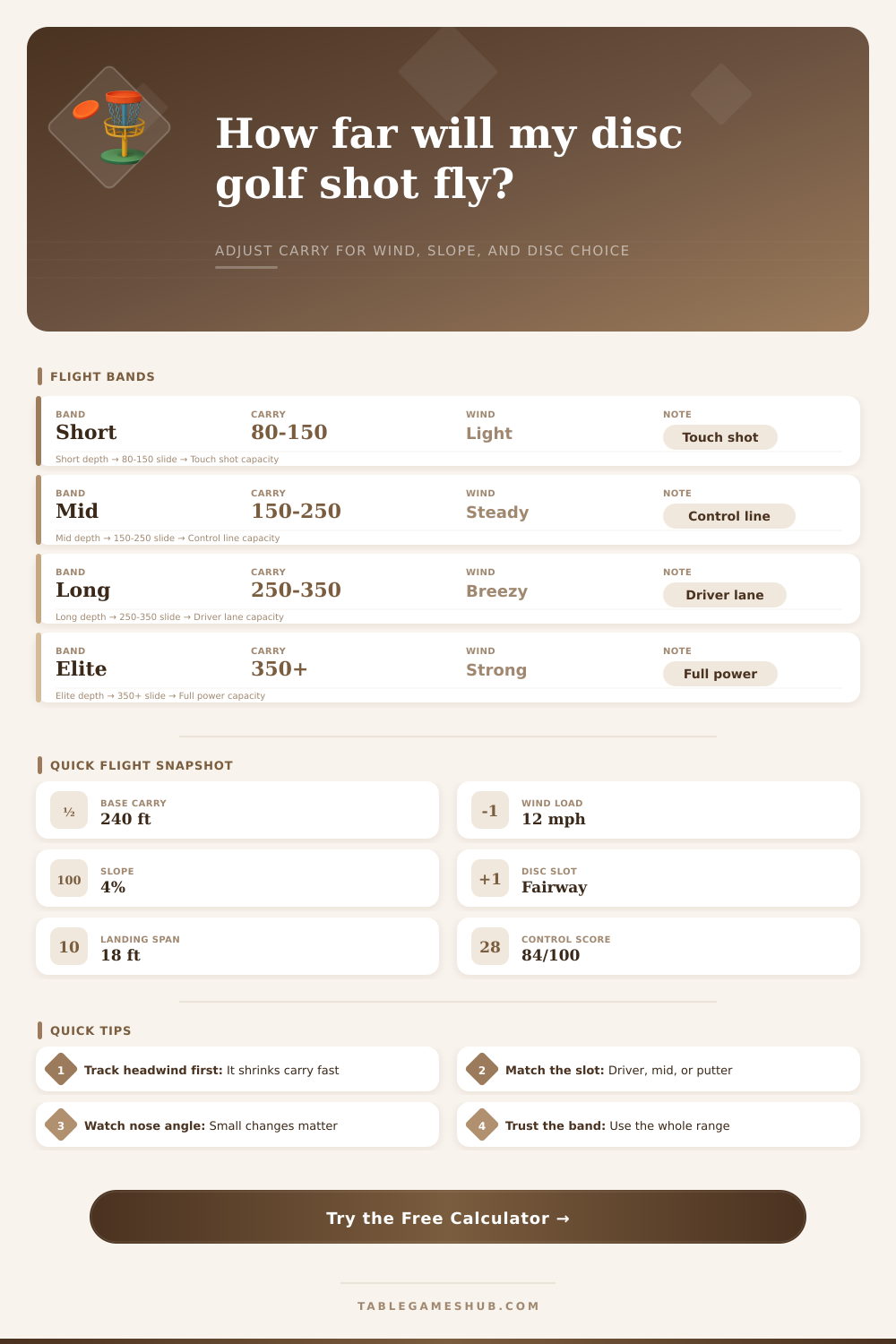
Adjust carry, total flight, and point-on range with disc class, wind, slope, and landing conditions.
| Disc Slot | Carry Band | Wind Bias | Landing Note |
|---|---|---|---|
| Distance Driver | 300-450 ft | Most sensitive | Big fade window |
| Fairway Driver | 225-325 ft | Balanced | Clean landing |
| Midrange | 150-225 ft | Steady | Stick-first |
| Putter | 80-175 ft | Least drift | Shortest skip |
| Wind | Carry Shift | Drift Shift | Best Use |
|---|---|---|---|
| 0-4 mph | Small | Small | Neutral lines |
| 5-9 mph | Noticeable | Moderate | Stable discs |
| 10-14 mph | Large | Large | Control shots |
| 15+ mph | Major | Major | Safer lanes |
| Condition | Carry Bias | Total Bias | Ground Note |
|---|---|---|---|
| Flat | Neutral | Neutral | Clean read |
| Uphill | Shorter | Shorter | More lift loss |
| Downhill | Longer | Longer | Extra glide |
| Hard ground | Neutral | Longer | More skip |
| Shape | Carry Bias | Fade Bias | When to Use |
|---|---|---|---|
| Flat | Balanced | Balanced | Straight lane |
| Hyzer | Slightly shorter | More fade | Safe finish |
| Anhyzer | Longer | Less fade | Turnover line |
| Spike | Shortest | Sharp | Vertical drop |
To achieve distance in the game of disc golf, player must understand how various factor affect the distance that a disc can travel. Distance isnt just a result of how hard a player throw a disc, but also the effect of air, angle, and the ground upon which the disc travel. While many player focus upon their arm speed when attempting to achieve distance with their disc, there are other factor at play in the game, such as the effect of wind and slope upon their discs.
Wind is one of the primary factor that will impact the distance of a disc’s travel. A headwind will reduce the distance that a disc can carry, and can reduce the distance of a distance driver by as much as 20%. Tailwinds will increase the distance that a disc travel, but can also cause understable disc to travel in wide curves.
What Affects Disc Golf Distance
Crosswinds will cause disc to drift to the left or right. Crosswinds impact discs with high rate of glide the most. Thus, a player must take into account the wind and choose a disc that will remain on the intended flight path.
Slope is another factor in the distance that a disc travel. If the fairway upon which a player intend to throw a disc is sloping in a way that indicate that it will travel upward from the player, the slope will reduce the distance of that disc. Conversely, a slope that slopes downward from the player will increase the distance of a disc.
Thus, players must evaluate the slope of the ground prior to throw. Disc class are divided according to the way in which they will travel and the distance that they can achieve. Distance driver are discs that can travel beyond 300 feet in calm air, but are very sensitive to wind.
Fairway driver travel between 225 and 325 feet. Midrange disc travel between 150 and 225 feet, but are more reliable then drivers because they drift less. Putters are used to travel between 80 and 175 feet, and the wind does not easy move them.
Glide is a factor in how far a disc can travel. Discs with high glide rate will travel farther, but may flip over too early if there is a strong wind. Discs with low glide rate will hold their line better in gust of wind.
Stability is also a factor in how well a disc perform in various conditions. Overstable disc are beneficial in headwinds, while understable disc are beneficial in tailwinds. The angle at which a player is throw a disc will alter the way in which it fly and the distance that it can achieve.
A flat release will cause a balanced flight of the disc. A hyzer angle will cause the disc to fade at the end of its travel. An anhyzer angle will allow the disc to turn as it travel further along its intended curve.
Additionally, the nose of the disc must be pointed in the appropriate direction; if it is too high, the disc will lose its lift, and, consequently, its distance. The ground upon which a player throws a disc will determine the skipping of the disc. If the ground is soft, such as grass, the disc will stop quick.
If the ground is hard and firm, the disc will skip and roll, increasing the distance that it will travel. Thus, players must consider the ground upon which they will throw their disc. In order to improve player score in disc golf, there are some mistake that should be avoid.
One mistake is to ignore nose-down discipline; throwing with the nose of the disc pointed upwards will cause the disc to lose distance. Another mistake is to use distance driver for every shot; players better accomplish shots under 150 feet with putters. Finally, players should always observe the wind and the slope of the course prior to throwing their disc.
By considering the wind and slope of the course, players will be able to control the distance that their disc travel.