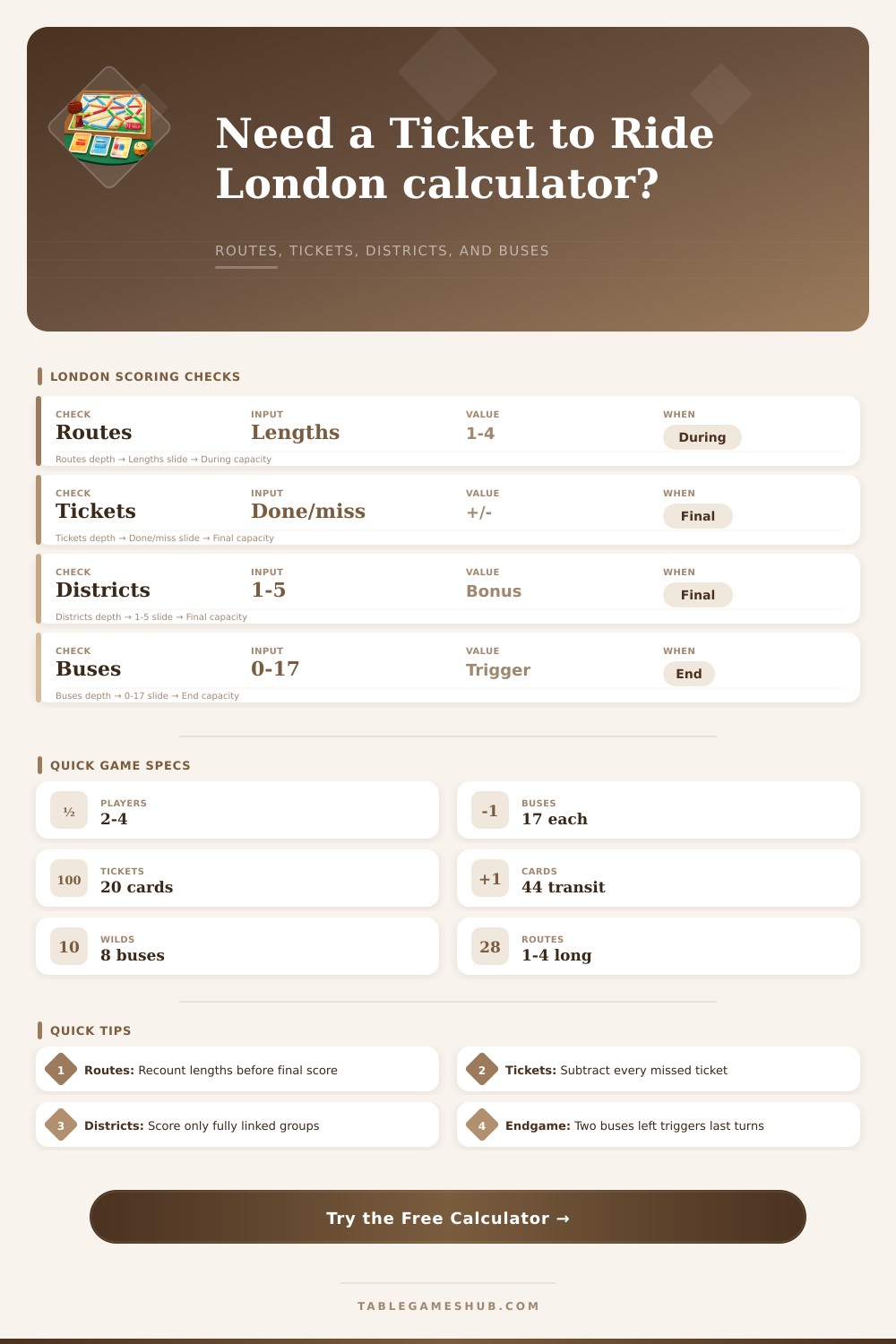
Ticket to Ride London Calculator
Total a London endgame score from claimed route lengths, completed and failed Destination Tickets, completed District numbers, buses remaining, player count, and manual score corrections.
1London Endgame Presets
Load a named table state, then edit route lengths, ticket points, District numbers, bus supply, and penalties to match the player's board.
2Route, Ticket, and District Inputs
3London Component and Spec Grid
4London Scoring Reference Tables
| Route length | Plastic buses used | Route points | Calculator code example |
|---|---|---|---|
| One-space route | 1 bus | 1 point | 1x4 means four claimed length-1 routes |
| Two-space route | 2 buses | 2 points | 2x3 means three claimed length-2 routes |
| Three-space route | 3 buses | 4 points | 3x2 means two claimed length-3 routes |
| Four-space route | 4 buses | 7 points | 4x1 means one claimed length-4 route |
| Ticket status | Endgame action | Score effect | Calculator field |
|---|---|---|---|
| Completed card | Reveal and verify continuous path | Add printed value | Completed Destination Ticket points |
| Failed card | Reveal unconnected locations | Subtract printed value | Failed Destination Ticket points |
| Extra kept card | Cannot be discarded after keeping | Add or subtract at final scoring | Include in the correct ticket total |
| Secret card audit | Check path through claimed routes only | No opponent routes count | Use manual correction if needed |
| District input | Required connection | Points scored | Calculator note |
|---|---|---|---|
| District 1 | All same-color number 1 locations linked | 1 point | Enter 1 once for each completed District 1 group |
| District 2 or 3 | Each location in that district connected | 2 or 3 points | Enter values as 2,3 or 2/3 |
| District 4 or 5 | Higher-value district fully linked | 4 or 5 points | Partial districts score nothing |
| Repeated values | Separate completed district groups | Each value counted | 2,2,5 scores 9 district points |
| Bus state | Rule check | Scoring impact | Calculator warning |
|---|---|---|---|
| 3 or more buses left | Game continues unless another player triggered endgame | No direct score | Shows as not triggering final turn |
| 2 or fewer buses left | Each player gets one last turn | No bonus by itself | Endgame trigger notice appears |
| Route code uses over 17 buses | More pieces than a player owns | Route audit is invalid | Warning asks for route recount |
| Two-player double route | Second parallel route closes after first claim | May affect ticket paths | Two-player reminder appears |
5Scoring Tips
Recount route points before tickets: London route points are normally marked during play, but route-length code makes it easy to audit the score marker before adding secret tickets.
Districts need full connection: enter a District number only when all locations in that same colored and numbered group are linked by the player's own claimed routes.
Ticket to Ride London ends with the decisive turn: who will win and who lose? Once a player’s pile of plastic buses drops to two or fewer, it’s time for final round. Each player gets their final move and it’s time to tally points.
As you look around at piles of color-coded trains and hidden cards on the board, perhaps you’re realizing that taking a chance with that long trip through Westminster wasn’t such a great idea after all. While everyone’s looking on, it’s time to do some math in your head. That’s where the calculator comes in. The pieces is turned into a simple bottom line, removing any guesswork and allowing you to debate outcome.
Counting Points in Ticket to Ride London
The London version of the game is smaller and denser than others; it’s tighter. Seventeen isn’t many buses, so you have to make hard decisions right off the bat: Do I use this bus now for a four space route, worth seven points? Or do I conserve my buses for that tricky destination ticket down the line? With the tool, you can absorbs which routes you’ve claimed in simple code. You type out lengths like 1×4 or 3×2, and it instantly converts them into points. Under pressure, that saves time, plus it reveals whether or not you’re playing efficienty. Did you plow half your buses through short, one point routes? The math will tell you that, which shows how you could of played better next time.
The other side is destination tickets. These play different. At the time they’re played, you don’t know what they will be worth (how good of a score they’ll get you). So some people hold onto as many as possible in hopes of a huge payout, and others throw away risky ones just to avoid losing. The difference is shown by the calculator splitting the tickets you’ve completed from those you haven’t. If you complete one it helps your score, if not it hurts it immediately. There’s no “almost” with these, so missing on a big-ticket one will cost you points, sometimes enough to negate all those little route you did take. Holding too many cards in hope of a better route later is self-sabotage. This section helps you measure that once the game is over with its inputs.
There’s another reason; the district bonuses. These are squares on the board that give bonus points when you connect all location of a given number and color. They seem like extra work, so people tend to overlook them. But they can be the difference between winning and losing in a close game. When using the calculator, you’re asked what districts you finished. It will calculate that separately from the points for your route. Why? Because that shows you how many points each bonus gave you towards making win (or loss). Many casual gamers falls into the trap of concentrating only on large train routes without paying attention to the bonuses.
But what about the endgame trigger? To ensure the game ends correctly, the calculator looks at how many buses you have left. Does that mean you win? No, unless there are less than three buses remaining. If you have more than two buses left, you’ll continue playing. Because knowing when the game is over and who gets the last point can get confusing!
In two-player games, things get more complicated because double routes can really mess with other players. In these games, you don’t want to end the game too early or cause any confusion about whose turn it is. By taking into account number of players, the tool can put some context around your score.
Why do I have *that* score? It breaks down exactly where all those points came from: was it districts? Tickets? Routes? It makes the total tally feel transparent instead of a simple score. And now it’s also a learning experience. How would next time be different? Should you try to get little wins, or take a chance on going for long routes?
Often, the reason one person wins and another loses isn’t due to luck. It’s simply because they did slightly better math at the end.