Explode Dice Probability Calculator
Model exploding dice pools with exact faces or threshold triggers, reroll ones, capped explosion chains, target sums, expected value, and tail probability for tabletop score checks.
| Total | Exact probability | Tail probability | Relative weight |
|---|---|---|---|
| Calculate | 0% | 0% |
| Game roll pattern | Typical trigger | Why it is used | Calculator setting |
|---|---|---|---|
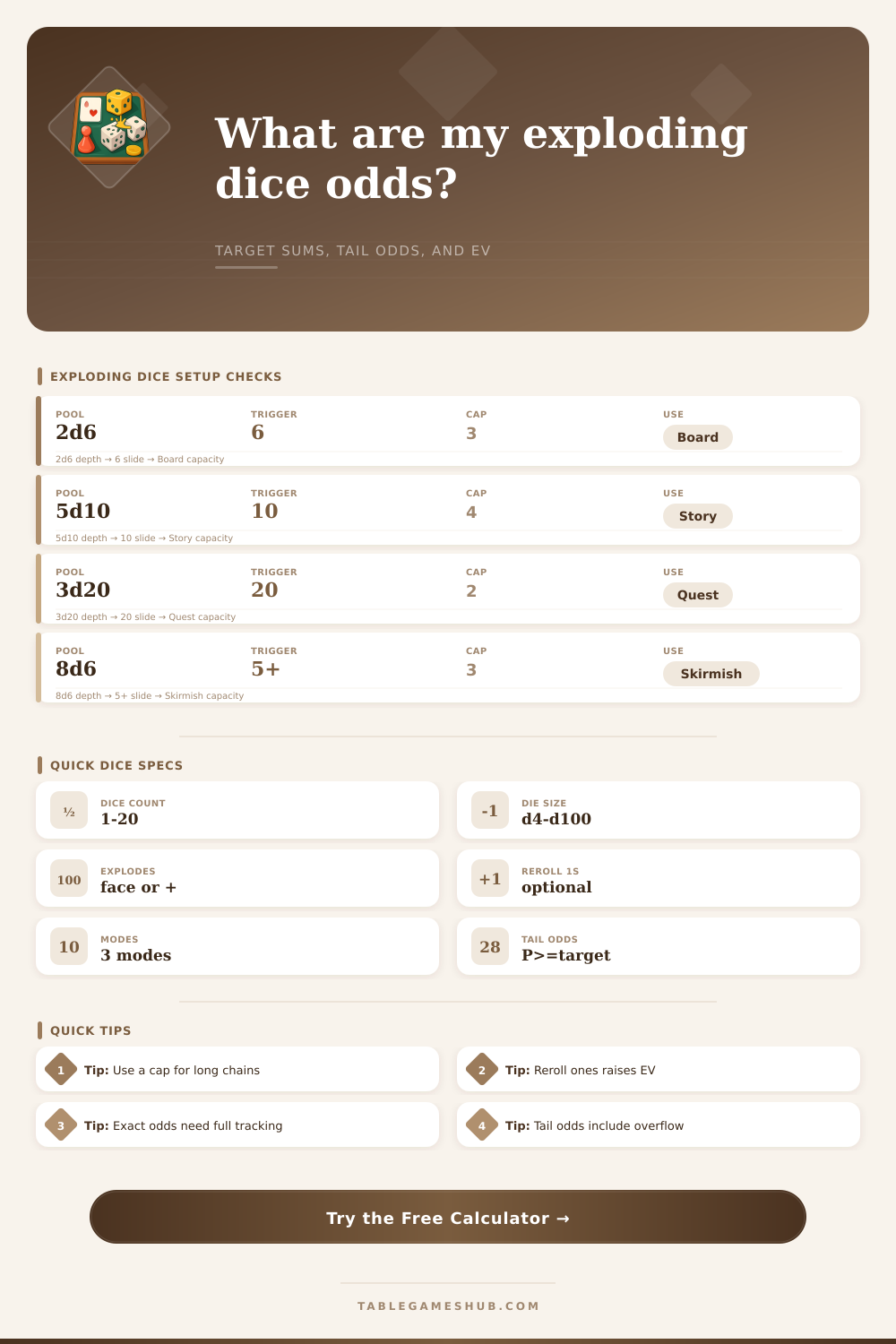
| Open-ended d6 pool | Natural 6 | Simple high-face burst | Max face, cap 3 |
| Story d10 pool | Natural 10 | Clean percentile-style dice math | Max face, cap 4 |
| Crit-heavy skirmish dice | 5 or 6 on d6 | Frequent chains with wider tails | Threshold 5 |
| Open d20 challenge | Natural 20 | Rare but dramatic extra roll | Exact 20 |
| Mode | Probability counted | Best for | Overflow handling |
|---|---|---|---|
| At least target | P(total ≥ target) | Difficulty checks | Counts overflow |
| Exactly target | P(total = target) | Exact puzzle totals | Does not infer overflow |
| At most target | P(total ≤ target) | Low-roll success systems | Excludes overflow |
| Tail probability | Always P(total ≥ target) | Risk comparison | Counts overflow when possible |
| Max explosions | Chain length | Computation effect | Use when |
|---|---|---|---|
| 0 | Base die only | No explosion tail | Compare normal dice |
| 1-2 | Short chain | Fast, small tail | Casual table checks |
| 3-5 | Medium chain | Good tail estimate | Most tabletop pools |
| 6+ | Long chain | Needs safety cap | Rare open-ended rules |
| Die | No reroll mean | Reroll 1 once | Change before explosions |
|---|---|---|---|
| d4 | 2.50 | 2.88 | +0.38 per die |
| d6 | 3.50 | 3.92 | +0.42 per die |
| d10 | 5.50 | 5.95 | +0.45 per die |
| d20 | 10.50 | 10.98 | +0.48 per die |
When you roll those dice onto the table they go quiet. That is a solid pool. But wait… you notice one is a ten, one’s a natural six and both could possibly explode into more chaos. Now it isn’t just about whether or not you hit a static number. It’s about guessing at how far that initial spark flies before dying out.
A single explosion of dice transform a straightforward curve of probabilities. It becomes something with a long, heavy tail that has a strong chance to swing wildly in any given direction. That’s why the calculator above does all the math for you (without having to guess), you’ll be able to see exactly where you stand with your odds.
How Exploding Dice Change Your Odds
What many players instinctively grasp about exploding dice is they increase your average. What they don’t necessarily grasp is how dramatically those rules shifts the odds in favor of extremes. Each exploding die add another roll to the sum, which then has the potential to explode itself. Rather than adding flatly, you have a geometric series of probability. The expected value rise, but so does the variance.
You’re far more likely to end up with some spectacular result, but just as likely to draw out a long chain of lower rolls without ever seeing anything happen. It’s a risky proposition that will pay off big for anyone patient enough to see it through … and ruin them if they aren’t lucky enough to begin with.
The biggest choice you’ll make with exploding dice pools is setting the size of your explosion cap. If left uncapped, there’s no upper bound and we can’t calculate precise probability values using basic math tools. To get around this, the calculator assumes some kind of cap on the number of possible explosions to keep the math manageable while maintaining accuracy for reasonable play conditions. 3-4 explosions per dice should covers the overwhelming majority of what happens in the table.
Beyond that, while it appeals to our inner mathematician, is hardly ever going to change anything about how the game plays. By then the tail is so skinny that you’re not really considering it as part of strategy, but more “once-in-a-campaign” stuff.
Another thing that groups tack on to cushion the effects of failure is rerolling natural ones. This mechanic takes the worst case situation off each die in your pool, increasing your base expected value. It doesn’t always mean you get more explosions, but it means all the other rolls will be just a little bit sweeter. Rerolling lows with exploding highs gives you a distribution that’s both broader and higher than normal dice.
No longer can you rely on the comfort of the bell curve. In exchange, you have the thrill of big, swing-for-the-fences shifts in momentum. What matters most with exploding dice are their success modes. Unlike regular dice, where a 7 on a d6 can still be counted as a 7, the exploding mechanic shift that chance over many more points such that asking for a perfect result is frequently a fools errand.
Instead, the key measure for skill checks and combat alike is tail probability: how likely are you to roll at least x? This captures the over-flow ignored by regular die distributions. When your situation demands matching a specific value, say a damage threshold or puzzle code, then it’s the exact mode that shows you just how fragile those chances realy are. The calculator makes this difference quite clear so you don’t mistake hitting a target for going past it.
These percentages need some context. On their own, a 20 percent chance doesn’t sound great. But what if you have three chances? It could mean making or breaking a critical roll. An 80 percent chance sounds like a sure thing…until you consider the other 20 percent is rolling so poorly that it’s literaly game over. That’s why knowing how the curve looks can help you make smarter decisions around the table.
Instead of only thinking about average, you begin accounting for variance as well. To conclude, Dice explosions are all about letting go. You let go of the routine nature of a check to make it something that’s actualy tense. You will learn about the mechanics behind triggers, caps, and rerolls so they are no longer magic randomness, but rather a calculated tool in your arsenal.
You know what to expect based off the math to support your gut feelings. Time to roll the dice.