Archery Arrow Length Calculator
Match draw length, release style, and front-end clearance before you trim a single shaft.
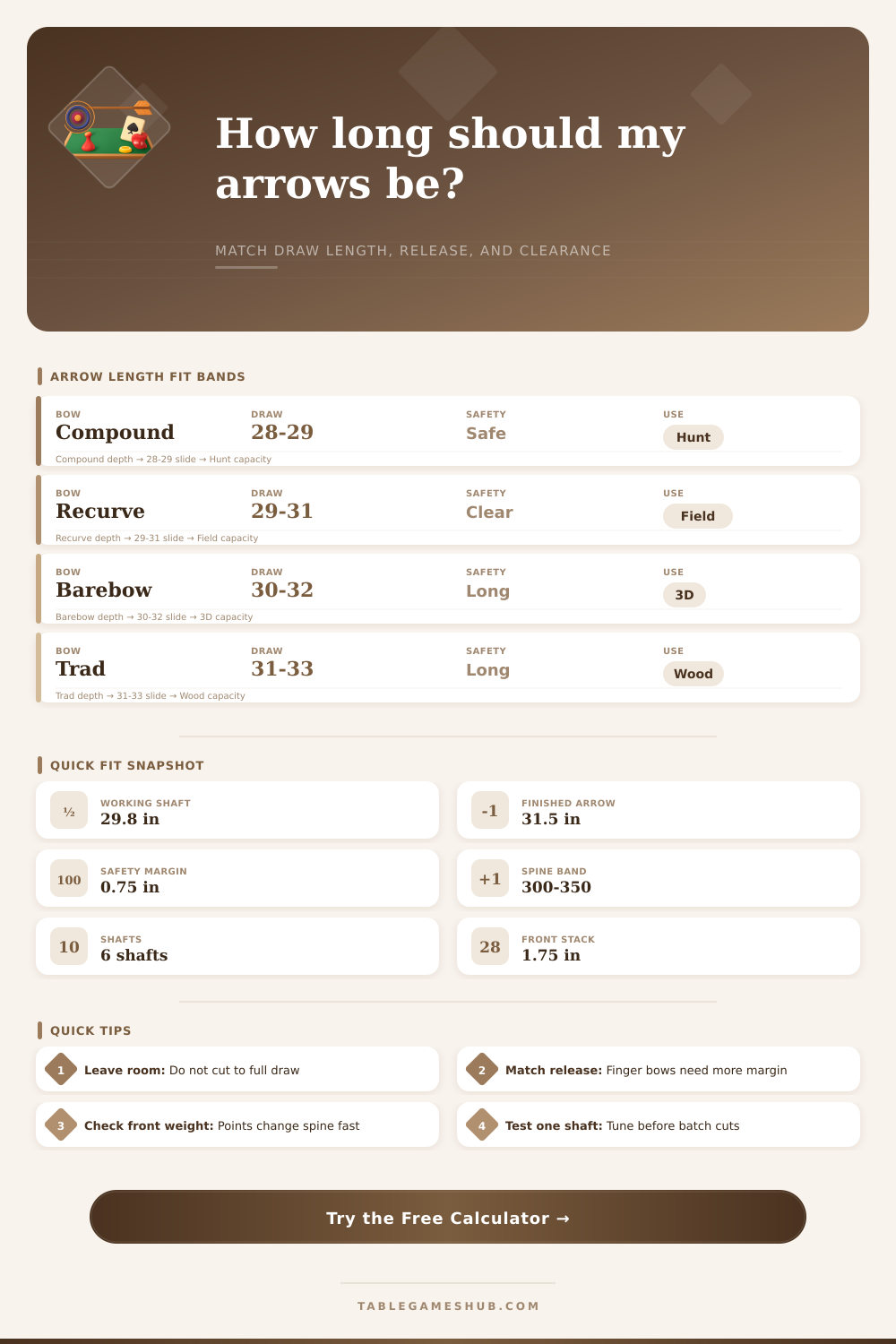
| Bow Style | Buffer | Cut Feel | Common Use |
|---|---|---|---|
| Compound release | 0.4 in | Shortest | Hunt |
| Compound fingers | 0.6 in | Short | Back-up |
| Recurve | 1.0 in | Longer | Target |
| Traditional | 1.3 in | Longest | Wood |
| Release | Allowance | Feel | Use |
|---|---|---|---|
| Trigger | 0.1 in | Tight | Comp |
| Thumb | 0.2 in | Clean | 3D |
| Fingers | 0.6 in | Open | Rec |
| No release | 0.9 in | Long | Trad |
| Shaft Family | Band | Cut Shift | Best Fit |
|---|---|---|---|
| Carbon hunt | 300-350 | Medium | Hunt |
| Target carbon | 250-300 | Low | Spot |
| Micro-diameter | 200-250 | Low | Fast |
| Hybrid | 350-400 | Medium | Field |
| Length Band | Feel | Margin | Use |
|---|---|---|---|
| 28-29 | Short | Tight | Indoor |
| 29-30 | Med | Safe | Field |
| 30-31 | Long | Clear | 3D |
| 31-33 | Very long | Wide | Trad |
The length of an arrow is one of the more critical measurements for archery. The length of the arrow determine how the arrow performs and interacts with the bow. If the archer cut the arrow too short, the arrow will either strike the riser of the bow or it will cause injury to an archer.
On the other hand, if the arrow is too long for the archer’s bow, the arrow will be heavy and the increased weight will reduce the speed of the arrows. In order to ensure that the arrow is both safe and efficient, it is critical to determine the correct lengths for the arrow. The length of the arrow is not the same than the draw length of the bow.
How to Choose the Right Arrow Length
The draw length of the bow is the distance from the arrow grip of the bow to the point where the archer anchors the string. The length of the arrow is the distance from the nock throat of the arrow to the face of the inserts. Various factors can change the length of the arrow that an archer must use.
For instance, if the archer use a recurve bow and releases the arrow with they’re fingers, then the arrow length must be longer to provide enough space for the string paradox. The string paradox is the degree to which the arrow will flex when the archer releases the string from the bow. In contrast, if the archer uses a compound bow that has a mechanical trigger that releases the arrow, then the length of the arrow can be shorter.
This is because the mechanical release will provide enough space for the arrow to be nocted in the correct positions on the arrow. In addition to the factors related to the type of bows that the archer uses, the components on the arrow can also impact the length of the arrow. The length of the arrow will be longer if the archer use heavy hunting broadheads or thickly inserts.
In this situation, the archer will have to shorten the length of the arrow shaft to account for the length of the front component of the arrow. If the archer ignores the length of the points and inserts when measuring the length of the arrow, the arrow’s spine will change. The spine of the arrow is a measurement of how much the arrow will bend during flight.
Therefore, if the arrow’s spine is changed, it will not fly accurate. In addition to the specifications of the arrow components and bows, safety margin must also be provided for the arrow length. A safety margin must be provided for the arrow length to prevent the arrow from striking the bow.
If the archer cut the arrow shaft to the minimum length, there may not be enough space for the archer to draw the bow properly for an arrow shot. If the archer draws the bow too high or if the string of the bow stretch, the arrow may strike the riser of the bow. To calculate the length of the arrow, the draw length, bow buffer, release allowance, rest clearance, nock space and safety margin must be add together.
In addition to the length of the arrow, another important factor related to arrow length is the spine of the arrow. The spine of the arrow is the degree to which the arrow will bend during the flight of the arrow. The length of the arrow can change the spine of the arrow.
If the arrow is longer, it will be easier for the arrow to bend than a shorter arrow. This means that a longer arrow will act like a weak arrow shaft. For this reason, if an archer is shooting arrows with a longer shaft, the spine of the arrow may have to be stiffer to provide enough strength to the arrow shaft.
In order to ensure that the length of the arrow is correct, there are various tests that can be used. One test is the paper test, where the archer will shoot arrows at a piece of paper to ensure that the arrow is flying straight. Another test is the bare shaft test.
In this test, the archer can shoot arrows without fletching to see if the arrow shaft flies the same as the fletched arrows. If the arrows dont group together at a target, the length of the arrow or the arrow spine is likely incorrect. When preparing a set of arrows, it is critical to ensure that the arrows are of the same length.
Using a trim jig will ensure that every arrow shaft is of the same length. Once the archer has determined the length of the arrow, the archer should apply that length to every arrows that is to be shot. You should of checked the length of the arrows carefully so they look moddern and professional.
Using a jig is alot more easier to ensure that the arrows is correct. It makes the process more comfortabley for the archer. Its important to check the arrows length to avoid any errors.