Suburbia Score Calculator
Estimate final population from borough tiles, income, reputation, cash conversion, goals, lakes, adjacency effects, and red-line pressure.
Projected End Score
| Score Source | How It Enters Final Score | Calculator Field | Common Mistake |
|---|---|---|---|
| Population marker | Base score before bonuses | Current population | Forgetting reputation movement still remaining |
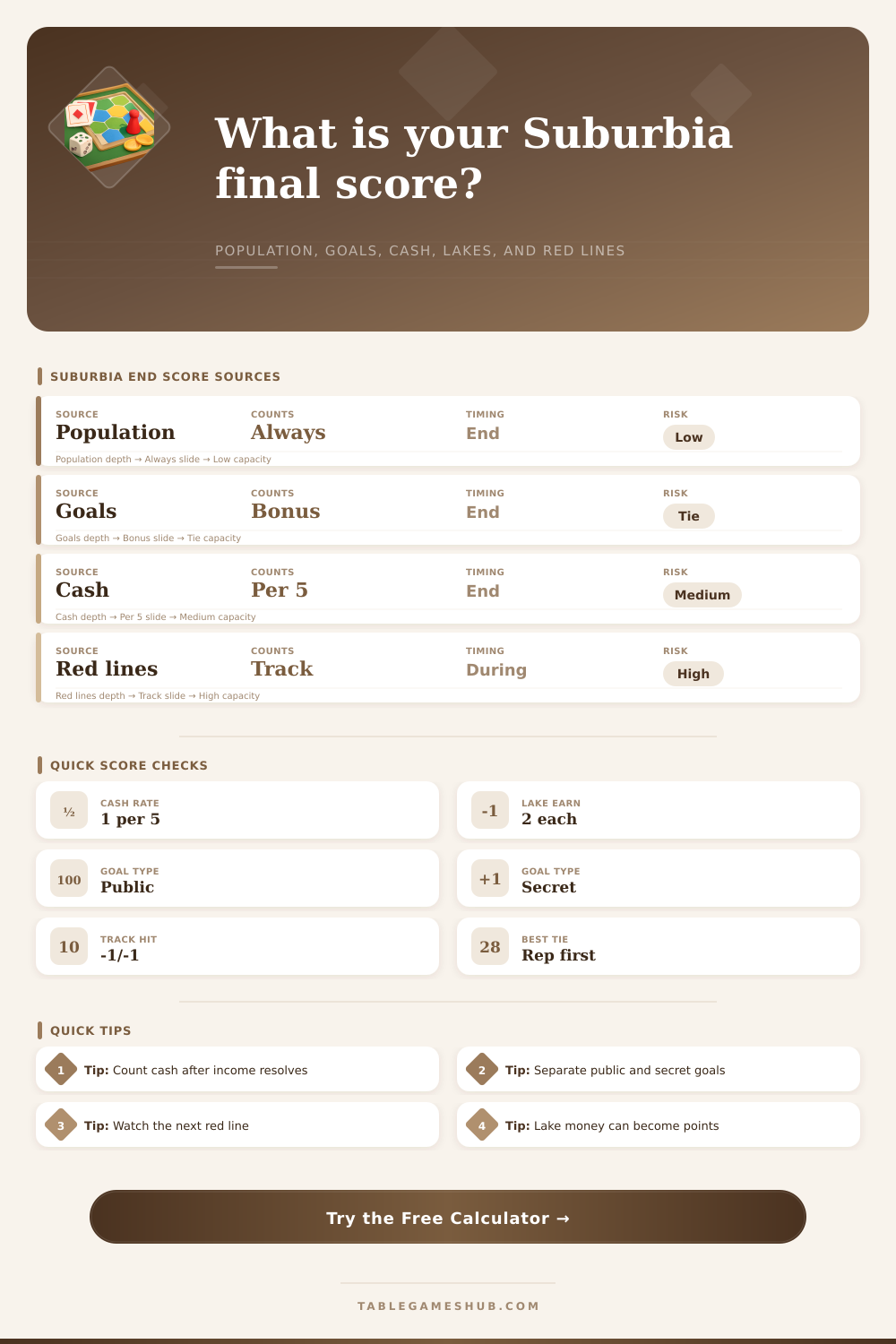
| Cash reserve | 1 population for each full 5 money | Cash remaining | Rounding up instead of flooring |
| Public goals | Population if you win outright | Public goal population | Counting a tied public goal |
| Secret goal | Private objective population if achieved | Secret goal population | Adding it before checking condition |
| Tile text | Immediate, adjacency, or end score changes | Adjacency and tile end scoring | Missing doubled investment effects |
| Borough Tile Family | Typical Score Role | Track Pressure | Best Calculator Input |
|---|---|---|---|
| Residential | Population growth and adjacency boosts | Can rush red lines | Residential tiles and adjacency population |
| Civic | Reputation, goals, and conditional scoring | Often positive reputation | Civic tiles and secret goal population |
| Commercial | Income and set-based bonuses | Usually improves cash conversion | Commercial tiles and income track value |
| Industrial | Income engines with reputation tradeoffs | May lower reputation | Industrial tiles and manual adjustment |
| Lakes | Immediate money that can become final population | No direct red-line movement | Lake tiles and paid lake edges |
| Red-Line Situation | What Changes | Scoring Impact | Planning Check |
|---|---|---|---|
| Crossing forward | Income down 1 and reputation down 1 | Lower future cash and population pace | Compare projected base to next red-line field |
| Crossing backward | Income up 1 and reputation up 1 | Relevant when reputation is negative | Use manual adjustment for rare backward cases |
| Goal scoring after track pressure | Population bonus increases score | Usually does not matter for later turns | Keep goals separate from reputation growth |
| Cash-heavy finish | Money converts only by full groups of 5 | Extra 1 to 4 money may not score | Use cash conversion card |
| Build Pattern | Strongest Input | Weakest Input | Endgame Read |
|---|---|---|---|
| Income engine | Income and commercial tiles | Reputation may lag | Cash conversion can close the gap |
| Reputation sprint | Reputation and residential adjacency | Red-line exposure | Check new thresholds before assuming growth |
| Lake pivot | Lake tiles and paid edges | Tile end scoring | Good when cash converts cleanly by 5 |
| Goal chase | Public and secret objective population | Cash reserves | Do not count tied public goals |
Suburbia’s last turn isn’t so much calculated as it is a heart attack. You look down at your board with your finger poised just above the population marker… What are my income streams? How can I support this without going beyond the red line penalty? That’s when the game go from creative city planning to cold arithmetic.
The calculator here saves you all the mental gymnastics of balancing cash conversions vs. It accounts for reputation risk. It does the math for you after tracking your position and plugging in your borough state. It provide a clear ceiling on what your score realy looks like before committing to that last move.
How the Calculator Helps You Win
The red lines are a source of pressure that most player do not realize is having an effect on their path toward the end game. By now, we’re all familiar with the rules. Any time your pop marker slides over any of those threateningly horizontal lines, both your rep track and income track slide down one spot each. In isolation it doesn’t seem like much, but the compounding effect is rapid: Your reduced earnings mean less earning power moving forward, all while you’re working to go out strong. The table on the page spell this out. It shows how slowing your forward crossing will lower your pace. It also shows how backward crossing can work in your favor if you’ve kept your tracks in check. Think of those penalties not as random misfortune, but as a tax on ambition.
Intuition also falls flat when it comes to cash. We all want to hold onto some because we think that maybe we can save up enough to get a goal win, or use that last coin to buy a tile later on. But the conversion rate of endgame is brutally clear: One population point for each full five money you have in your hand. Those three coins lingering there in your palm? They’re purely decorative paper at this point.
The calculator tell you what number of points that liquidity is going to convert into, based off your existing cash plus any projected income from upcoming turns. And it makes you choose: Should I spend those four coins now, even though they might not net me a point? Or am I better off hanging on, only to come up short of the conversion threshold?
The tension in lakes comes from the fact that they’re completely dependent upon adjacency: an empty lake tile will only ever be water, whereas a lake surrounded by commercial buildings produces a reliable source of income every single turn. To accurately model that stream of income, the tool wants to know how many tiles you typicaly surround a lake with. That’s important because middle-game lake-heavy strategies frequently appears weak until their neighbors come online and begin paying out. Basically, you’re betting on the future payoff from adjacency bonuses to pay for your last few turns worth of population growth. It is a high-risk/high-reward move if done properley.
You are adding more variables that math alone can not solve, such as public and secret goals. In addition to fields for each, the calculator assumes that you’ll win these things outright if you put any value down there. That’s where your judgment comes into play the most. You are tied for first on a public goal with two other people. Putting the entire population down is optimistic, at best; misleading, at worst. Only count those points that is practically in the bank. A secret goal is safer because no one else know what is happening. However, you must be honest about whether your borough layout actualy meets the condition.
In the end, this isn’t a decision-making tool, it’s a way to take the math out of the mechanics. So you get to see through the noise and concentrate on your strategies. You’ll still need to choose what tile goes where and who plays it. But now you don’t need to worry about whether your income engines will pay their bills or if your reputation is strong enough to support your aggressive growth. With a clear picture in front of you, the math becomes clear. Go ahead. Build your city in peace.