Opposed Dice Pool Calculator
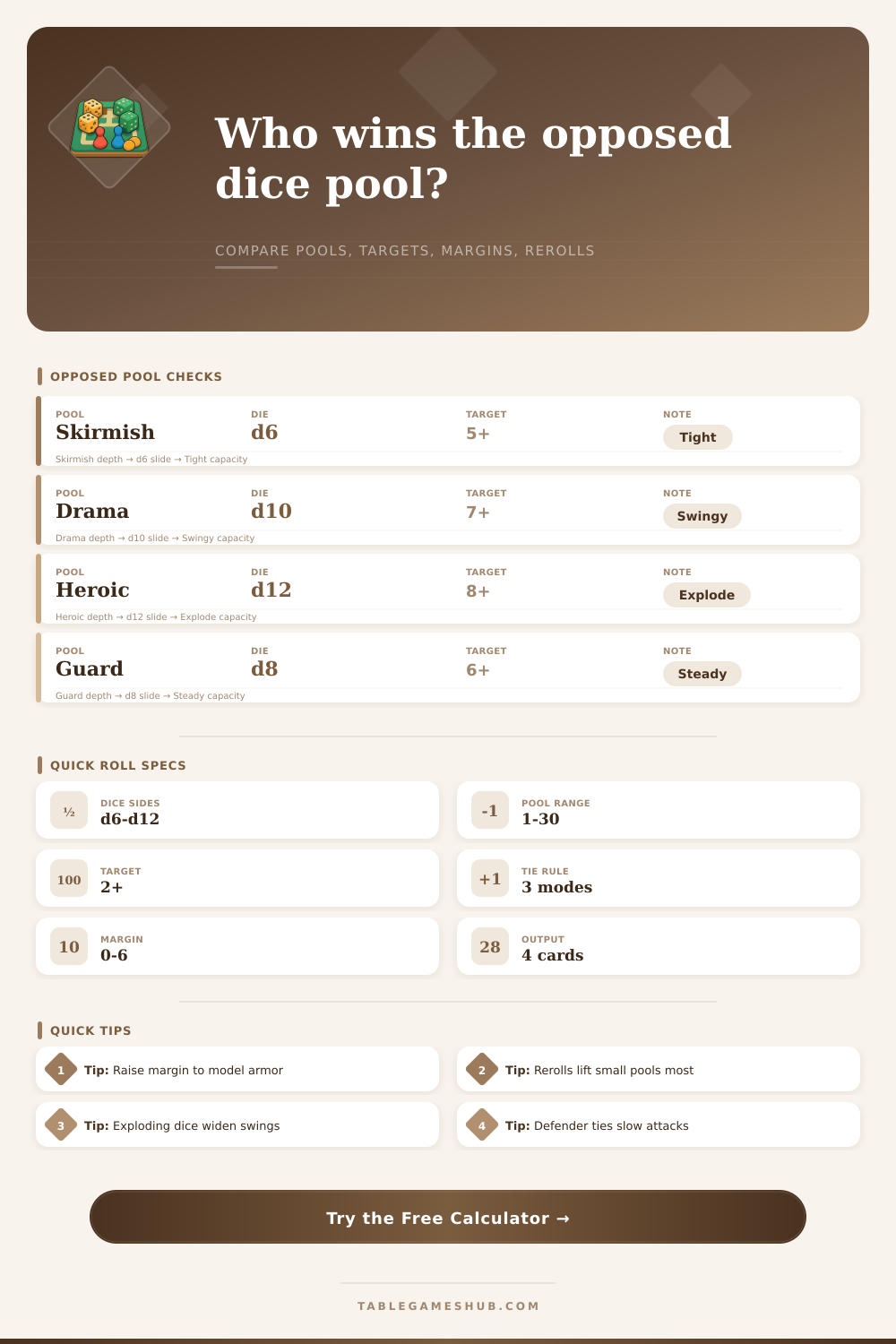
Compare attacker and defender dice pools with success targets, tie rules, required margins, one-roll rerolls, and exploding maximum-face successes.
| Die and target | Success faces | Base chance | Use case |
|---|---|---|---|
| d6 on 5+ | 5, 6 | 33.3% | Hard tactical test |
| d8 on 6+ | 6, 7, 8 | 37.5% | Guard or cover roll |
| d10 on 7+ | 7, 8, 9, 10 | 40.0% | Drama pool default |
| d12 on 8+ | 8 through 12 | 41.7% | Heroic high-face pool |
| Margin field | Attacker needs | Close band | Common table meaning |
|---|---|---|---|
| 0 | More successes | Exact tie only | Fast contest resolution |
| 1 | At least +1 | Exact tie only | Standard opposed check |
| 2 | At least +2 | Win by one fails | Armor, shield, or cover |
| 3+ | Large success gap | Most small wins fail | Boss or hard resistance |
| Modifier | What changes | Best visible on | Calculator model |
|---|---|---|---|
| Reroll 1s | Small lift | High targets | Only first-roll 1s reroll once |
| Reroll fails | Large lift | Small pools | Failed first rolls reroll once |
| Explode max | Higher ceiling | Large dice | Maximum face adds one success |
| Both active | More swing | Hero moments | Reroll can also explode if max |
| Scenario | Attacker | Defender | Rule emphasis |
|---|---|---|---|
| Guard Duel d6 | 6 dice | 5 dice | Simple +1 contest |
| Spell Resist | 8 dice | 7 dice | Defender reroll support |
| Boss Defense | 9 dice | 12 dice | High margin wall |
| Exploding Drama | 7 dice | 7 dice | Maximum faces matter |
It’s that time. You’re at the table. The tension rises. The dice rattle in their cup. It all comes down to roll of a die. One side pushes hard while other holds its ground. It seems random, yet any player who’s rolled these dice enough times will tell you: it’s never completly random.
When you add opposed rolls of dice together, the result become part narrative, part statistics; and most players intuitively manage resulting battle of odds. This intuition serves you well… until things start to become complex or the stakes increase. Then you must understands precisely what each of those numbers mean for survival of your character.
Understanding Dice Rules
At its core, it’s a pretty simple mechanism: roll some dice, see how many match up to a certain value, then compare your result with another players result. Whoever has more wins. It is simple enough, except you layer things upon each other. If a tie goes to the defense? That impacts thing. Want to re-roll failed dice? That changes results.
Those aren’t small details; they swing probabilities in ways that seem odd without visualizing the spread curve. Which is where the die roller calculator come into play. Rather than present you with an average number that hides what’s happening behind the curtain, it models out relationship between all variables so you can visualize the effect they will have on the roll itself.
But keep in mind size of the die itself. That alters everything about the fight. If you use a six-sided die, you’re in for a close struggle with narrow margins of victory. Each success matter. Move up to a 12-sided die. You’ll get higher possible results and wider swings. And it’s not just cosmetic; bigger dice can lowers variance compared to the pool size (if your target number isn’t very high) or increase variance compared to the pool size (if your target number is pretty high).
Depending off what your target number is, adding more dice to the pool will either raise your chance of winning quickly or plateau faster.
And what about ties? Statistically speaking, balanced pools is punished by rules where defenders win on a perfect tie. While it makes sense from a theme perspective (after all, you’re defending something), it means the attacker is already at a disadvantage if they end up tied with their opponent. A simple change to the tie rule, or the margin required for victory, can represent superior positioning, cover, or even armor, without adding new dice mechanic. It’s a little tweak that could of make all the difference in whether you succeed in your attack.
Where it gets interesting (and where folks frequently misestimate their probabilities) is with rerolls. A single reroll of ones gives some small mitigation to a bad roll; a full reroll of misses is the sort of spike you want on your team if you’re trying to scrape out a win. With this tool you can isolate those factors and see what impact your character’s abilities realy give. Does one extra die count for more then the ability to reroll? Math will often tell different story, as each specific outcome can be very impactful in a limited pool.
And then there’s exploding dice. These also increase chaos. They increase the limit of what might happen. And that is most useful in dramatic scenes where you want something to swing large because it feels earned rather than random. In those situations it broadens the distribution which means extremes will be more frequent…both good and bad.
All this means is: Opposed Pools are a way to manage risk. You need enough dice that you can reliably roll the number you want. But not so many that you’re wasting your resources rolling all those extra successes that never get used. Having that exact know-how of break even points lets you create characters that are fun to play, rather than purely statistically optimal. You no longer guess when the dice are going your way, and plan for the times they do which is realy what tells the story. The dice may determine the scene. But now you know exactly what they’re trying to say.