Strength of Schedule Calculator
Measure how tough a table game schedule was using opponent win rate, ratings, field depth, top-tier exposure, format pressure, and sample reliability.
◎Schedule Presets
Load a real league or tournament pattern, then replace the values with your own match log.
⚙Schedule Inputs
Full Breakdown
∑Formula Result Cards
Opponent Record Index
Opp WR / 50% x 100
Transforms average opponent win rate into a neutral-100 schedule strength score before rating and field corrections.
Rating Differential Index
100 + (Opp - Field) / 8
Every 8 rating points above the field average adds about one SOS index point before capping.
Mix Pressure Index
100 + Top% x 24 - Low% x 18
Rewards schedules with many upper-tier opponents and discounts slates padded by bottom-tier matchups.
Final SOS Index
Blend x Format x Depth + Context
The final result blends record, rating, rank, mix, repeats, seat pressure, recent form, and sample reliability.
▣Component and Spec Comparison Grid
☰Reference Tables
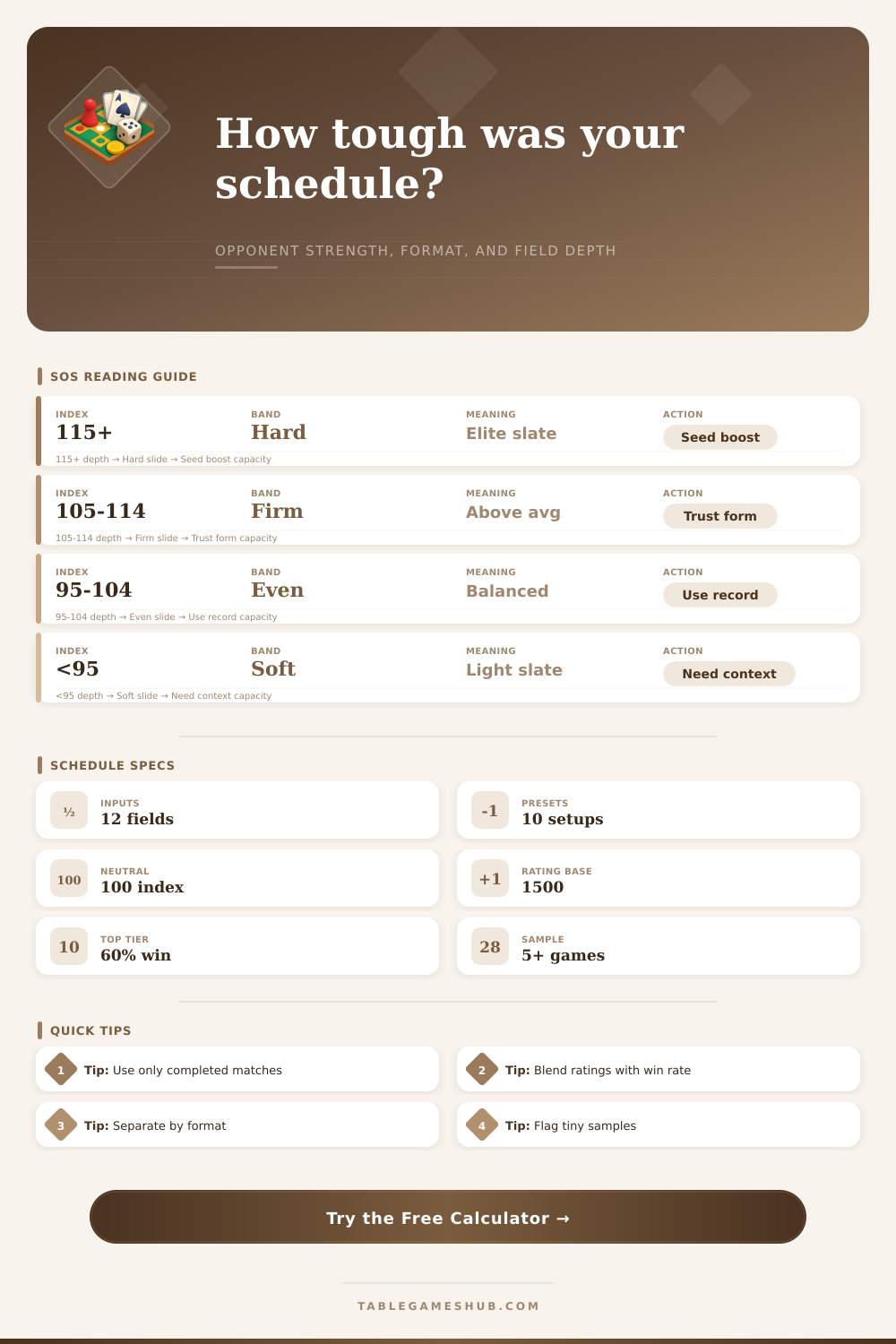
| Final SOS | Band | Schedule Meaning | Ranking Use |
|---|---|---|---|
| 120+ | Elite | Repeated high-rated or top-form opponents | Strong seed tiebreak and power-ranking lift |
| 110 to 119.9 | Hard | Clearly tougher than the room average | Record deserves positive context |
| 100 to 109.9 | Firm | Above average without being extreme | Compare with performance margin |
| 90 to 99.9 | Even | Near neutral or mildly soft | Use standard standings first |
| Below 90 | Soft | Lower-rated, lower-form, or padded slate | Require stronger results before promotion |
| Format | Typical Bias | Useful Input Focus | Multiplier Range |
|---|---|---|---|
| Swiss tournament | Winners face stronger opponents late | Top-tier games and recent form | 1.00 to 1.06 |
| Round robin league | Every player can share the same opponent set | Repeat count and field depth | 0.98 to 1.02 |
| Club ladder | Pairings cluster near current rank | Rating differential and rank percentile | 0.99 to 1.05 |
| Multiplayer pods | Seat draw and table composition matter more | Seat disadvantage and top-pod count | 1.00 to 1.07 |
| Miniatures campaign | Scenario and faction spread can tilt difficulty | Context adjustment and repeat count | 0.98 to 1.06 |
| Opponent Type | Win Rate Marker | Rating Marker | SOS Effect |
|---|---|---|---|
| Elite contender | 65% or higher | +120 over field | Large lift, especially in small fields |
| Upper table regular | 55% to 64% | +40 to +119 | Reliable positive pressure |
| Middle table opponent | 45% to 54% | Within 40 points | Near neutral schedule weight |
| Lower table opponent | 35% to 44% | -40 to -119 | Mild discount unless recent form is hot |
| Development opponent | Below 35% | -120 or worse | Meaningful schedule softness signal |
| Signal | When to Apply | Typical Amount | Warning |
|---|---|---|---|
| Seat or color pressure | Uneven first-player, dealer, or table position load | 1% to 5% | Do not double count if ratings already capture it |
| Repeat opponent discount | Same opponent appears multiple times outside planned finals | -1 to -4 points | Round robins can ignore small repeat effects |
| Recent form lift | Opponents were hot during your schedule window | 0 to +4 points | Use current-window form, not season reputation only |
| Small sample caution | Fewer than five matches or thin opponent records | Confidence cap | Index can be directionally right but unstable |
ℹSchedule Tips
Use opponent records excluding your match when possible. That prevents your own result from making the schedule look easier after a win or harder after a loss.
Keep formats separate before comparing players. A multiplayer pod slate, a head-to-head ladder, and a Swiss bracket create different kinds of opponent pressure.
There’s nothing like crushing a tournament bracket. Then someone mumbles something about being lucky. Yeah, it burns. Because this stuff are competitive. You want to beat everybody, but you also want your victories to count for something. Beating beginners feels hollow compared to rough run through elite tables.
That’s why we made the strength of schedule calculator. It puts an end to discussion using facts instead of gut feelings. It makes it possible to translate vague ideas of toughness into a number anybody can use. What makes this measure tick is its focus on quality of your opponents (and it breaks that down into rating and win rate).
What Is Strength of Schedule?
How well your opponents is playing are the quickest indicator of how good you’re doing now. Did they win more than sixty percent of their matches? You faced a serious challenge regardless of their long-term history. Reputation-wise, ratings give you a wider base line for how skilled player are. It pins the rest of the math against the mean of everyone else. Each point you have above the mean increase the pressure on your schedule score little by little.
It’s meant to be balanced so no one outcome skews the whole equation. Maybe the newcomer who’s got hot is boosting up the win rate stat, but his rating pull him back down. You need that kind of balancing act to get an accurate read.
The lineup matters as much or more than the level of play. Four middle-tier opponents is not equivalent to two heavy hitters and two newbies. That’s why we have the mix pressure. For example, it will reward slates where most matchups involves strong players. It will penalize slates with too many easy wins due to weak links.
But you must factor in the format as well. In a Swiss tourney, each round will pit winners vs. Winners, making the bracket more difficult as you go. Losers, making the bracket more difficult as you go. A round robin will spread out strength better over time. This adjustment for format is necessary because you don’t want to be comparing a player’s performance at one type of event different than another.
But then there’s the sample size… One of the most crucial checks of the data set. Two-game schedules is statistically noisy and may mislead. That’s why the calculator notes lower levels of confidence for smaller samples, warning you not to overvalue early wins (or under-value early losses). It’s a safeguard against short-term hot streaks and slumps, too.
Other real-world variables are missed by cold, hard numbers, such as travel fatigue in big brackets and seating advantages or disadvantages in multiplayer titles. These manual adjustments is intended to be sparse: reserved for times where you have compelling evidence of some external factor skewing things a bit.
What you get at the end is a single index centered on one hundred. Above a score of one-fifteen, it’s a top slate, and one deserving of major seeding credit. Below a score of ninety, it’s a soft schedule that could require further look before assuming any player’s performance represents proof of strength. If you want to put these results into practice, the tool includes reference tables that help you turn your scores into real-world action items for league managers. Tie-breakers? Check. Who deserves credit for their standing due to pure force-of-will? You got it.
In short, this calculator doesn’t measure your ability. It measures the path you took. It quantifies the level of difficulty involved in that journey and provides a proper context for the record. You might of won, sure. But now you know just how difficult it was to get there, which connects a lot more deeply.