Step Dice Probability Calculator
Compare d4, d6, d8, d10, d12, and d20 step odds for target-number checks, dice pools, summed checks, modifiers, step shifts, exploding dice, rerolls, and critical thresholds.
Load a real table-use scenario, then adjust the step, target, modifier, pool size, and resolution mode to match your rule set.
| Band | Exact Probability | Expected Frequency | Table Meaning |
|---|
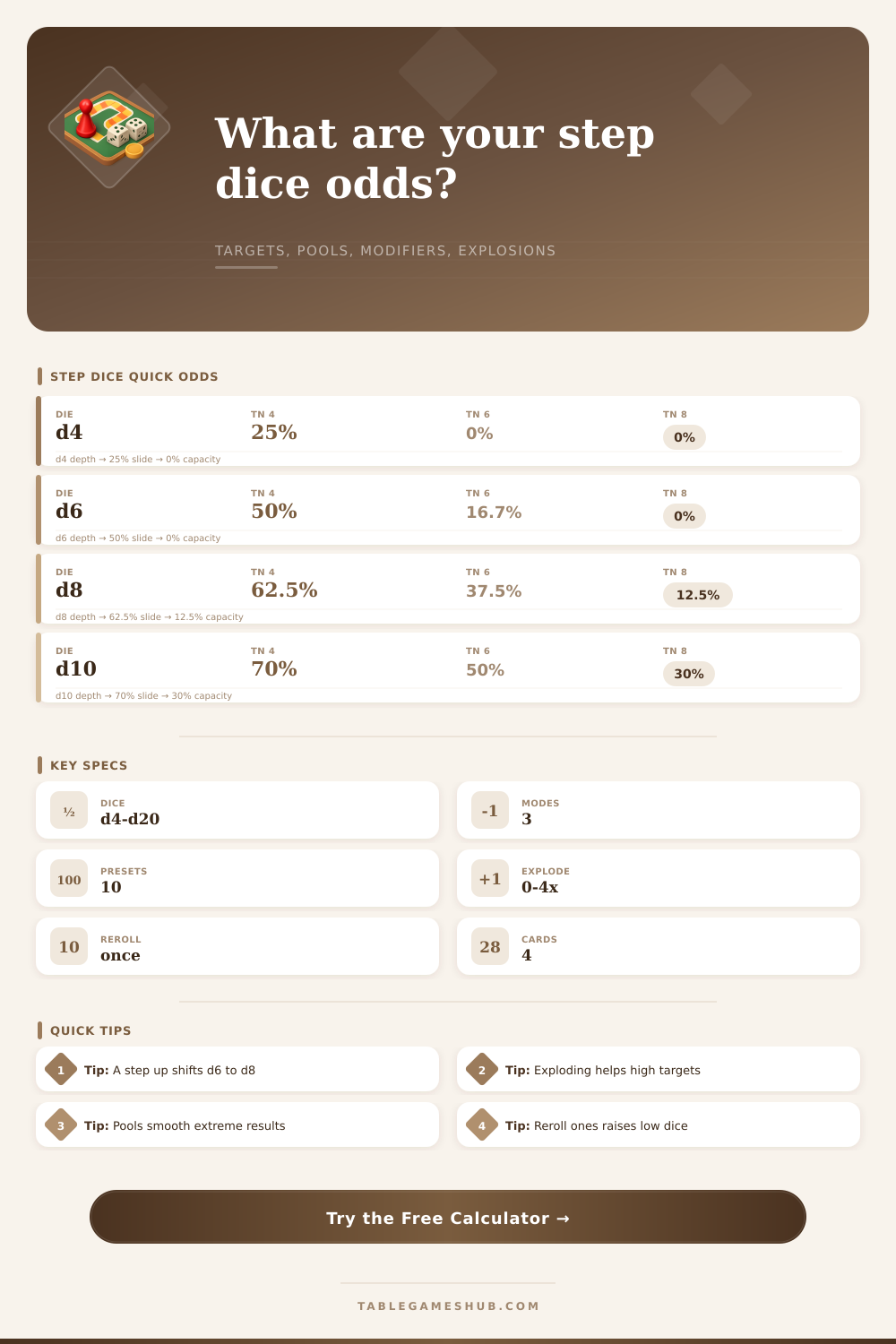
| Die step | TN 4 | TN 6 | TN 8 | TN 10 | TN 12 |
|---|---|---|---|---|---|
| d4 | 25.0% | 0.0% | 0.0% | 0.0% | 0.0% |
| d6 | 50.0% | 16.7% | 0.0% | 0.0% | 0.0% |
| d8 | 62.5% | 37.5% | 12.5% | 0.0% | 0.0% |
| d10 | 70.0% | 50.0% | 30.0% | 10.0% | 0.0% |
| d12 | 75.0% | 58.3% | 41.7% | 25.0% | 8.3% |
| d20 | 85.0% | 75.0% | 65.0% | 55.0% | 45.0% |
| Base die | Down 1 | No shift | Up 1 | Up 2 | Common table use |
|---|---|---|---|---|---|
| d4 | d4 | d4 | d6 | d8 | Untrained or weak trait |
| d6 | d4 | d6 | d8 | d10 | Average trained check |
| d8 | d6 | d8 | d10 | d12 | Skilled trait or asset |
| d10 | d8 | d10 | d12 | d20 | Expert check or strong gear |
| d12 | d10 | d12 | d20 | d20 | Master tier before d20 cap |
| Dice pool | At least 1 success | At least 2 successes | Expected successes | Best use |
|---|---|---|---|---|
| 2d6 | 55.6% | 11.1% | 0.67 | Light advantage |
| 3d6 | 70.4% | 25.9% | 1.00 | Small skill pool |
| 4d6 | 80.2% | 40.7% | 1.33 | Team support pool |
| 5d6 | 86.8% | 54.0% | 1.67 | High asset pool |
| Die | Target 8 | Target 10 | Target 12 | Why it matters |
|---|---|---|---|---|
| d4 | 6.25% | 4.69% | 1.56% | Needs repeated max rolls |
| d6 | 13.89% | 8.33% | 2.78% | Long shots become possible |
| d8 | 12.50% | 10.94% | 7.81% | High face starts the tail |
| d10 | 30.00% | 10.00% | 9.00% | Target 10 is natural max |
| d12 | 41.67% | 25.00% | 8.33% | Large die handles hard TNs |
Target tip: Compare probabilities after modifiers, not before. A +1 modifier can matter more on d4 than on d12 because it covers a larger fraction of the die faces.
Pool tip: Decide whether extra dice are counted, summed, or only compared by highest result. Those three table procedures create very different odds.
The dice fall on the table and it all stops for just long enough for you to see what came up. For that split second between reward and risk, before someone shouts out a number, you think “Yeah I bet that’s got higher odds” (a d6 is better then a d4) but it doesn’t really help as much when your character has a modified target number of nine and she’s standing in a burning building.
Plug in your situation into the calculator above, let it do the hard work and then carry on while time ticks away.
Understanding Dice Odds
Bigger dice mean better chances: That’s the basic assumption behind step dice. It’s so self-evident as to be uninteresting. The problem come from building upon the initial dice roll with additional modifiers. A single plus one looks like nothing, but it makes all the difference in the world depending on what side of die you’re looking at. While it fills a quarter of face on a d4, it changes things by just five percent of a d20. As your die increases in size, the value of that modifier decrease.
Know the underlying odds before tweaking them. While most of us are worried about passing/failing, we don’t account for the make-or-break threshold and leave value on table. Many narrative games will reward hitting well above target or prevent complications if you do. This tool allows you to raise the bar and find out how frequently you exceed the goal as opposed to barely scraping by. Depending on your play style (big hit? big risk?), the critical chance can help you decide what dice to roll. It compels you to consider both upside potential vs. Consistency.
The other wrinkle is exploding dice, which violate normal distribution curve because rolling a maximum value triggers an extra roll. All of a sudden, you’re allowed to generate values that previously weren’t possible. On top of that, higher-sided dice makes this even more interesting. Long odds become worthwhile again, particulary as you move up in the size of the die. As chart on the page explains, a d10 acts very differently than a d6 on high-target shots. It’s no longer just about rolling to succeed. It’s now about taking calculated risks within a larger range of possibilities.
But that’s not what dice pools do at all. Rather than rolling a big die, you’re rolling multiple little ones and counting the number of successes. There are more opportunities to succeed. This evens out the variance, so outliers don’t mean as much. Each time you roll a pool of three d6s, your result get closer to average. A swingy roll of a d12 can result in either a catastrophic miss or an insane win. Adding to a pool versus stepping up a single die alters the feel of game. One is reliable, while the other retains some of the drama of the swing roll.
When players view modifiers as absolutes instead of relative changes they frequently apply the wrong modifier. Adding two to a d20 feels significant in the moment, but statistically, it barely moves the needle. That same +2 may be the difference between succeeding and failing a check with a d4, making it a coin flip. The context defines what the modifier is worth. Having this ratio in your head when building characters/balancing encounters means you don’t accidentally make things too hard or too easy.
But the reroll rules adds a floor to what you get back, they take away the possibility of getting the worst result from the distribution. Rerolling ones removes the automatic failures that can derail momentum in a scene. It’s small, but adds enough to the expectation of every dice roll that success isn’t inevitable, but also increases the likelihood that things will work out. And that gets us past the moment when things go south and keeps the game going.
And, at its core, that’s what probability is: Not fortune-telling, but learning the chances and making wiser decisions now. And while good players certainly don’t have to remember all the percentiles, they should of understood where the knobs will have the most impact on their playstyle. Do you like to slowly build up with a dice pool? Or are you someone who likes to risk everything on one roll, hoping for a big payoff? Knowing how to interpret these numbers supports that gut feeling when you next throw the dice down.