Splendor Noble Path Calculator
Estimate how close your tableau is to a noble visit, whether the gem row supports the path, and how much opponent pressure should change your tempo.
Enter bonuses in Splendor color order: white, blue, green, red, black. The calculator reads permanent development bonuses, not temporary gems spent from your hand.
Noble path result
Calculation breakdown
5
Gem colors
3
Noble points
10
Token limit
3
Reserve cap
4
Market cards
15
Win trigger
3-3-3
Common shape
2-2-2-2
Wide shape
| Pattern | Total Bonuses | Typical Path | Race Note |
|---|---|---|---|
| 3-3-3 | 9 | Three-color engine | Fast if two colors are already at two bonuses. |
| 4-4 | 8 | Focused two-color lane | Strong when market exposes cheap matching cards. |
| 3-3-3-3 | 12 | Wide discount build | Usually needs early engine work and token discipline. |
| 4-3-3 | 10 | One anchor color | Check whether the fourth bonus delays card prestige. |
| 2-2-2-2 | 8 | Broad pivot | Can threaten two nobles if colors overlap cleanly. |
| Read | Race Margin | Opponent Distance | Best Action |
|---|---|---|---|
| Clean claim | +2 or more | 4+ turns | Take efficient cards and avoid over-reserving. |
| Live race | 0 to +1 | 2-3 turns | Prioritize exact bonus colors over general value. |
| Behind | -1 or worse | 0-2 turns | Reserve the key card or pivot to a second noble. |
| Overbuilt | +4 or more | 5+ turns | Convert excess discounts into prestige cards. |
| Preset | Bonus Shape | Path Lean | Use When |
|---|---|---|---|
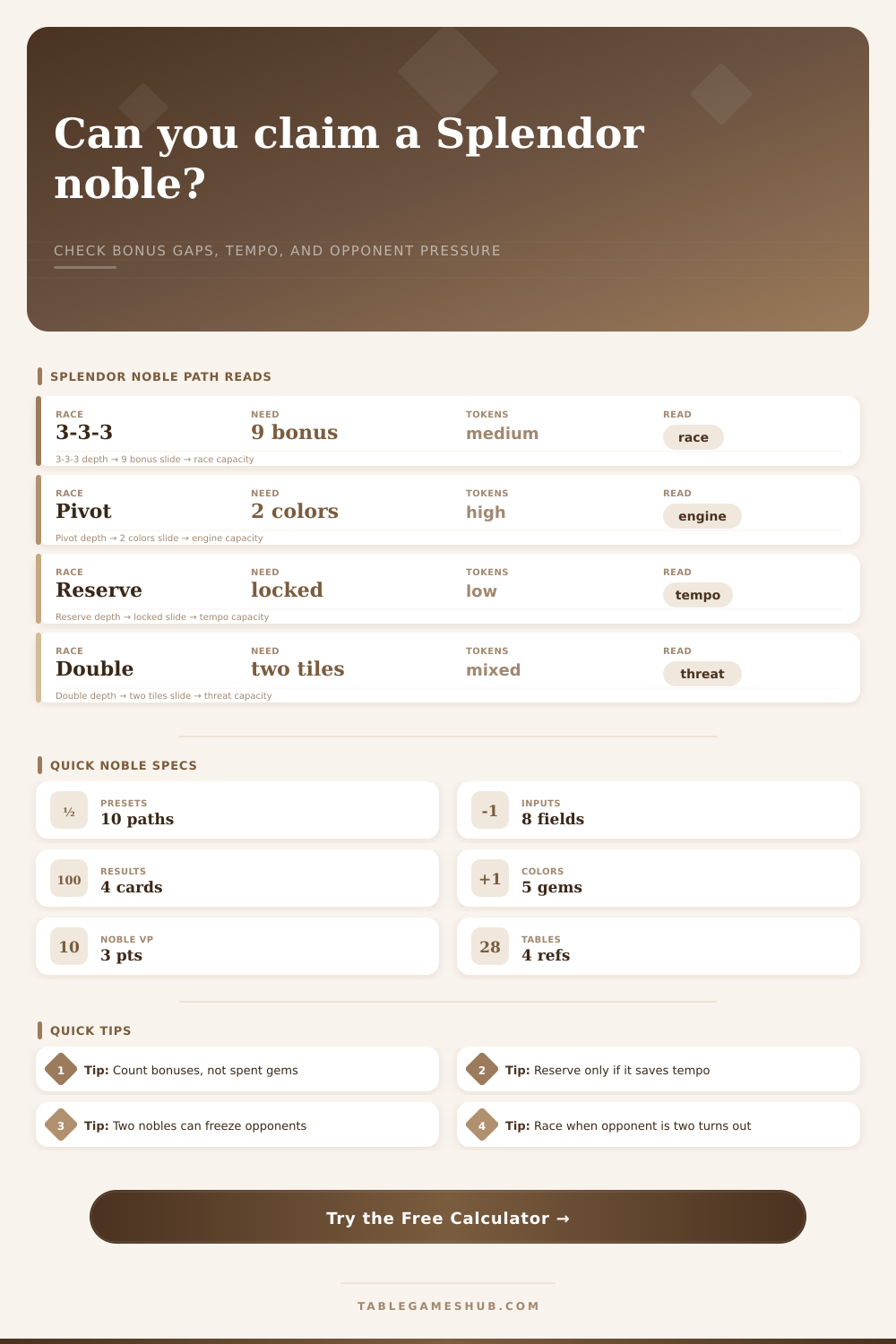
| 3-3-3 Noble Race | Two colors near ready | Direct claim | The noble is worth more than a single point card. |
| Gem Engine Pivot | One color excess | Market pivot | Your discounts open a cheap missing-color card. |
| Reserve Tempo Lock | Gap card held | Protected path | An opponent can steal the exact card you need. |
| Double Noble Threat | Overlapping colors | Board control | One card advances two noble requirements. |
| Token State | Relevant Tokens | Gold Value | Path Impact |
|---|---|---|---|
| Exact colors | 3+ | 0-1 | Shortens buys because each token points at a missing bonus card. |
| Mixed colors | 1-2 | 1+ | Flexible, but may cost one collection turn before buying. |
| Off-color load | 0-1 | 0 | Raises token risk and slows the noble path by a turn. |
| Reserve bank | 2+ | 2+ | Best when reserved cards already match missing noble colors. |
Splendor also has distraction pieces known as noble tiles which give three victory points. Because of this, they is a distraction for most players. It is tempting to get those tiles when you have the necessary cards on hand to go for them as free points. But that’s a dangerous instinct. Nobles are not there to reward your good colors. They are there to trap player who fail to calculate their true bonus structure instead of what they currenty have in their hand of gems.
What’s the difference? Spending power isn’t necessarily permanent infrastructure. Yes, you may be able to afford to buy a card now, but do you has the three white bonuses to make a visit? If not, then you just wasted a turn purchasing a card that provide discount tokens but nothing towards the prize.
Why Nobles Are Traps
First it forces you to consider the permanent development bonuses before considering the temporary gems in your hand. In other words, it require you to remove the temporary jewels and focus on what your tableau offers when the card is eventually played. Why? Because the nobles visit as soon as the requirements are fulfilled, not necessarily because you possess sufficient gems to purchase an additional card that round. If your tableau is perfectly aligned with one particular noble tile, then you could of being penniless yet still triumph.
Once you plug-in the relevant noble’s requirements plus your existing bonus distribution, this tool does all the number-crunching. It’ll tell you how many additional cards you need and whether you’re racing anybody else for same prize. Most games is won or lost by understanding tempo. It’s not a noble race of who can get the most points at any given moment; it’s a race of who can fill up their color requirements as quickly as possible without falling into traps by picking up wrong gem. If your readiness score on the calculator reads close to zero, you’re broken and chasing a ghost.
That’s the time when hanging onto a reserve card seems like a good idea. However, it tend to slow you down, unless that reserve happens to be the very card with the bonus color you need. Then, and only then, does reserving for defense make sense, when the other player is within two turns of snagging your key piece. Outside that situation, reserving cards tends to slow you down, allowing your opponents to catch their breath and earn points in another area.
And then there’s the shape of that noble tile. Some nobles want a wide range of colors with equal needs, indicating a broad engine build. Others ask for specialized focus along only two or three gems. This is reflected in the reference table on the page, where they show what common patterns matches against typical market conditions. A broad engine will take longer to build but become more flexible as soon as it runs. A focused lane goes faster, but you’re leaving yourself exposed if market clears from cheap options in your favorite color choices. Understanding which noble fits your current board state lets you pivot early instead of grinding away at an impossible requirement in the late game.
Another wrinkle is with prestige cards, which give points instantly, potentially leading to endgame without even claiming any nobles whatsoever. In some cases, being under-built for bonus colors but well-stocked on discounts might make swapping for point cards more practical than pursuing a noble chase. To help account for this, the calculator also takes into account the prestige value; does the instant reward of three points from the noble justify waiting versus the two point cards? Sometimes it’s just better to turn your nose up at the shinies, get as many points as possible and win strictly based off card value.
In the end though, the noble is more like a milestone than a destination. It should be a marker in your plan or something that rockets your engine forward, not something that derails your plan just to get a nice token. If you can begin to think about it as a conditional contract instead of a free point, then you’ll sharpen your play. Instead of grabbing cards just because they seem good, you’ll only purchase the ones that really fill out a gap towards a visit. This change in mindset will make your mid-game choices clearer and more considered. It will help you decide whether to sprint, to hold back, or simply walk away.