Marrakech Score Calculator
Total visible carpet squares, dirham points, covered opponents, connected-region risk, and final majority position on the 7 by 7 Marrakech board.
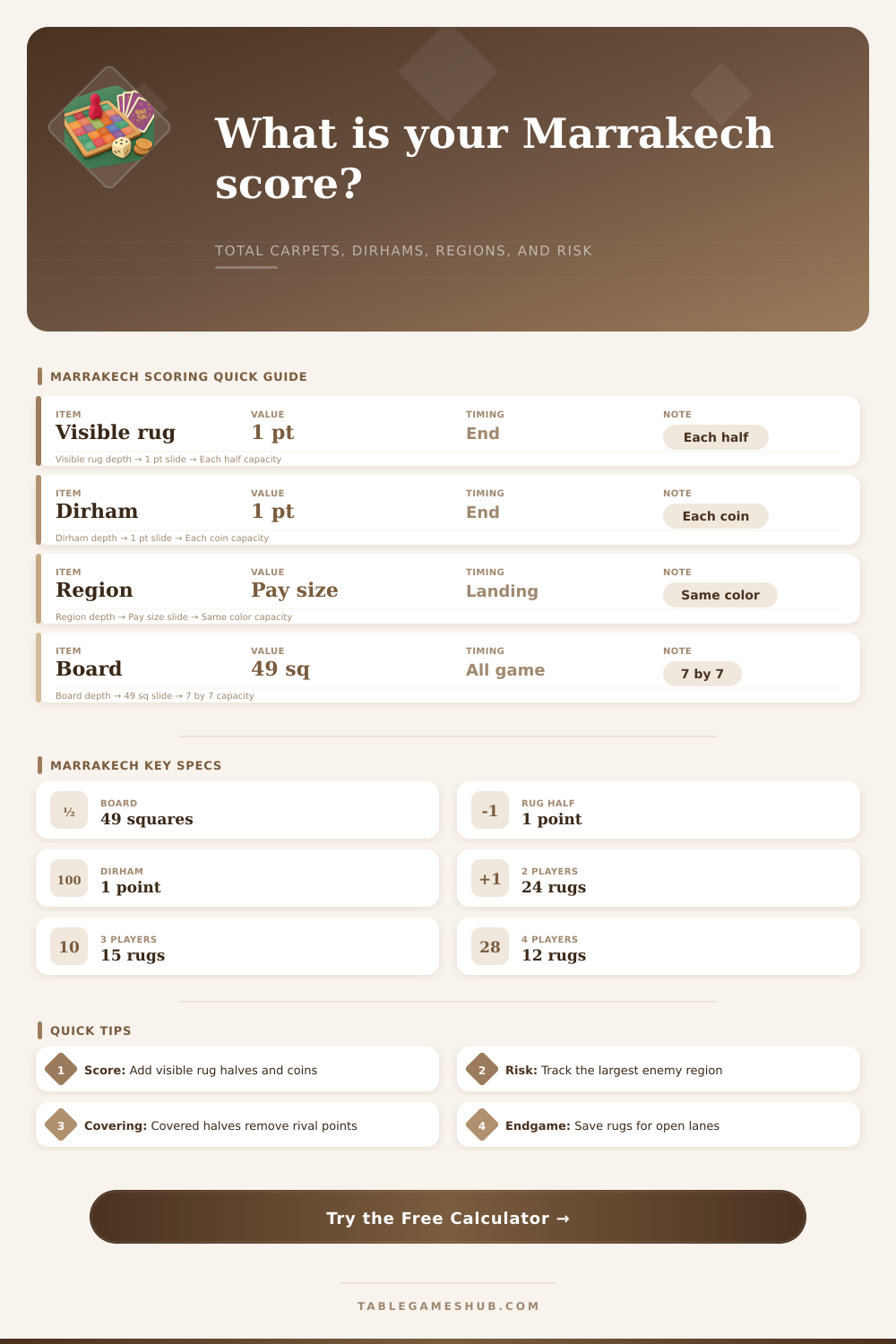
| Scoring Element | Formula | When Counted | Marrakech Use |
|---|---|---|---|
| Visible carpet squares | Visible halves x 1 | Final count | Main board-control score |
| Dirham total | Coins x 1 | Final count | Added directly to carpet points |
| Connected region payment | Region size x 1 | Assam landing | Paid to rug owner, reducing payer coins |
| Covered opponent halves | Covered halves x 1 swing | During placement | Removes rival points while adding control |
| Player Count | Carpets Per Player | Maximum New Halves | Scoring Pressure |
|---|---|---|---|
| 2 players | 24 carpets | 48 halves | Long duel, heavy covering |
| 3 players | 15 carpets | 30 halves | Middle-density market |
| 4 players | 12 carpets | 24 halves | Tight board, fast scoring swings |
| Any count | Remaining rugs | Rugs x 2 halves | Endgame placement ceiling |
| Assam Risk Band | Distance Signal | Lane Signal | Expected Read |
|---|---|---|---|
| High | 0 to 1 move | Open enemy lane | Plan for full connected-region payment |
| Medium | 1 to 2 moves | Mixed colors | Expect a partial risk hit |
| Low | 3 or more moves | Your color blocks | Risk is mostly positional |
| Final count | No moves left | Irrelevant | Use score total only |
| Final Majority Situation | Visible Gap | Dirham Gap | Calculator Meaning |
|---|---|---|---|
| Carpet leader | +4 or more | Any lead | Protect exposed regions |
| Coin leader | Within 3 | +5 or more | Avoid large Assam payments |
| Chasing board | -4 or worse | Even coins | Cover high-value rival color |
| Late swing | Any gap | Negative coins | Largest region risk can decide score |
| Spec Area | Marrakech Detail | Calculator Input | Result Impact |
|---|---|---|---|
| Board geometry | 7 by 7 grid | Visible and open squares | Board-control percentage |
| Rug geometry | Two adjacent halves | Carpets still in hand | Placement ceiling estimate |
| Region geometry | Orthogonal connected color | Largest connected regions | Payment risk and pressure |
| Final scoring | Rug halves plus dirhams | Visible squares and coins | Total and margin |
The game of Marrakech are a game in which players earns points from the number of visible carpet and coins that is held by those players. In order to win the game of Marrakech, a player must understand how the two game element contribute to a players final score. A player earn one point for each of the visible half of color on the game board, as well as one point for each of a dirhams that the player hold in their hand.
If another player’s carpet covers a carpet (or if it is flipped face down), then the carpet is no longer visible to other players. As a result of a carpet becoming invisible, the carpet is not earning any points for the player that owns that carpet. Thus, players must keep track of which of their carpets are visible and which of their carpets is covered by opponents, as only those that is visible will contribute to the players score.
How to Count Points in Marrakech
The movement of the Assan piece can lead to changes to a player’s score. If the Assan piece land on the edge of a block of color, the player who control that color block receives a number of dirham as payment for the player’s move. The number of dirhams that the player receives is equal to the size of that color block.
Thus, more larger color blocks can lead to a player receiving a significent number of dirhams, but also place the player at risk of losing those points if another player’s carpet covers the player’s color block during their turn. The number of carpets that a player still have in their hand can affect the score that a player can earn during the game. Each player starts with twelve carpets.
Each carpet contain two halves of color, leading to twenty-four possible halves of color for each player. However, each carpet that a player place on the game board contributes to the player’s score. Thus, if a player still has carpets in their hand, those carpets cannot contribute to the player’s score.
Additionally, a carpet can be used to cover an opponent’s color, which remove points from the opponent and adds points to the player. A player must compare their score to that of an opponent to determine their strategy for the game. A player’s score is calculated as the number of visible halves of color that the player control in relation to the game board, as well as the number of dirhams that the player control in their hand.
It is possible that another player may have fewer visible color half, but may have earned more dirhams through the movement of the Assan piece. Additionally, it is also possible for a player to have more visible colors than an opponent, but to have fewer dirham. Thus, a player must consider the score of each opponent and determine whether they are working to protect their lead (if any) or chasing their deficit (if any).
The calculator is a tool that help to players to track their score during the game. A calculator can track the number of visible halves of color that a player controls, as well as the number of dirhams that they controls. The calculator can also estimate the number of carpets that each player has remaining in their hand, as well as the maximum score that each player can potentially earn during their turn.
Additionally, the calculator can display the margin of a players score relative to their opponent. Thus, the calculator can help a player to understand whether they are attempting to protect their lead or chasing at a deficit. Furthermore, it can provide players an understanding of the visible color and visible dirham during the game.