Solo Whist Calculator
Score a Solo Whist hand with contract targets, optional overtrick rules, four-seat ledgers, and a compact support-odds estimate for the bidder.
Each preset fills a different Solo Whist contract, scoring schedule, trick result, and table ledger.
| Seat | Role | Start | Hand | New Total |
|---|
| Contract | Target | Side | Trump Context |
|---|---|---|---|
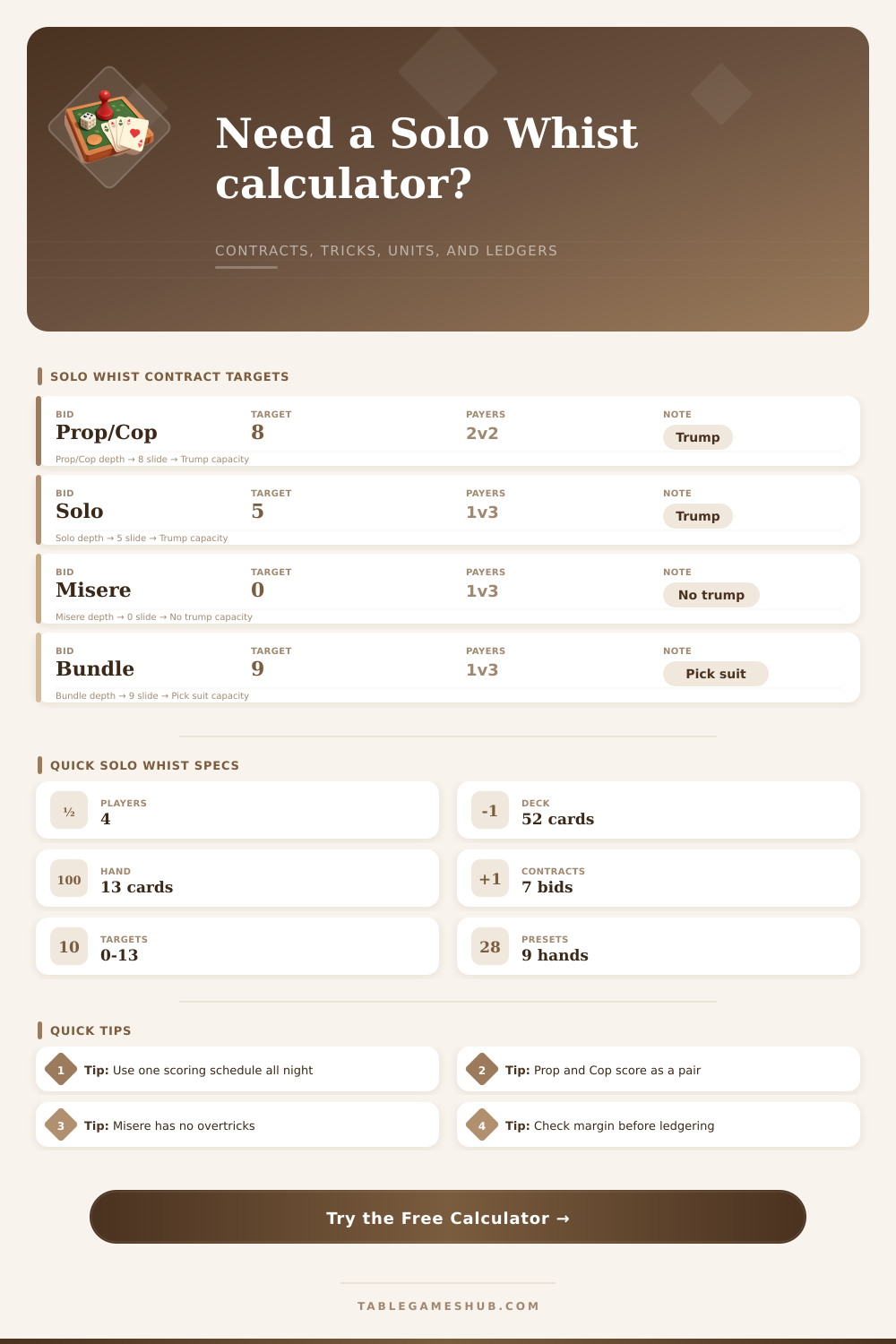
| Prop and Cop | At least 8 tricks | Two players versus two | Turned card suit |
| Solo | At least 5 tricks | Bidder versus three | Turned card suit |
| Misère | Exactly 0 tricks | Bidder versus three | No trump |
| Abundance | At least 9 tricks | Bidder versus three | Bidder chooses suit |
| Abundance in Trumps | At least 9 tricks | Bidder versus three | Turned card suit |
| Misère Ouverte | Exactly 0 tricks | Bidder versus three | No trump, hand opened |
| Abundance Declared | All 13 tricks | Bidder versus three | No trump, bidder leads |
| Schedule | Prop/Solo | Misere/Abundance | Open/Declared |
|---|---|---|---|
| Classic units | 1 / 1 | 2 / 3 / 3 | 4 / 6 |
| Common club units | 2 / 2 | 3 / 4 / 4 | 6 / 8 |
| High-solo units | 2 / 4 | 8 / 12 / 12 | 16 / 24 |
| Custom base | Base / Base | 2x / 3x / 3x | 4x / 6x |
| Extra Rule | Prop and Cop | Solo | Abundance |
|---|---|---|---|
| None | Base only | Base only | Base only |
| Standard extras | 1 per over or under | 1 per over or under | 2 per over, 1 per under |
| Solo-heavy | 1 per over or under | 2 per over or under | 2 per over, 1 per under |
| Misere bids | Not used | Not used | No extras on zero-trick bids |
| Example | Result | Per Payer | Ledger Effect |
|---|---|---|---|
| Solo makes 5, classic | Success | 1 unit | Bidder +3, each defender -1 |
| Prop/Cop make 8, common | Success | 2 units | Each partner +4, each defender -4 |
| Misere takes 1, classic | Fail | 2 units | Bidder -6, each defender +2 |
| Abundance makes 10, extras | Success | 5 units | Bidder +15, each defender -5 |
Ledger tip: For Prop and Cop, score both partners equally and charge both defenders equally. This keeps the four-seat ledger balanced to zero for the hand.
Odds tip: The support percentage uses combinations from the unseen-card pool. It is a planning estimate, not a substitute for exact card reading at the table.
Whist is a game of changing allies and high stakes, whether you’re playing with a partner or going solo. Once the cards leave your hand, the score system holds you responsible. You may feel like you bid well by taking as many tricks as possible, but the score sheet might show something different once partner credits and overtricks is counted.
For four players, this calculator will keep ledgers and score contracts. It’ll even estimate support odds to avoid arguing math at the table. You play; it does the math.
How to Keep Score in Whist
In Solo Whist, counting high cards take a back seat to probability. Selecting a contract is an insurance policy of sorts; it’s betting that you’ll be protected from bad luck. With Partner and Cop, there’s safety in numbers: they combine their teamwork to steal eight tricks with a turned trump, assuming your partner play well. Going Solo shifts the risk entirely onto you. Only five tricks, but every card in your hand need to perform precisely. Here, the calculator lists those targets by contract. It tells you exactly what number of trick will make it or break it.
Clubs have wildly different scoring, which confuses beginners. Classic: A buck per payer per solo. Common Club: Double up your reward to recognize the courage of brave people. High-Solo: Double your reward. Select one format at the outset and adhere to it throughout the game. Compare common classic, high-solo and other formats in the reference table on page. Switching formats mid-game will make the ledger useless and may strain relationships, too.
Also, it’s helpful to know how much an extra trick cost/earns, and many players don’t realize that bonuses (or penalties) for overtricks are usually more severe in Solo bids. You can set the calculator to play with no extras at all, just regular extras, or ones with the bigger bonuses/penalties for overtricks. Having a single extra trick from a bid of five sounds nice, but it may be worth double in terms of points earned from the opponents if they go solo-heavy. A modest victory becomes a substantial swing.
With misere contracts, it’s all inverted: you want to lose every single trick. With no overtricks possible, the only aim with Misere is zero. If you take any tricks at all, you instantly fail plus pay a steep price. Extra rules related to Declared bids, Ouverte, and Misere are ignored by the tool. You either go clean or face severe punishment. Since there’s no partial credit for effort, Misere is among the most nerve-wracking contracts to play.
Your support odds are the statistical likelihood that your bid has legs. By entering cards that are known to be helpful but currently unknown, along with your sure tricks, it calculates a percent chance that the rest of the cards in the deck will fall into place to help you carry out your plan. It’s a type of hypergeometric calculation which uses the unseen pool of thirty-nine cards. It is just math, telling you whether or not you should take a risk for the potential reward. Fold marginal hands when you know your odds before they bleed points based off your ledger.
Long sessions are fairer if you keep a four-seat ledger. Both players wins or loses together in Prop and Cop, and the score gets updated automatically on the calculator without anyone being able to say: “I forgot where I stood.” It also avoids forgetting that each bidder splits the spoils with his/her partner. Ambiguous aspects of scoring can cause players who understand the rules well to get away with murder when you forget to watch your score.
Whist is as much about skill as it is luck when played solo. You don’t get to choose your hand. However, you do get to determine how you play it by taking calculated risks with smart bids and knowing where each card’s value lie on the scoreboard. By taking the emotions out of the equation with a reliable way to calculate, all that remains is to deal again. And that’s why you continue playing well after midnight.