Clans of Caledonia Contract Calculator
Compare an Export contract against your stocked goods, slaughterable animals, merchants, market cash, import rarity, direct bonuses, and contract scoring pressure.
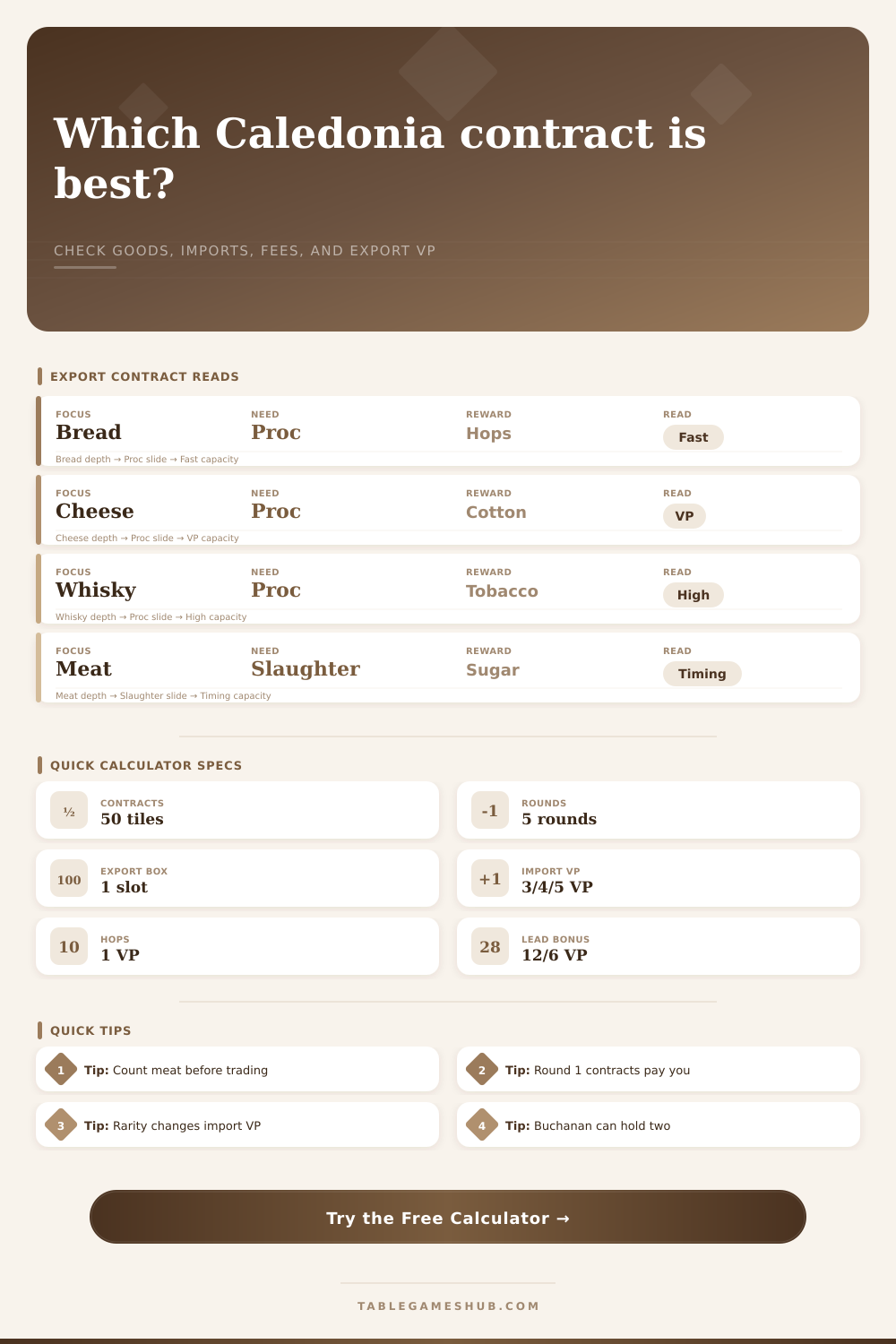
Use this for Clans of Caledonia Export contracts. It models the official goods restriction, meat slaughter timing, one-slot contract pressure, round take fee, import-good VP, and common direct export bonuses.
Contract result
| Rule area | Accurate contract rule | Calculator use | Common mistake |
|---|---|---|---|
| Required goods | Export contracts never require Grain or Milk. | Only Bread, Cheese, Whisky, Wool, Mutton, and Beef are modeled as requirements. | Counting Milk as directly payable for Cheese. |
| Meat icons | Meat requirements are paid by slaughtering Sheep or Cows during fulfillment. | Sheep cover Mutton and Cows cover Beef, with future production loss shown separately. | Buying meat from the market as if it were a normal good. |
| Export box | Most clans can hold only one unfulfilled Export contract at a time. | The take action is counted unless the contract is already on your box. | Taking a new contract before clearing the old one. |
| Clan Buchanan | Buchanan has an additional Export box and may fulfill up to two contracts in one turn. | Buchanan mode reduces slot pressure and improves action tempo. | Charging Buchanan twice when taking two contracts in one turn. |
| Round | Take contract fee | Timing read | Calculator effect |
|---|---|---|---|
| 1 | Receive £5 | Early contracts improve cash and give time to produce missing goods. | Take fee is treated as +£5 net cash. |
| 2 | Pay £0 | Still flexible, especially if production chains are already placed. | No cash penalty is applied. |
| 3 | Pay £5 | Good contract quality must cover the fee and action tempo. | £5 is subtracted from net money value. |
| 4 | Pay £10 | Late contracts need stock on hand or a clear market buy route. | £10 is subtracted and tempo penalty rises. |
| 5 | Pay £15 | Only high-import, majority-swing, or ready-to-fulfill contracts usually pass. | £15 is subtracted and readiness is stricter. |
| Scoring item | Endgame value | Calculator formula | Timing note |
|---|---|---|---|
| Hops | 1 VP per Hops icon. | Hops icons × 1 VP. | Stable value; no rarity race. |
| Cotton, Tobacco, Sugar cane | 3, 4, or 5 VP each by final rarity. | Reward icons × projected rarity value after this fulfillment. | Least imported is worth 5 VP; most imported is worth 3 VP. |
| Leftover goods | Basic goods 1 VP, processed goods 2 VP. | Spent goods subtract their leftover VP opportunity value. | Late contracts must beat the value of simply keeping goods. |
| Money | 1 VP per £10 remaining. | Net money from rewards, fees, and buys divided by 10. | Negative cash pressure lowers the estimated VP read. |
| Export majority | 3-4 players: 12 VP then 6 VP. 2 players: 8 VP for most. | Your contracts after this tile are compared with rival counts. | Ties split the relevant tiers and round down. |
| Component | Game rule | Contract relevance | Calculator treatment |
|---|---|---|---|
| Shipping upgrade | Pay £4 to increase reach across rivers and lochs. | Does not unlock fulfillment, but may unlock port bonuses or expansion bonus spaces. | Shipping reach is compared to the nearest useful port bonus distance. |
| Port bonus | Can be used if neighbouring or within shipping reach of one of your units. | Some port bonuses improve contract turns, including reducing meat by 1. | Reachable meat port reduces one Mutton or Beef icon before slaughter is checked. |
| Free space bonus | Take an immediate Expand action without paying land cost. | Best when shipping reaches a high-value space or a neighbourhood buy. | Counts as a practical bonus with extra value when shipping is upgraded. |
| Bonus upgrade | Choose free shipping, free merchant, or £5 technology upgrade. | Can solve shipping reach, merchant shortage, or income setup. | Each bonus upgrade adds practical VP-equivalent value and improves readiness. |
Consider this example: In Clans of Caledonia, you’re presented with an export contract requiring two loaves of bread, one mutton, and one wool along with a bonus for the space it sits on. One of these resources is easy, you’ve got your bread. Another isn’t far off, you’ve got your wool. But you’ve got just one sheep, which means if you spend it to fulfill the mutton requirement now, you could cripple your future wool production. And if you hold onto the sheep? Well, what about that empty contract slot? Calculating the right move take some thought, not hasty strategy.
By plugging in your starting state, it crunches the numbers for you. You no longer have to keep all the market variables in your head. Penalties for being late into the game? It is covered. Most clans has a one-slot limit? Opportunity cost isn’t just about goods. That’s why the tool flags lost production if you’re sitting on two sheep but you want one mutton. This is where people screw up. Seeing those instant points for cotton, they forget how it hurts your supply chain going forward. Killing an animal isn’t free! You sacrifice some current glory in exchange for future money.
How to Use the Calculator for Better Moves
Finally, keep in mind the import rarity mechanic. The value of cotton, sugar cane, and tobacco isn’t static. It changes depending on how many people bring it in throughout the course of the game. That’s why this calculator asks for the current totals on those rows. Because, while a tile may look mediocre in round two, it could be valuable in round five. This happens when you are just inches away from locking up the rarest import. The reference tables in the tool make this clear. You’ll know exactly where the threshold is before you take action.
In this case, though, numbers aren’t everything; it’s all about cash flow. Five pounds for taking a contract in round one? Great! Fifteen pounds to take that same contract in round five? Not so much. At game end, cash turns into points, so the calculator subtracts these fees from your net value. Does it cost too much bread? Then the calculator will check if you’re carrying enough cash and merchant units to purchase it from the market at today’s rates. It will also consider any discounts you recieve from neighboring neighborhoods. This is because purchasing goods increases their price across the board. Because you may be able to grab your contract now, but there might not be room for the next one… including yours, or anyone else’s.
Then there’s Clan Buchanan, which flips the script completely. It can fulfill multiple contracts per turn and has two export boxes. This tempo bonus is huge enough to warrant its own mode on the calculator. Because of their one-slot limitation, other clans need to weigh fulfilling previous obligations against grabbing new jobs; Buchanan types can string actions together like pearls on a necklace, converting market changes into a constant flow of points. Anyone else will lock themselves out of better deals by hanging on to a lousy contract.
Finally, consider timing. Earlier rounds have fewer stakes but more wiggle room, whereas later rounds require careful planning as time runs out and take fees is high. Depending on the number of slaughter/buys required, the calculator will calculate an estimate for its action pace. For example, completing a contract might require three different trade actions. Three goods are needed to fulfill this contract, then maybe it’s not worth the points gained.) Even if the imported rarity is very rare! Contracts should of fit with whatever production line you’re currently running. Contracts which require you to shift gears and use up actions aren’t good. It’s about maximizing your glory without bankrupting your future.
With this tool you’ll get both your readiness percentage and an estimated point spread. But more importantly, it shows you what the tradeoffs are. Decide when to cut your losses on a lousy contract or go deep into the market to score that hard-to-find import. Apply it to your turn order to eliminate the guessing. Know which contracts you’re signing are efficient based off the overall board state. The sheep can wait. The math won’t.