Shanghai Rummy Score Calculator
Total Shanghai Rummy hands by contract, card values, penalties, bonuses, and running standings for two to eight players.
Load a common ten-deal Shanghai contract, then adjust players and house values before calculating.
Enter previous totals plus remaining cards after the hand. Leave unused player rows blank or reduce active players above.
| Player | Prior total | 2-9 pips | 10-K cards | Aces | Jokers / wilds | Missed contracts | Manual +/- | Went out? |
|---|---|---|---|---|---|---|---|---|
| Deal | Standard contract | Minimum meld cards | Score pressure |
|---|---|---|---|
| 1 | Two sets of 3 | 6 | Low opening hand |
| 2 | One set of 3 + one run of 4 | 7 | First mixed contract |
| 3 | Two runs of 4 | 8 | Run-heavy discard risk |
| 4 | Three sets of 3 | 9 | Extra missed-contract risk |
| 5 | One set of 3 + one run of 7 | 10 | Long run starts to matter |
| 6 | Two sets of 3 + one run of 5 | 11 | High hand size swing |
| 7 | Three runs of 4 | 12 | High joker value risk |
| 8 | One set of 3 + one run of 10 | 13 | Longest single run |
| 9 | Three sets of 3 + one run of 5 | 14 | Penalty can decide standings |
| 10 | Three runs of 5 | 15 | Final maximum pressure |
| Card group | Classic value | Low-ace value | Strict value |
|---|---|---|---|
| 2 through 9 | Face value, entered as total pips | Face value | Face value |
| 10, J, Q, K | 10 each | 10 each | 10 each |
| Aces | 15 each | 1 each | 20 each |
| Jokers / wilds | 25 each | 25 each | 50 each |
| Players | Typical decks | Jokers | Scoring note |
|---|---|---|---|
| 2-3 | 2 decks | 4 jokers | Lower totals, faster swings |
| 4-5 | 3 decks | 6 jokers | Most common home table |
| 6-8 | 4 decks | 8 jokers | More wild-card exposure |
| Any table | House choice | House choice | Keep values fixed for all deals |
| Status band | Distance to target | Result label | Practical use |
|---|---|---|---|
| Safe | More than 80 points away | Low risk | Can absorb one poor hand |
| Watch | 41 to 80 points away | Medium risk | Track jokers and aces closely |
| Danger | 1 to 40 points away | High risk | One missed contract can cross line |
| Over | At or above target | Past line | Use table rule for elimination |
Contract check: Record missed contracts separately from card points so house penalties remain auditable after a long final deal.
Wild-card check: Confirm joker and wild values before Deal 1; changing those values mid-game can distort every standings gap.
Shanghai Rummy is a numbers game. Ten ever-rising deals adds up to a lot of pressure even without playing cards. Once the pile reaches Deal Seven, everyone looks down at their hands (as though each hand contains a live grenade) and the room go silent. What felt like an innocent misread of one set early-on doesn’t seem so innocuous anymore; they’re racking up, and by Deal Seven it’s not quite a card game, it’s a frantic race-to-the-bottom where your goal isn’t scoring more points as possible, just avoiding being eliminated entirely.
But we don’t want to distract from the game itself with manual math; tracking all these totals on paper, with pen adds extra friction. Let the app do the math for you while you concentrate on which four to drop and which one to save.
How to Keep Score in Shanghai Rummy
Each round is another deal that gets more difficult; the stakes increases too. Rounds in the early going are easy to fulfill, as you’ll typically only be looking to create two groups of three cards. Scoring wise, it’s pretty lenient in these initial deals. If you’re off by one or two card, so what? Then there are the mid-game rounds which get tougher: Longer runs becomes the order of the day. And this is when numbers kick you in the ass. You have to know not just how many points a card is worth, but how those points affects your total score. The calculator takes care of latter part, automatically adding up all scores while factoring in the proper aces and joker multipliers depending on your set of house rules.
But here’s the thing about house rules: they differ drastically from group to group. You’ve got some tables where aces is low-value cards (worth just one point). Others assign a fifteen-point penalty for aces, swinging the round right there. And then you have the issue of jokers which is an even larger variable, sometimes carrying a price tag of fifty points and other times a mere twenty-five. So unless you set your scoring method in line with table ahead of time, the final tally won’t mean anything.
Set those parameters at the beginning of the round so everyone knows the point value of the cards they fail to meld. They pay attention to the cards in front of them without considering the value system behind the score.
As the end draws nearer, risk management takes center stage. Players aim for a final score (typically around three-hundred points) that knocks them out of the competition by causing an automatic loss or sending them home. The system calculate this number and alerts you once you’re getting close to danger territory. And why does this make such a difference? Because it completely transforms how you play. If you’re well below the limit, you have room to bet big on ambitious melds. If you’re within forty points of the line, though, every point counts. You begin throwing away “safer” cards. These are cards that don’t contribute directly to your hand but you discard them to prevent aces or other high-value wildcards from landing in your pile.
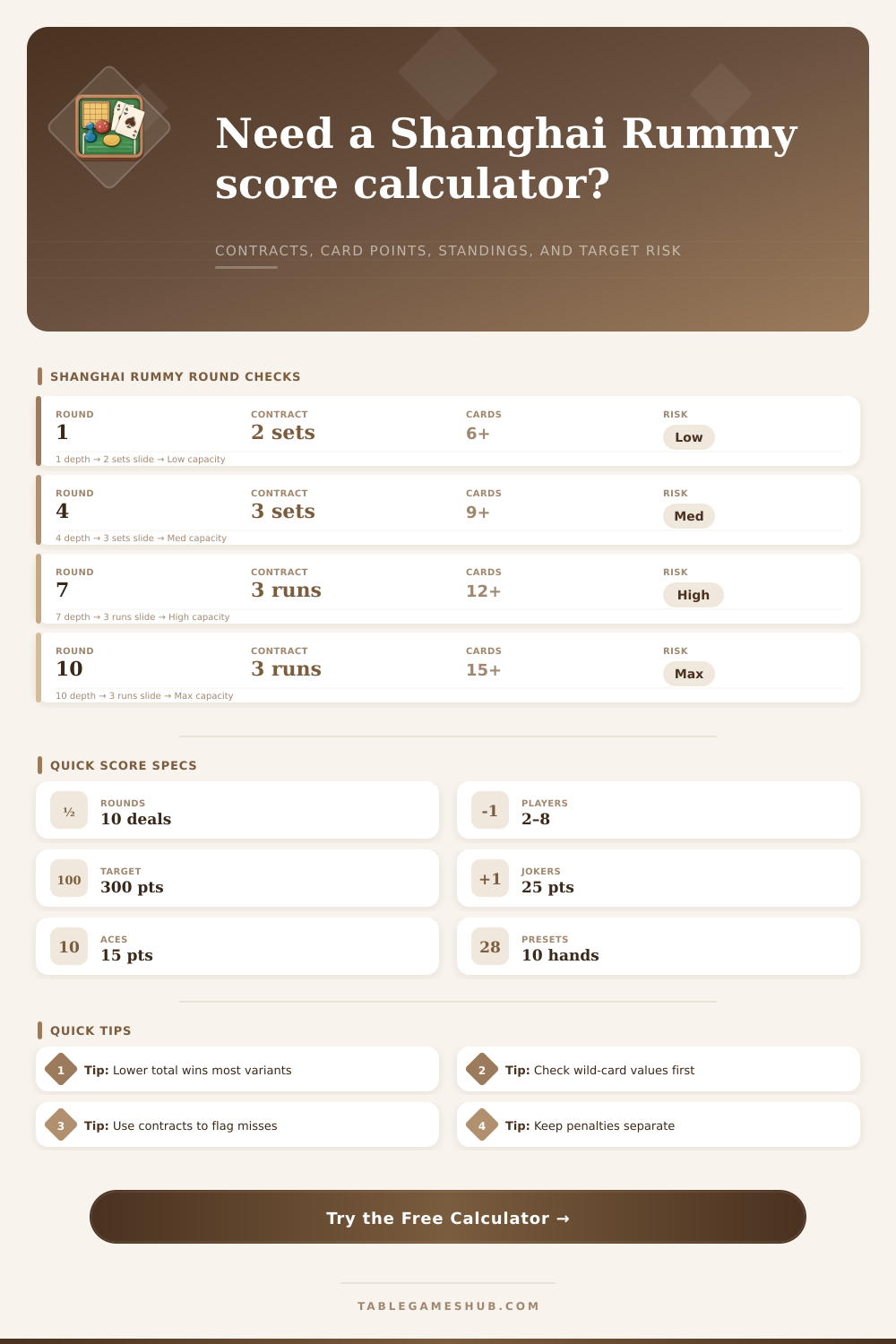
To explain all of this, the tool lays out the typical contract progression on its reference tables. It demonstrates that number of cards required to complete a hand goes up from six cards in the first deal to fifteen by the end. To make things even tougher, this means you have to adjust your game strategy at every turn. Early games favor fast play and easy sets; later games requires more patience and an ability to analyze discards carefully. Knowing about this gradient allows you to better focus your brain power.
One common source of error is the misconception between points and card values. Many beginning players assume that because face cards has a fixed number of points (10), it applies across all face cards, no matter which one you hold. This helps make scoring more even, but it also shows how much more valuabel some cards are than others. You’ll find yourself holding on to a king or queen only to realize that they don’t fit well within your melds. By breaking them down into individual parts, the calculator makes it clear what each card type adds up to, including any potential liabilities you may have overlooked in your hand.
So what is Shanghai Rummy? It’s a game of controlled chaos. You’re dealt the cards, but you make the score. In this way, a digital aid takes the admin out of the process so you can get on playing accurately and confidenty. The numbers don’t lie. If they are kept correctly, the final deal is about who plays best instead of who makes the most math mistakes. And that clarity is worth more than any single hand.