It’s the last round in Mombasa. You’re looking at a company track with great potential payoff, but it also seems too crowded to risk. You know the balance: should I stay, or should I buy?
This is where instinct often gets tripped up, as players gets caught focusing on what they see (the printed value) rather than the underlying structure (timing, dilution risk). The game tells you each card has a number on it, but what does it really mean? That’s not a piece of paper, it’s a contract. Its value depends on the number of remaining rounds, competing demand, and how well your own engine can absorbs those certificates into points.
How to Judge Share Value
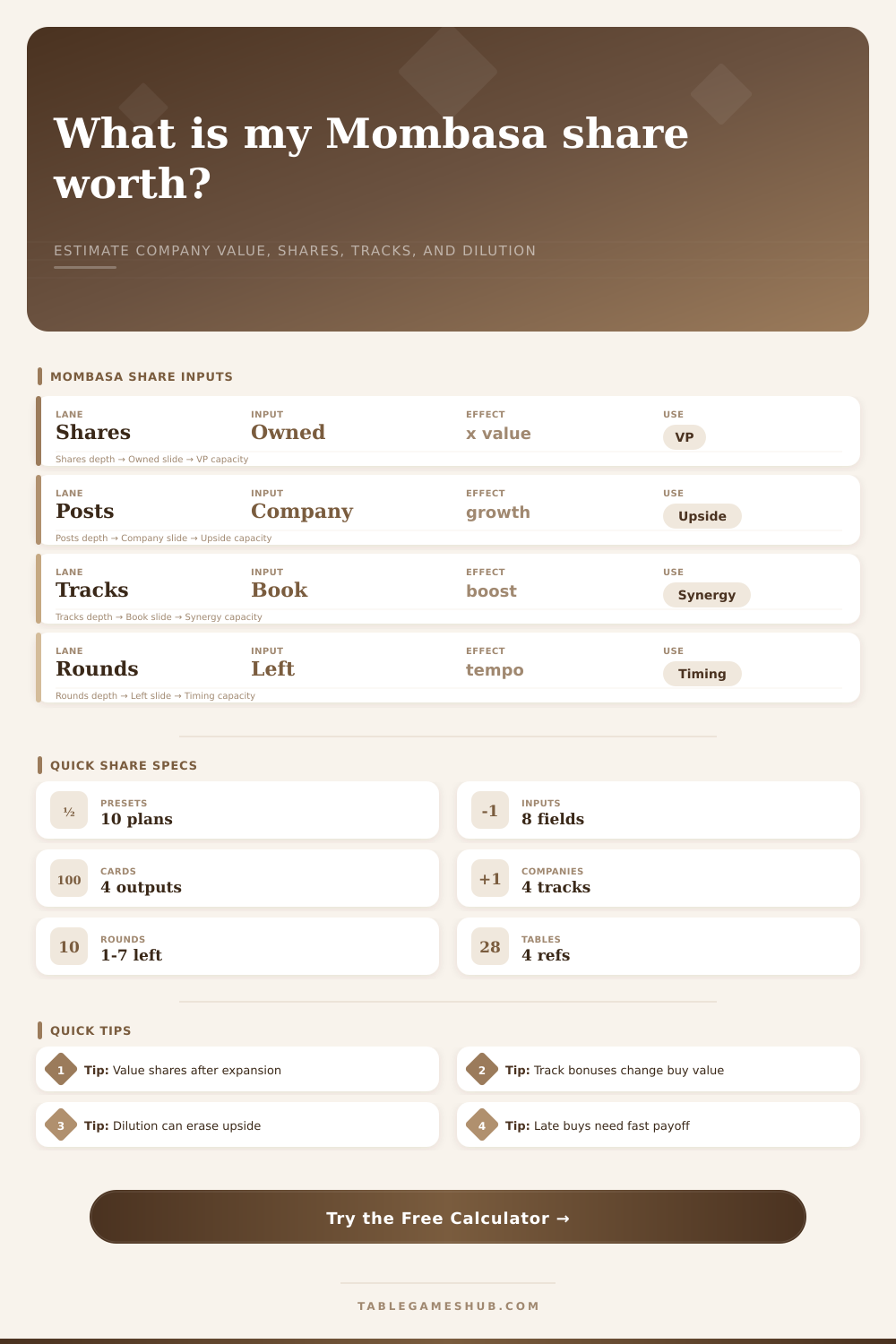
Use this calculator for math: Enter your current count and guess at how much you might expand, then leave the rest to the numbers. Now you’ll know whether that additional share are worth what you give up to get it.
In Mombasa, the difference between what a building will become and its existing value represent the basis of any good investment choice. A common rookie mistake is viewing the value of a company today and failing to go further. Is it a 6 point company? Sure, that’s safe to purchase! All that’s being ignored are the hidden trading posts waiting to be discovered. With three remaining, and just one more round on the clock, your shares may never hit their highest possible valuation. That’s where the expansion upside comes into play. By taking the remaining trading posts and multiplying them based off the game’s tempo, it helps you realize that points for tomorrow aren’t worth anything today; late-game speculations can easily be a rabbit hole.
And then there are combinations, which add up to a winning move even if your share isn’t all that hot. Your personal tracks (Bookkeeper, Diamond, etc.) act as force multipliers. If you’ve got a solid line going in one area, you’re better off with another share of some crappy company than you would of been with an otherwise identical share of some sweet hunk of real estate. This is because the crappy company complements your path to bonus markers and those valuable victory points that other people can’t access. Those are points of pressure, and the calculator factors them in when determining the worth of a share, knowing that it doesn’t stand alone; its value depends on your overall position on the board. It is a small difference, sure, but it is the kind that makes good players great.
Dilution risk is the quiet assassin of high scores. Buying into a company that several others have targeted mean you’re splitting the pool of possible growth across more people which reduces effective worth of every share. Competition isn’t just for points; it sets limits on how much you can expand. If another player buys into the same lane, they aren’t just competing against you, they are also cutting into your edge. Model this realistically with input fields for opponent pressure. You don’t know precisely what your rival thinks, but you can estimate how much the lane is in contention. If the table indicates lots of dilution? Then the projected value gets a haircut to account for that shared reality, so you won’t overvalue a company just because it appears expensive on paper.
The last variable tying all this together is timing. Some share purchases will be more immediately bankable (late game), some more reliant on future potential (early game). The tool provides some pre-set scenarios to better show how these different type of plays shape up. For example, a late share buy would need strong current value, as it doesn’t have much time to spare to raise its price with more posts. Meanwhile, an early purchase could afford weaker initial values, provided it still had space to expand. Knowing this pattern will prevent you from hanging onto your shares for too long (or entering a crowded lane prematurely). The reference tables gives you some benchmarks to guide those choices and let you know whether it’s time to buy, hold, or pivot depending on your adjusted value per share.
In the end, judging share value in Mombasa requires precise balancing of risk and reward. A good company isn’t necessarily a good opportunity; you must see both. Factors like time, dilution, synergy, and expansion enters the equation. This turns guesswork into strategic planning. You use the numbers the tool provides, but you are also called upon to read the table, to trust the forecasts when they fit the needs of your own engine. Keep in mind that a share is only as good as the plan behind it. Let the data guide your hand while keeping an eye on the prize.