Bowling Ball Weight by Age Calculator
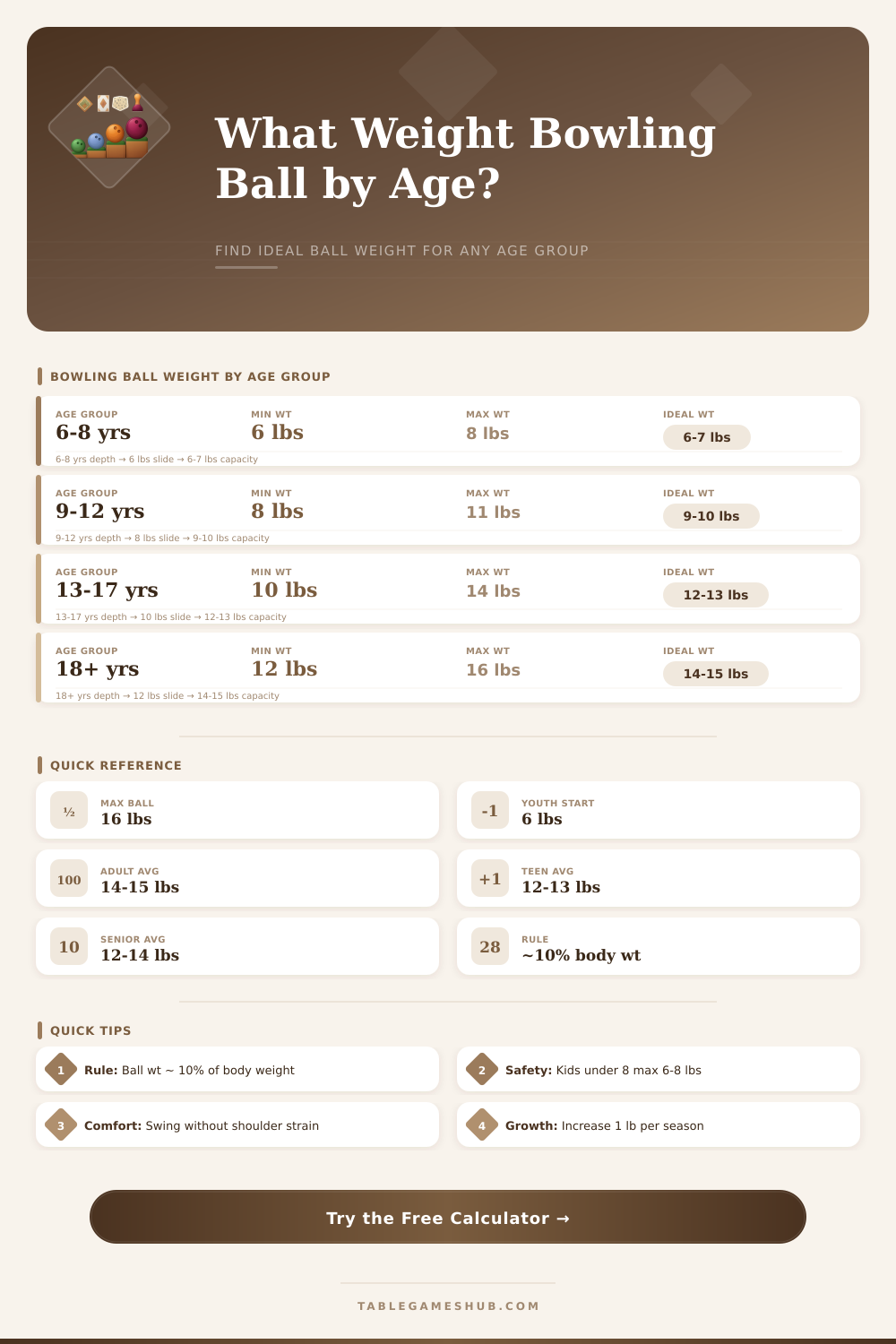
| Age Group | Recommended (lbs) | Min Weight | Max Weight |
|---|---|---|---|
| 5 - 7 years | 6 lbs | 6 lbs | 8 lbs |
| 8 - 10 years | 8 lbs | 6 lbs | 10 lbs |
| 11 - 13 years | 10 lbs | 8 lbs | 12 lbs |
| 14 - 17 years | 12 lbs | 10 lbs | 14 lbs |
| 18 - 25 years | 14 lbs | 12 lbs | 16 lbs |
| 26 - 40 years | 15 lbs | 12 lbs | 16 lbs |
| 41 - 55 years | 14 lbs | 12 lbs | 16 lbs |
| 56 - 65 years | 13 lbs | 10 lbs | 16 lbs |
| 65+ years | 12 lbs | 10 lbs | 14 lbs |
| Ball Type | Weight Range | Hook Potential | Ideal Lane Condition |
|---|---|---|---|
| Plastic / Polyester | 6 - 16 lbs | Low (1/10) | Dry / Spare Shots |
| Urethane | 10 - 16 lbs | Medium (4/10) | Medium-Dry |
| Reactive Solid | 10 - 16 lbs | High (7/10) | Medium-Oil |
| Reactive Pearl | 10 - 16 lbs | High (8/10) | Medium-Heavy Oil |
| Reactive Hybrid | 10 - 16 lbs | Very High (9/10) | Heavy Oil |
| Particle | 12 - 16 lbs | Very High (9/10) | Heavy Oil |
| Player Profile | Ideal Weight | Recommended Ball | Avg Game Duration |
|---|---|---|---|
| Child (6-8 yrs) | 6 - 8 lbs | Plastic | 45 min |
| Youth (9-12 yrs) | 8 - 11 lbs | Plastic / Urethane | 50 min |
| Teen (13-17 yrs) | 10 - 14 lbs | Urethane / Reactive | 60 min |
| Adult Beginner | 12 - 14 lbs | Plastic / Urethane | 60 min |
| Adult Advanced | 14 - 16 lbs | Reactive / Particle | 75 min |
| Senior (65+ yrs) | 10 - 14 lbs | Urethane | 60 min |
| Tournament | 15 - 16 lbs | Reactive Hybrid | 90 min |
Bowling balls weigh between 6 and 16 pounds. The lightest are usually for children, and the heaviest are the maximum weight in professional bowling More popular weights for adults range from 10 to 15 pounds, with men averaging 14; 16 pounds and women around 10; 14 pounds.
Common advice says a bowling ball should weigh 10 percent of your body weight, but no more than 16 pounds. So someone weighing 150 pounds should not use an 8-pound ball. To find the right weight, divide your body weight by 10 and add a skill factor.
Choose the Right Bowling Ball Weight
Naturally, because 16 pounds is the legal maximum, a person of 175 pounds will not find a 17.5-pound ball, because those do not exist.
Choosing a 14-pound ball is a great start. Let a pro shop fit it to your hand. That helps you hold and throw it more easylr, and it will not feel so heavy.
Many good players went down to 15 or even 14 pounds, because light balls react better with current materials. Moreover, they wear out the body less, which is a big advantage.
New technology of bowling balls allows you to hit more pins with less weight. The energy in the ball depends on mass and the boost during impact. A heavier ball hits hard, but only if you keep speed.
Energy grows with weight, but by the square of speed, so high speed with a light ball usually moves pins more effectively.
A 10-pound ball usually leaves too many pins standing, and strikes are possible, but hard. Curving the ball helps for better strikes. Right weight ensures steady speed.
Two-handed players usually handle a bit heavier balls, because the load spreads across both hands during the step.
Most 12-pound balls do not have the heavy block of heavier models. Some balls get a normal core only from 14 pounds. Remember that when picking.
Sixteen pounds was the standard, but many pros switched to 15 when hook entered the game. Because of the design of balls and modern mechanics, there are few reasons to throw 15 instead of 14.
Ball weight depends on the player and conditions of the lane. Throw what is comfortable for many games. Ideal weight is that you can keep it with an extended arm some seconds without trembling.