Relay Race Exchange Zone Calculator
Set a check mark, handoff target, and timing window from incoming speed, outgoing acceleration, zone length, and safety margin.
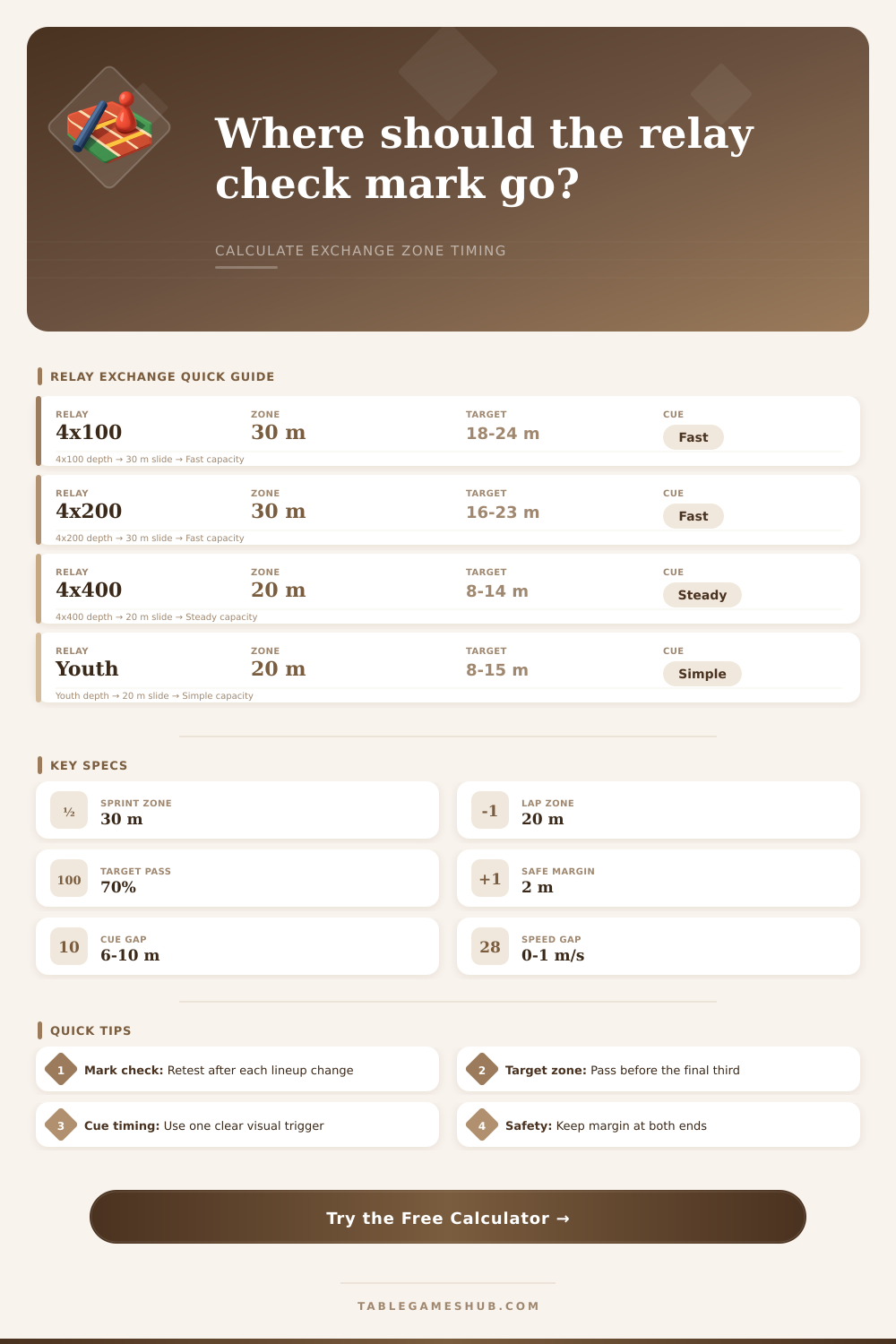
| Relay format | Typical zone | Target handoff depth | Common check mark range | Timing note |
|---|---|---|---|---|
| 4x100 sprint relay | 30 m / 98.4 ft | 18-24 m from entry | 7-11 m before zone | Visual cue, high speed, tight margin |
| 4x200 straight exchange | 30 m / 98.4 ft | 16-23 m from entry | 6-10 m before zone | More fatigue, slightly earlier pass |
| 4x400 lap relay | 20 m / 65.6 ft | 8-14 m from entry | 2-6 m before zone | Control speed before full sprint timing |
| Youth or first-year teams | 20-30 m | Mid-zone first | 2-7 m before zone | Use larger safety margins and simpler cues |
| Formula part | Calculation | What it means | Use in calculator |
|---|---|---|---|
| Incoming zone time | target distance / incoming speed | Seconds from entry line to target pass point | Sets target handoff clock |
| Outgoing distance | 0.5 x accel x time squared, then speed cap | How far the outgoing runner travels after cue | Matches runner position at pass |
| Check mark distance | incoming speed x required lead time | How far before the zone the cue should occur | Main mark recommendation |
| Pass margin | zone length - target - safety margin | Remaining usable zone after the handoff target | Flags late passes |
| Setup component | Low-risk spec | Aggressive spec | Watch item |
|---|---|---|---|
| Check mark | Shorter mark, earlier pass | Longer mark, faster outgoing speed | Outgoing runner leaving too soon |
| Handoff target | 50-65% into zone | 70-80% into zone | Pass drifting past exit line |
| Safety margin | 2-4 m each line | 1-2 m each line | Officials, lane traffic, fatigue |
| Outgoing cue | Single visual marker | Split cue plus call | Late head turn or false start |
| Speed match | Outgoing 0.5-1.5 m/s slower | Nearly equal speed | Reaching, braking, overrun risk |
| Result pattern | Likely cause | Adjustment | Retest cue |
|---|---|---|---|
| Outgoing waits or chops stride | Check mark too short | Move mark 0.3-0.6 m farther out | Same visual cue |
| Incoming reaches or calls early | Check mark too long | Move mark 0.3-0.6 m closer | Delay launch slightly |
| Pass near exit line | Target too deep or speed gap large | Reduce target by 1-2 m | Retest at fatigue speed |
| Pass before entry line | Target too early or mark too short | Shift target deeper into zone | Use zone line as cue check |
A relay exchange require specific timing and specific momentum in order to function proper. If the timing or the momentum of the runners is not correct, the relay exchange can fail. A relay exchange involve two runners: the incoming runner and the outgoing runner.
The incoming runner must pass the baton to the outgoing runner within an exchange zone. If the runners dont coordinate the relay exchange, the team may drop the baton or step outside of the legal exchange zone. Therefore, coaches uses check marks and cue timing to ensure the relay exchange happens correctly.
How to Time a Relay Exchange
The exchange zone is the area within the track where the relay exchange must take place. For sprints, the exchange zone is thirty meter long. For relays that are longer than the sprints, the exchange zone is twenty meters long.
The incoming runner enter the exchange zone at a high speed. The outgoing runner only begins to move after the incoming runner reaches a specific check mark within the exchange zone. The check mark is established to ensure that the baton reach the outgoing runner’s hand while within the exchange zone.
If the incoming runner reaches the check mark too early, the outgoing runner will have to slow down. However, if the incoming runner reaches the check mark too late, the relay exchange may occur outside of the legal exchange zone. The calculator is a tool that allows coaches to calculate the necessary timing for a relay exchange between the incoming and outgoing runners.
To use the calculator, the incoming speed of the runner, the acceleration of the outgoing runner, the reaction delay of the outgoing runner, and the safety margin for the exchange zone must be inputted into the calculator. These four factor must be accounted for because, for instance, a high school sprinter will not have the same acceleration as an elite athlete, and a runner on a curve will have a more different momentum than a runner on a straight portion of the track. The calculator account for these different speeds and different momentum levels.
The target depth for many team is seventy percent into the exchange zone. This portion of the exchange zone allow the outgoing runner to reach a useful running speed. However, this target depth only works if the speed gap between the incoming and outgoing runner is not too large.
If the incoming runner is much faster than the outgoing runner, the incoming runner will have to reach for the outgoing runner with the baton; this could result in the team dropping the baton. The calculator will show the speed gap between the runners so that the coach can decide whether to move the check mark or the target depth. Besides the factors that are accounted for in the calculator, there are two additional factor to consider in the relay exchange: fatigue and lane position.
If a runner is experiencing fatigue, he or she will not be able to run at the same speed as a runner who is not experiencing fatigue. Additionally, a runner in lane two will have a different view of the incoming runner than a runner in lane one. As such, the runner in lane one may have to cue earlier than the runner in lane two.
The calculator allow for different incoming speeds and different rate of acceleration to be tested so that coaches can determine the effects that fatigue and lane position will have upon the relay exchange. Relay exchanges often make mistakes with the location of the check mark. Some teams may place the check mark too far away from where the exchange zone begin.
They may want to allow time for the outgoing runner to reach their maximum speed. However, by placing the mark too far away, the outgoing runner may have to change their stride. Additionally, some teams place the check mark too close to where the exchange zone begin.
They may want to avoid disqualifications due to running too far outside of the exchange zone. However, if the check mark is too close to the exchange zone, the incoming runner will have to slow down or reach for the outgoing runner. It is better to begin with a check mark that is placed more conservatively and then adjust the check mark based on the relay exchange practice session.
A cue is used to let the outgoing runner know to begin to move. A cue can be visual or it can be verbal. While the calculator is a helpful tool to determine the time between the cue and the relay exchange, the coaches will have to practice calling the cue.
However, using the calculator will allow coaches to understand if the relay exchange will feel rushed if the cue is called at the start of the exchange zone; if the time between the cue and the exchange is less than a quarter second, then the exchange will feel rushed. For youth teams or developing runners, coaches should focus more upon the safety margin for the relay exchange. For youth teams, the safety margin is more important than the speed that the runners want to achieve during the exchange.
Additionally, if the exchange zone starts early within the exchange zone, there is more time for error than if the teams aim to complete the exchange later in the exchange zone. Thus, coaches can use the calculator to establish a safety margin, which will show them how far out they must place the check mark to achieve the same target depth. The reference tables within this tool provide information regarding the target depths for different type of relays.
For instance, sprints use deeper target depths because the runners travel at high speeds over a long exchange zone. Four hundred meter relays use shallower target depths because the incoming runner is fatigued after completing three relay. These ranges are not rules that must be followed, but they can provide coaches with a starting point for relay exchange strategy.
A relay exchange involve the interaction of many factor. For instance, the speed of the incoming runner will impact the other variable within the relay exchange system. Additionally, the rate at which the outgoing runner will accelerate will impact the other variable of the relay exchange system.
The calculator allow coaches to view how changing one of these variable will impact the exchange system. By using the calculator and by using the data of the runners, coaches can move away from guessing what speed or how fast the outgoing runner should accelerate, and instead focus upon perfecting the relay exchange itself.