Three Thirteen Score Calculator
Total every 3-13 Rummy hand with round wilds, unmelded-card points, house caps, missed go-out penalties, standings, and leader gaps.
1Preset Score Sheets
Pick a real Three Thirteen table state, then adjust the round and player lines before calculating.
2Round Settings
3Player Score Lines
Deadwood base should exclude wild cards if you enter wilds separately. A went-out player is scored as 0 for the round unless an adjustment is entered.
| Player | Previous total | Deadwood base | Wilds left | Adjustment | Round status |
|---|---|---|---|---|---|
Score Breakdown
4Three Thirteen Round Specs
5Reference Tables
| Round | Cards Dealt | Wild Cards | Scoring Note |
|---|---|---|---|
| 1-4 | 3, 4, 5, 6 | 3s through 6s | Low totals can change quickly because hands are short. |
| 5-8 | 7, 8, 9, 10 | 7s through 10s | Midgame swings usually come from one large unmelded card group. |
| 9 | 11 cards | Jacks | Jacks count 11 if left unmelded under rank scoring. |
| 10 | 12 cards | Queens | Queens count 12 if left unmelded under rank scoring. |
| 11 | 13 cards | Kings | Kings count 13 if left unmelded under rank scoring. |
| Card Type | Standard Value | Calculator Entry | House Rule Check |
|---|---|---|---|
| Ace | 1 point | Add to deadwood base | Some tables score ace as 15; enter adjustment if needed. |
| 2 through 10 | Face value | Add exact unmatched points | Wild rank still follows the round card count. |
| Jack, Queen, King | 11, 12, 13 | Add face-card penalty | Late rounds can create large final swings. |
| Wild card left over | Rank value | Use wilds-left field | Switch to 0, 15, or 20 if your table uses that rule. |
| Players | Suggested Decks | Highest Deal | Reason |
|---|---|---|---|
| 2-3 | 1 deck | 39 cards | Enough cards for normal draw and discard space. |
| 4-6 | 2 decks | 78 cards | Common family setup for full 13-card rounds. |
| 7-8 | 3 decks | 104 cards | Prevents thin draw piles in the final rounds. |
| Any table | Add jokers only by rule | Varies | Enter joker penalties as adjustments if used. |
| Situation | Score Entry | Result Impact | Calculator Control |
|---|---|---|---|
| Player goes out | 0 round points | Protects a low total | Choose Went out status. |
| Unmelded wilds | Wild value times count | Adds separate penalty | Use Wilds left and Wild value mode. |
| Missed go-out call | Deadwood plus penalty | Raises that round score | Choose Missed go-out status. |
| House cap | Limit round score | Softens extreme hands | Use cap scoring style or cap field. |
6Scorekeeping Tips
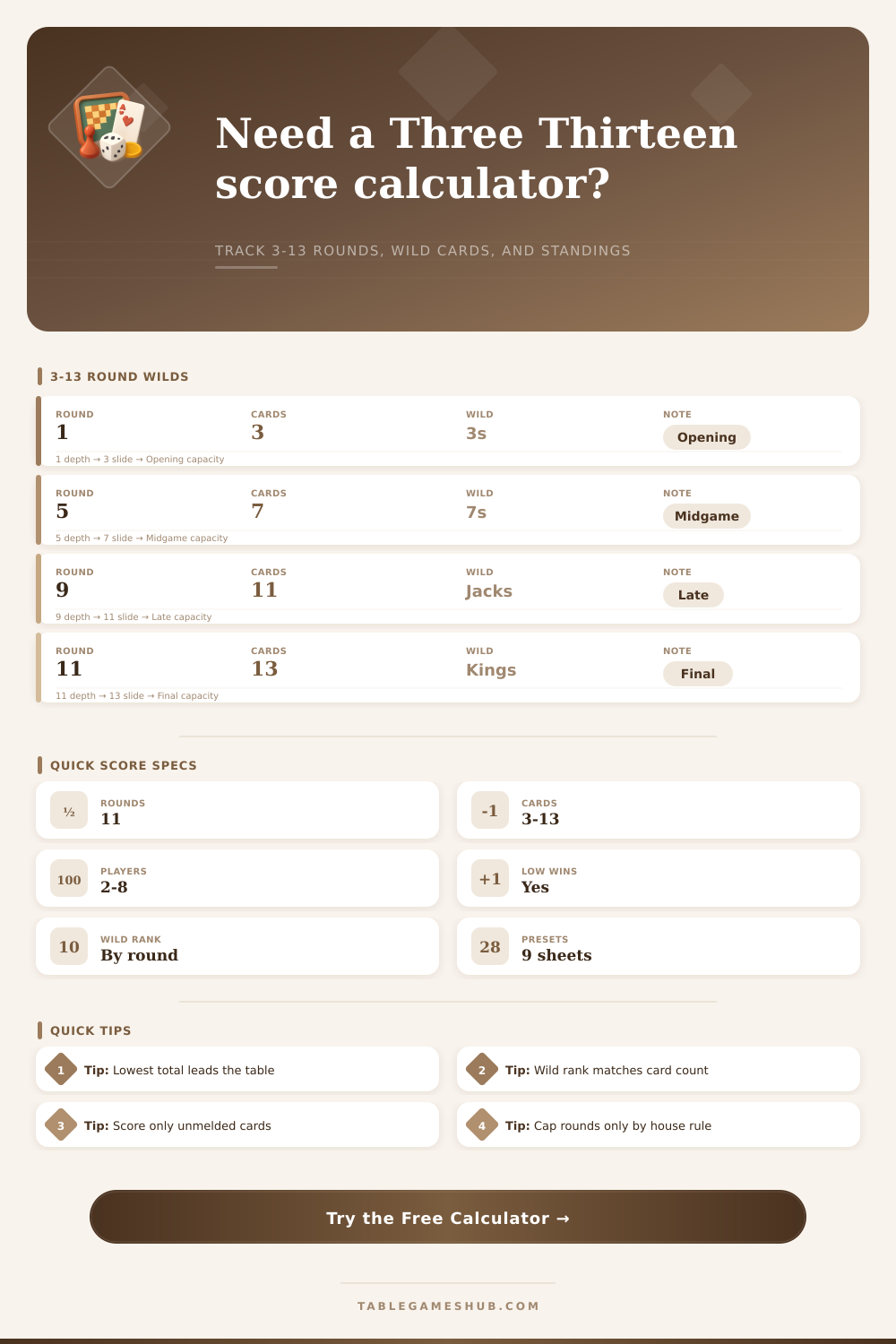
Round wild reminder: In Three Thirteen, the wild rank normally matches the number of cards dealt that round, from 3s in the opening hand to kings in the final hand.
Deadwood entry: Enter only unmelded card points. If you count wild cards separately, leave them out of the deadwood base and use the wilds-left field.
Generally, games of Three Thirteen reach their peak tension not at the moment that one player’s gone out, but rather when the round wild card switches from sevens to jacks. With face cards penalized heavily for not melding, this switch converts a pile of easily dealt with extra cards into series of possible disasters. Most family arguments starts here, during manual end-of-round scoring in the midst of these wild rounds. They start when someone remembers an unmelded seven was worth nothing last time, so it should of be worth nothing now.
By leaving math to a dedicated calculator, you can concentrate on strategy instead. Scoring in Three Thirteen comes down to eleven rounds where goal is to get the fewest possible points. Cards are dealt one per round beginning with three (hence the name), increasing each subsequent round until reaching thirteen. This also determine the rank of the wild card for that hand. Enter the previous running total and deadwood for this hand. And here’s the catch: How do you treat those wilds? Typically they’re scored at par if not melded, but most house rules let you score no points for unmatched wild cards. (Those house rules is handled easily enough by adjusting settings, there’s no need to argue about it while playing.) For your convenience, the tool handles both cases.
Why Use a Score Calculator for Three Thirteen
It’s not just about points; it’s also about rhythm. A king in your hands doesn’t sting early like it will later, but don’t let that lull you into thinking things are going well. Score low in round four and think you’re banking it? Look out: Those killer face cards sitting in your hand could be ticking time bombs later on, and then they’ll blow your score wide open. The calculator’s got a running tally of this, too. Each round’s penalty add up to show you where you stand at every point. It shows whether it pays off to play it cool now, knowing it will cost you big-time later on, or to go for broke with a partial meld. A partial meld may hurt your immediate score but can actualy help your chances overall.
I don’t think anyone fully appreciates how much getting missed go-outs matters. I’ve seen players call go out while they still have deadwood enough times to know that it’s a big deal, regardless of what your low-hand was going into the round. It will cost you 3 rounds of lead in the blink of an eye. Marking your status as either normal or missed ensures the correct penalty are applied accurately without needing to recall house rule amount during the heat of play.
It also makes managing the number of players at a table easy. It recommends the size of deals and cards required based off the number of players, so you never have to wonder if you should have used two decks instead of three for a six-player table. For novice players who have yet to memorize which cards become wild on what turn, the reference tables inside this tool will help them remember without having to stop and look things up. After a few rounds of frantic melding, it gets hard to keep track of when queens take over from tens. That can cost you dearly if you think a queen is wild when it isn’t and you end up having to score that card at its actual value. Being able to see exactly what happens each round help eliminate such errors. Scoring mistakes add up fast: they can turn a close competition into an embarassing blowout before you even finish the last round of chess.
All told, Three Thirteen does not favor blind luck more then adaptation and patience. You have to weigh the temptation to leave early against the need to stay alive long enough to endure the penalty-heavy rounds toward the end. Players will aggressively pursue large melds only to find themselves open to huge deadwood penalties if they miss; others will play safe and get stuck in the middle game. There’s no right way to play, but there’s certainly a right amount of score. By letting the calculator do the drudgery of addition and subtraction, you’re freed up to mentally wrestle with whether to keep an exposed queen in hopes of a sequence, or let it go and risk picking up some cards later on. What the numbers don’t take away from you, they’ll give back in spades: the ability to focus more on playing the game instead of fighting over who’s got the right answer on paper after the last card is drawn.