Seeding Bracket Calculator
Calculate bracket size, byes, seed placement, protected seed paths, seed pairing positions, and first-round conflict pressure before publishing a tournament bracket.
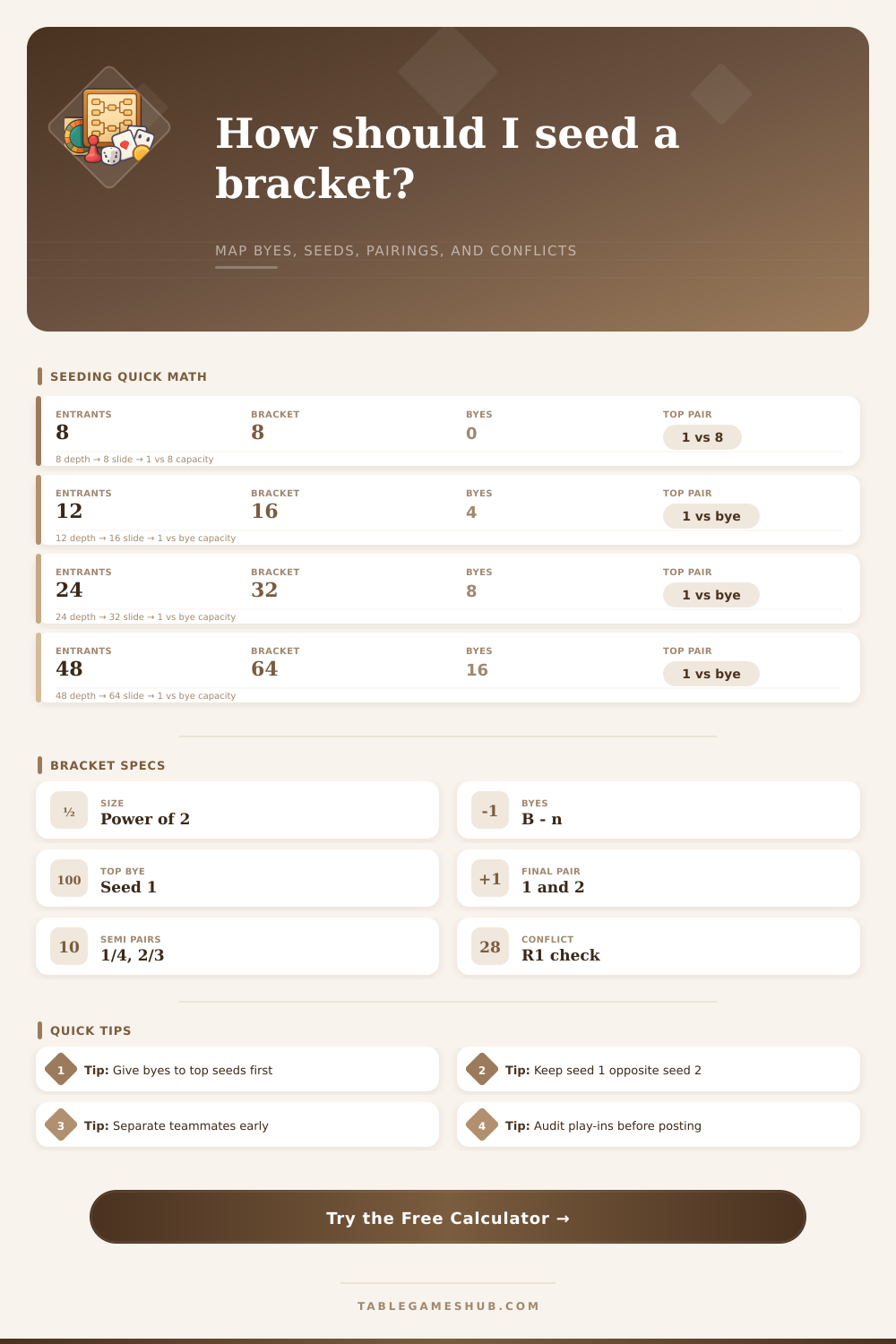
| Entrants | Bracket Size | Opening Byes | Top Seed Path | Final Seed Pair |
|---|---|---|---|---|
| 8 | 8 | 0 | 1 vs 8, then 4 or 5 | 1 and 2 opposite |
| 12 | 16 | 4 | 1 gets bye, then 8 or 9 | 1 and 2 opposite |
| 16 | 16 | 0 | 1 vs 16, then 8 or 9 | 1 and 2 opposite |
| 24 | 32 | 8 | 1 gets bye, then 16 or 17 | 1 and 2 opposite |
| 32 | 32 | 0 | 1 vs 32, then 16 or 17 | 1 and 2 opposite |
| 64 | 64 | 0 | 1 vs 64, then 32 or 33 | 1 and 2 opposite |
| Protection Level | Best Use | Separation Goal | Typical Pairing | Audit Note |
|---|---|---|---|---|
| Top 2 | Small casual event | Opposite halves | 1 and 2 cannot meet before final | Check only final path |
| Top 4 | Club or store bracket | One per quarter | 1/4 and 2/3 semifinal paths | Works cleanly at 8 plus slots |
| Top 8 | Regional cut | One per eighth | 1/8, 4/5, 3/6, 2/7 | Needs 16 plus slots |
| Top 16 | Large open bracket | One per sixteenth | High-low pairings by section | Needs 32 plus slots |
| Conflict Type | Input to Track | Round-One Test | Common Fix | When to Allow |
|---|---|---|---|---|
| Same club | Club or store group | Two players from same group paired | Swap with same seed band | Late rounds only |
| Repeat match | Prior-round opponent list | Players already met in pool play | Move lower seed within band | Small fields |
| Teammates | Team roster marker | Teammates meet immediately | Protect as hard conflict | Only if unavoidable |
| Travel pair | Shared travel group | Paired before bracket develops | Use play-in or adjacent swap | Open seeding events |
| Metric | Formula | Meaning | Example at 24 |
|---|---|---|---|
| Bracket size | Next power of 2 | Seed slots including byes | 32 |
| Byes | Bracket size - entrants | Empty first-round seed slots | 8 |
| Main matches | Entrants - 1 | Single-elimination champion path | 23 |
| Rounds | log2(bracket size) | Rounds in full bracket tree | 5 |
| R1 pairings | Bracket size / 2 | First line items to audit | 16 |
| Bye share | Byes / bracket size | Empty first-round slot percent | 25% |
Protect by seed band
When resolving a conflict, swap within the same seed band first. That preserves the bracket strength curve while keeping known teammates or repeat opponents apart.
Audit before publishing
Byes make some round-one conflicts invisible because one player advances automatically. Review the first playable matchup for every protected seed.
Seeding a tournament bracket involve managing several different variables. The variables that you must manage when seeding a tournament bracket involve the player, the seed rankings of those players, conflict between those players, and the number of slots for those players within the tournament bracket. For efficiency, the number of slot within the tournament bracket should be a power of two, which often means that some player will receive byes into the tournament bracket.
A seeding bracket calculator can perform the mathematical calculation for a tournament bracket, and a seeding bracket calculator can use the constraint that you provide to create a tournament bracket. The first step in seeding a tournament bracket is to decide on the size of the tournament bracket. For instance, if there are twenty-four players in your tournament, you will need to use a thirty-two-slot tournament bracket because twenty-four are not a power of two.
How to Seed a Tournament Bracket
Because there are more slots than players, you will have to give some players byes to those slots. Byes will usually go to the players with the highest seed number because that will ensure that the top players skip the first round of the tournament. Every bye given to a player will shorten the path that that player must follow within the tournament bracket.
These player will usually be the top tournament seeds. Another important aspect of seeding a tournament bracket is the use of protected seeds. By using protected seeds, you will ensure that the strongest players in your bracket do not encounter each other very early within the tournament bracket.
Protected seeds should be placed in different area within the bracket. The number of protected seeds that will be used will depend on the total number of players within the tournament. For small tournament, two protected seeds might be used, while large tournaments might have eight protected seeds.
Protected seeds are used to even out the tournament for the strongest players so that they will not be eliminated early in the bracket. This isnt the same as showing favoritism for the strongest players. Conflicts between players should also be managed within a tournament bracket.
A common conflict between players is if the players are teammates or from the same club. In these cases, the players should not be seeded to encounter each other in the first round of the tournament bracket. A seeding bracket calculator will track the number of conflicts between players and show the number of conflict within the bracket.
If there are few conflicts between players, you can resolve them by swapping players within the same section of the bracket. If there are many conflicts between players, play-in matches might be necessary to resolve those conflict. There are various placement method for players within a tournament bracket.
The most common is high-low placement, which means that the highest seed will be placed against the second highest seed. Other placement methods include serpentine placement, where the players of the highest seeds are placed in a different rhythm within the bracket, and random placement, where the protected seeds are placed first and the remaining players are placed randomly within the bracket. The placement method will change the way that the tournament bracket looks, but it will not change the math of the bracket.
Byes and play-in matches can be given to players at the top or bottom of the tournament bracket. Byes can be given to the top seeds to even out the tournament for those players, but giving byes only to the top seeds will make the tournament bracket seem more unfair. Byes can also be given to the different quadrants of the bracket to even out the tournament bracket.
Play-in matches can be given to the players at the bottom of the tournament field. These matches will help you to even out the number of players, and play-in matches can be given to those at the bottom of the tournament bracket. A seeding bracket calculator will show you the effect that your choices of byes and play-in matches will have on the total number of matches within the tournament bracket.
A tournament bracket can change based on the number of players within the tournament bracket. This might happen if you have more players than you have estimated, or if some of the players have dropped out of the tournament. Even with these changes in the number of players, the formula for calculating the number of matches and rounds will remain the same.
Some tournament organizers will reseed the players within the tournament bracket after the play-in matches are completed. Others will lock the tournament bracket once it has been published. A seeding bracket calculator will provide organizers with a starting point for the tournament bracket, but the calculator will not be able to make judgment calls about seeding changes caused by changes in the number of tournament players.
As with any other process, people will make mistakes when seeding a tournament bracket. One of the most common is to choose a size for the tournament bracket before knowing the number of players that will join the tournament. Another of the most common mistakes is to protect too many of the tournament seeds if the number of player is relatively low.
Yet another of the most common mistakes is to ignore the distribution of byes within the bracket, which might make players to ask why some players have byes and others do not. Prior to assigning any players to specific seeds within the bracket, the organizer should run the number for the bracket. By doing so, they will be able to adjust the bracket according to the number of players that are to enter the tournament.
A tournament bracket can be created for a variety of reasons. Among them is to provide every player within the tournament with a fair chance of winning the tournament. Another reason to create a tournament bracket is to ensure that the tournament remains on schedule.
A seeding bracket calculator can handle the math for the tournament bracket, but the person organizing the tournament will have to make the decision regarding what constraints are important for the tournament bracket. You should of considered all variables before starting. Its important to get the bracket right the first time.
The tournament’s success depends on it. You’ll want to double check teh math. People sometimes find the process more difficult then they expected.
Making alot of mistakes can be frustrating. It is actualy a moddern way to organize games.