Scrabble Tile Bag Probability Calculator
Estimate letter, blank, vowel, power-tile, and exact word draw odds from a live Scrabble bag after removing seen tiles and the rack you already hold.
1Bag Probability Presets
Load a common rack or endgame situation, then edit the bag state, draw size, target letters, and blank handling.
2Tile Bag Inputs
3Formula Cards
Target Pool Odds
sum C(S,i) C(F,n-i) / C(N,n)
Use hypergeometric probability when you need at least K target letters from the remaining bag.
Exact Word Odds
favorable racks / C(N,n)
The calculator enumerates required letter counts and lets blanks cover missing letters when wild mode is on.
Replacement Check
sum C(n,i) p^i (1-p)^(n-i)
With-replacement mode uses binomial or multinomial logic as a comparison to the real bag draw.
Bag State
live count = set - seen - held
Every seen or held tile changes the denominator, so late-game odds should be recalculated from fresh counts.
4Scrabble Tile Spec Grid
5Reference Tables
| Letter Group | Tile Counts | Bag Role | Probability Note |
|---|---|---|---|
| High vowels | A 9, E 12, I 9, O 8 | Main rack balance | Common enough that seen tiles matter late. |
| Other vowels | U 4 plus blanks 2 | Flexible support | U is scarce compared with A, E, I, and O. |
| Core consonants | N 6, R 6, T 6, L 4, S 4 | Word builders | S has only four copies, so track each one. |
| Mid consonants | D 4, G 3, B C F H M P V W Y 2 | Rack texture | Two-copy letters swing quickly in small bags. |
| Power letters | J 1, K 1, Q 1, X 1, Z 1 | High-point pressure | A single seen tile removes the whole letter. |
| Question | Targets in Bag | Draw Size | Approximate Odds |
|---|---|---|---|
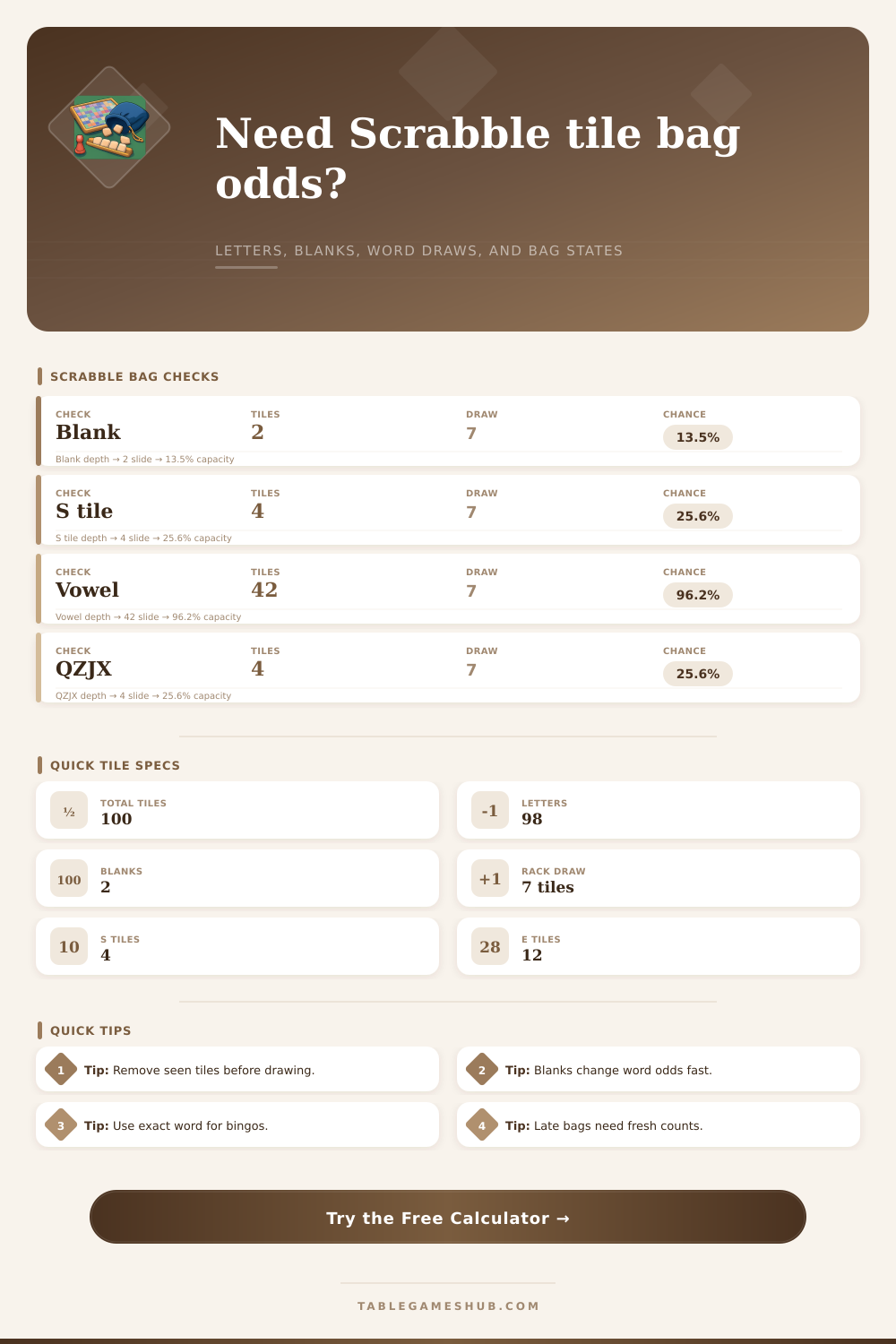
| At least one blank | 2 | 7 | About 13.5% |
| At least one S | 4 | 7 | About 25.6% |
| At least two vowels | 42 | 7 | About 85.8% |
| At least one J, Q, X, or Z | 4 | 7 | About 25.6% |
| Avoid all vowels | 42 | 7 | About 1.3% |
| Situation | Best Mode | Target Entry | What It Answers |
|---|---|---|---|
| Fishing for any vowel | Target pool | AEIOU | Chance of drawing at least K vowels. |
| Need a plural hook | Target pool | S | Chance of finding one live S tile. |
| Building a bingo | Exact word | TRAINER | Chance the draw completes the word with held tiles. |
| Dodging clunky tiles | Avoid target | JQXZ | Chance the draw contains none of those letters. |
| Checking blank help | Exact word | QUIZ | Chance with blanks acting as missing letters. |
| Bag Size | Live Targets | Draw Two | Draw Four |
|---|---|---|---|
| 40 tiles | 1 target | 5.0% | 10.0% |
| 40 tiles | 3 targets | 14.6% | 27.7% |
| 25 tiles | 1 target | 8.0% | 16.0% |
| 25 tiles | 4 targets | 29.0% | 52.2% |
| 12 tiles | 2 targets | 31.8% | 57.6% |
6Probability Tips
Count the bag first. The same seven-tile draw can change dramatically after a few vowels, S tiles, or blanks have already appeared, so enter known seen tiles before trusting a rack estimate.
Separate pool and word questions. Use target pool mode for "any of these letters" and exact word mode when duplicate letters and blanks must satisfy a specific rack shape.
These are typical tiles as you lay them out on your rack. A single letter can make or break a good word into a great move. But it isn’t just the design of the board that makes Scrabble so tense. It is the uncertainty of what is in bag of tiles, wondering if you will get the S needed to turn a mediocre play into a winning move. You have four consonants and are hoping for an S. You have too many vowels and hope for a consonant. Understanding what lies ahead in the bag let you guess with more calculation then luck.
Players assume that the bag remains constant during gameplay. The odds remains constant, they figure. Not true. This is because Scrabble is a non-replacement game. Each time someone draws a tile, they reduces the set of potential letters in the bag. This in turn changes chances for everyone else. So if your opponent uses two E tiles, then there are fewer chances of drawing an E yourself. Being aware of this allows you to stop guessing and start predicting outcomes.
How to Count Tiles in Scrabble
So after entering current game situation with the tool above, it calculates out the odds for you. You enter all the tiles you have left in your rack. And then add any letters that has been played or seen in your opponent’s rack. That reduces overall amount of tiles still available. Blank tiles come into play if there’s a particular word you want to use. The calculator allows you to consider them either as relevant to the game (useful substitutes) or irrelevant (noise). It distinguishes between exact needs for certain words vs. It handles more general questions.
For example, whether or not you’ll pull a vowel from pool is a question about the pool. Getting an exact set of letters to spell a word such as TRAIN is different. Here it’s a matter of counting letters and factoring that in.
Why does this matter? Because your gut won’t work with small quantities. It seems probable that you’ll draw at least one valuable tile (e.g., J, Q, X, Z) when there’s plenty in the bag. But math says otherwise: there are just four high-value tiles (J, Q, X, Z) total. Over time, they’ll get pulled into other people’s racks and into previously-played words. Suddenly, there is zero chance of pulling them. Yet the player thinks there’s a good shot of drawing them anyway, he have the wrong info. Letter frequency shifts a lot as the round goes on; look at reference tables.
There’s another dimension to tile management that can’t be fully expressed by numbers: psychology. Being told there’s 30% chance of pulling out an S isn’t as helpful as being able to know that your opponent has three S tiles. In this case, it means you should of be more cautious with the other two because they’re less likely to be held by your opponent. That’s where seeing the tiles comes in. It allows you to turn these ideas into real facts that matter to you and your match-up. You’re calculating based off what happens in front of you, not mere statistical probabilities.
The change at the end is often ignored by many casual players. Even with just ten tiles remaining, they continue to play like they still have plenty of time and draws remaining. By now, however, each tile revealed change the chance of what will be in your last draws. Knowing only one vowel might mean you have almost no chance of drawing enough tiles for a well-balanced refill. Knowing, however, that no high-point letters are left on the board means you may make some risky word attempts. If the high-score tiles is exhausted, don’t worry about someone stealing it away from you at the last minute.
But this is where Scrabble becomes less about vocabulary knowledge and more about mastering information management. It teaches you to watch for the gaps in between your turn. If you’re able to exactly identify what’s absent from the bag then you’ll begin to engineer results rather than hope for them. Scrabble leaves clues if you simply get good at tracking the tiles.