Catan Probability Dots Calculator
Compare Catan number-token dots, 2d6 roll chances, resource production, city multipliers, robber downtime, and expected cards across a real board position.
◎Preset Catan Board States
Load a common settlement or city pattern, then adjust tokens, resources, buildings, robber pressure, and roll horizon.
⚙Board Position Inputs
🏠Number Tokens and Buildings
Enter each productive hex your settlements or cities touch. Leave unused spaces as None.
Hex 1
Hex 2
Hex 3
Hex 4
Hex 5
Hex 6
🧮Four Formula Cards
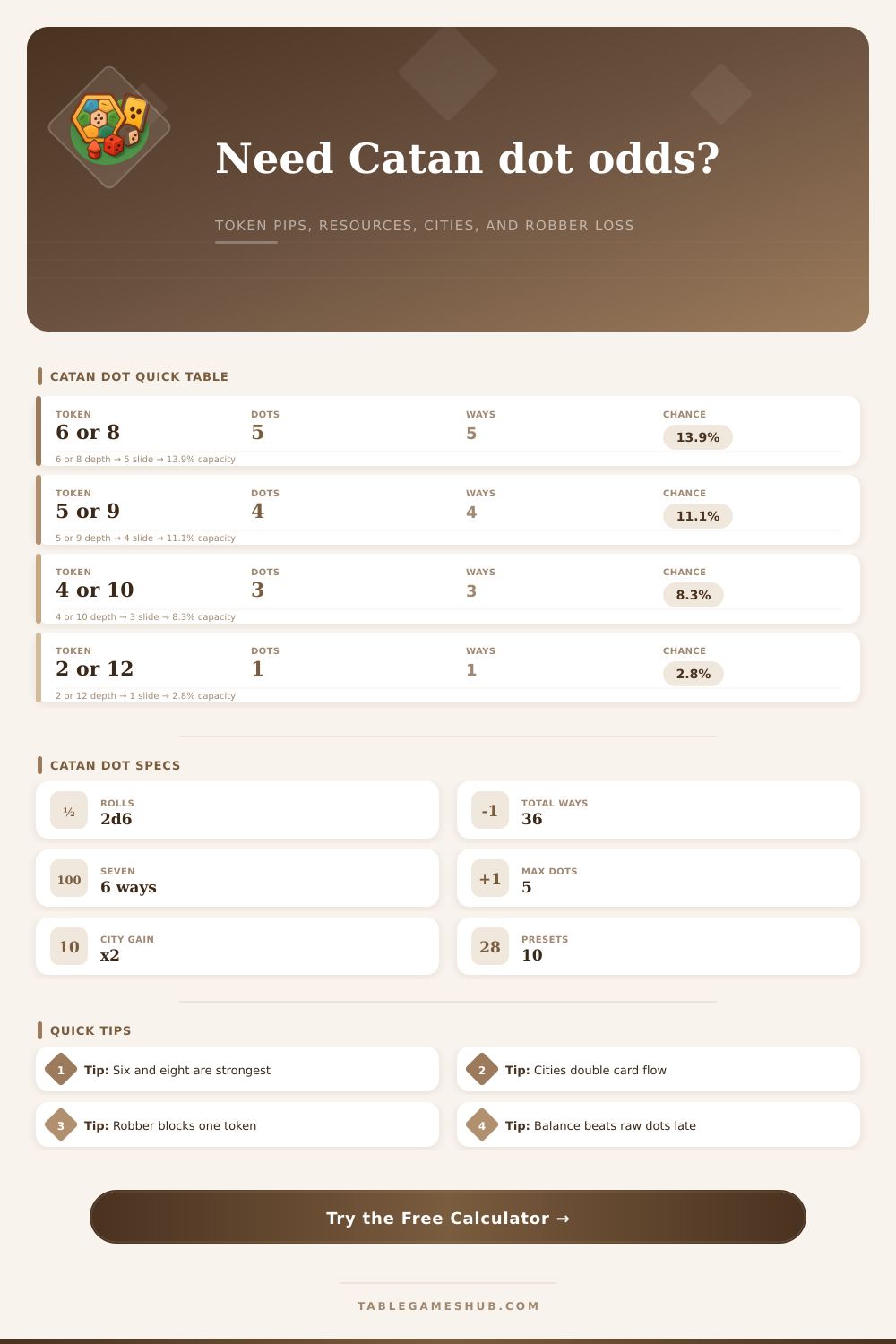
On 2d6, a token with five roll combinations has five dots, while 2 and 12 have one dot each.
A 6 or 8 appears 5 ways out of 36, so each has a 13.9 percent chance per roll.
Settlements use multiplier 1 and cities use multiplier 2 for the same token probability.
Blocked tokens are discounted by the share of the horizon you expect the robber to remain there.
⚙Catan Dot Spec Grid
☰Reference Tables
| Token | Dots | 2d6 ways | Chance per roll |
|---|---|---|---|
| 6 or 8 | 5 dots | 5 of 36 | 13.9 percent |
| 5 or 9 | 4 dots | 4 of 36 | 11.1 percent |
| 4 or 10 | 3 dots | 3 of 36 | 8.3 percent |
| 3 or 11 | 2 dots | 2 of 36 | 5.6 percent |
| 2 or 12 | 1 dot | 1 of 36 | 2.8 percent |
| 7 | Robber | 6 of 36 | 16.7 percent |
| Building state | Multiplier | Example on 6 | Use in calculator |
|---|---|---|---|
| No building | 0x | 0 cards per hit | Leave unused spaces as None |
| Settlement | 1x | 5 expected cards per 36 rolls | Opening and expansion positions |
| City | 2x | 10 expected cards per 36 rolls | Upgraded production engines |
| Robber block | Discounted | Reduced by blocked-roll share | Use robber token and blocked rolls |
| Resource plan | Key tokens | Healthy dot target | Watchout |
|---|---|---|---|
| Road and settlement push | Brick and wood | 6 to 9 combined dots | Ore and wheat can lag |
| City upgrade plan | Ore and wheat | 8 to 12 combined dots | Robber often targets ore |
| Development card plan | Ore, wheat, sheep | 10 to 14 combined dots | Brick can become scarce |
| Port conversion plan | One strong resource | 8+ dots on port resource | Needs trade access to pay off |
| Preset | Board idea | Main test | Expected lesson |
|---|---|---|---|
| Opening Ore-Wheat-Sheep | Classic city race start | Ore, wheat, sheep flow | Checks early upgrade pace |
| Robber Sitting on a Six | Strong number is blocked | Production loss | Shows why high dots attract pressure |
| Port Plan with Low Dots | Trade-heavy board | Dominant resource | Reveals if port conversion is enough |
| Late Game City Stack | Multiple cities online | Card volume | Separates raw flow from balance |
ℹProbability Tips
Read dots as expected cards. One settlement on a 6 is worth about five cards per 36 rolls before robber effects; a city on that same 6 is worth about ten.
Check resource shape, not only total dots. A 13-dot start can still stall if all production is on one resource and no useful port is available.
The number six come up a lot and when you place it down you’re likely to get it on lock-down. It’s producing ore more consistantly and you know where you stand. Unfortunately, that means another player keep rolling other numbers over and over again. While their stuff continues flowing, yours slows to a halt, and it has nothing to do with good or bad luck.
It’s all about variance and volume. Understanding this will help you keep resources flowing consistantly.
Understanding Dice Odds in Catan
You might be tempted to focus on high dot counts (six and eight in particular), as they come up nearly fourteen percent of the time. But that clumping make it vulnerable: If the robber lands on one of those hexes, too bad. Smaller dots spread out the risk and are less volatile when dice don’t cooperate with high-probability outcomes.
It runs all those odds through your custom board setup so you can see where money goes and how to advance your economy there without making any math mistake. This makes cities twice as important to production equation. While a single settlement produce about five cards every thirty-six rolls (a six), a city produces ten. But it’s not just twice as good; it’s twice as bad if someone blocks one of those tokens.
The robber downtime feature illustrate this in another way: it helps you see how long an opponent might leave the thief on a hex. If you have one of your cities blocked for half the game, you are getting fewer cards than on an average three-settlement board and your card flow is not consistent.
While there’s no direct benefit to having more dots regardless of their value, the dot counts do matter, and also how those dots are balanced across resources. After all, producing 15 dots‘ worth of one thing won’t help you settle or build a road if you don’t have that same amount of another material. Even with luck on your side, you’ll be stalled out.
This is clear from the presets within the tool, especially port plans. These plan rely on trade to keep a plan going through a single strong resource. It makes you consider how many cards you might want based off their type, rather than number alone.
Recency bias can cause early game positioning issues because people are likely to remember what last few dice did. “Oh yeah, I just had 3-6-6 so next I’m going to get a six.” But dice rolls are independent. They don’t care about the last few rolls you’ve made; they will all come out eventually. The dice has a long tail, meaning all numbers will eventually be seen if you give it time. It’s better to plan for that eventual distribution rather than hope that your popular numbers hits now.
The odds for each number vary significantly depending on where they sits on the bell curve. As you can see from the reference tables, the further you move away from the mean, the faster the odds drop off into insignificance. According to the tables, if you rely on edge numbers you’re risking less than three percent of seeing a two or a twelve. Granted, there will be periods where you luck out for several rolls but over course of time it’s statistically unfavorable.
The tool’s balance rating feature measure that exposure and allows you to perform a quick sanity check before choosing an otherwise risky configuration. You should of used it sooner. However, Catan is also a resource management game disguised as a luck-based contest. The source doesn’t actualy mention the probability of rolling a seven. A city on an eight yield two cards per five rolls. Plan your builds accordingly.
Plan your trading accordingly. The randomness of dice stops being random and becomes the basis for statistical expectation. This is what separates a competitive player from casual player; the dots give you something solid to work with, even if the dice don’t seem to.