Pool Play Seeding Calculator
Rank a pool of board-game, card-game, dice-game, or tabletop tournament entrants by match points, tiebreakers, point spread, opponent strength, head-to-head edge, and penalty adjustments.
◎Pool Play Presets
Load a real seeding scenario, then adjust the scoring model, entrants, cut line, and tiebreak emphasis.
⚙Seeding Format Inputs
☷Entrant Standings
Enter current pool records. PF and PA are points for and against, VP totals, table points, or any event-approved scoring unit.
𝒫Formula Cards
MP = W x win + D x draw
Primary pool rank comes from match results, using your event's win and draw values.
Spread = cap(PF - PA)
Point differential is capped by match count so one extreme result cannot overwhelm the pool.
Pct = PF / (PF + PA)
Point percentage separates similar records when one entrant scored efficiently across the pool.
Score = MP x 100 + ties
The score combines match points, capped spread, point percentage, opponent strength, head-to-head, and penalties.
▦Pool Spec Grid
☰Calculated Standings
| Seed | Entrant | Record | Match Pts | Spread | Point % | Opp % | Status |
|---|---|---|---|---|---|---|---|
| 1 | Alder | 4-0-1 | 12 | +42 | 55.0% | 58% | Advance |
ℹReference Tables
| Format | Entrants | Typical rounds | Advancing seeds |
|---|---|---|---|
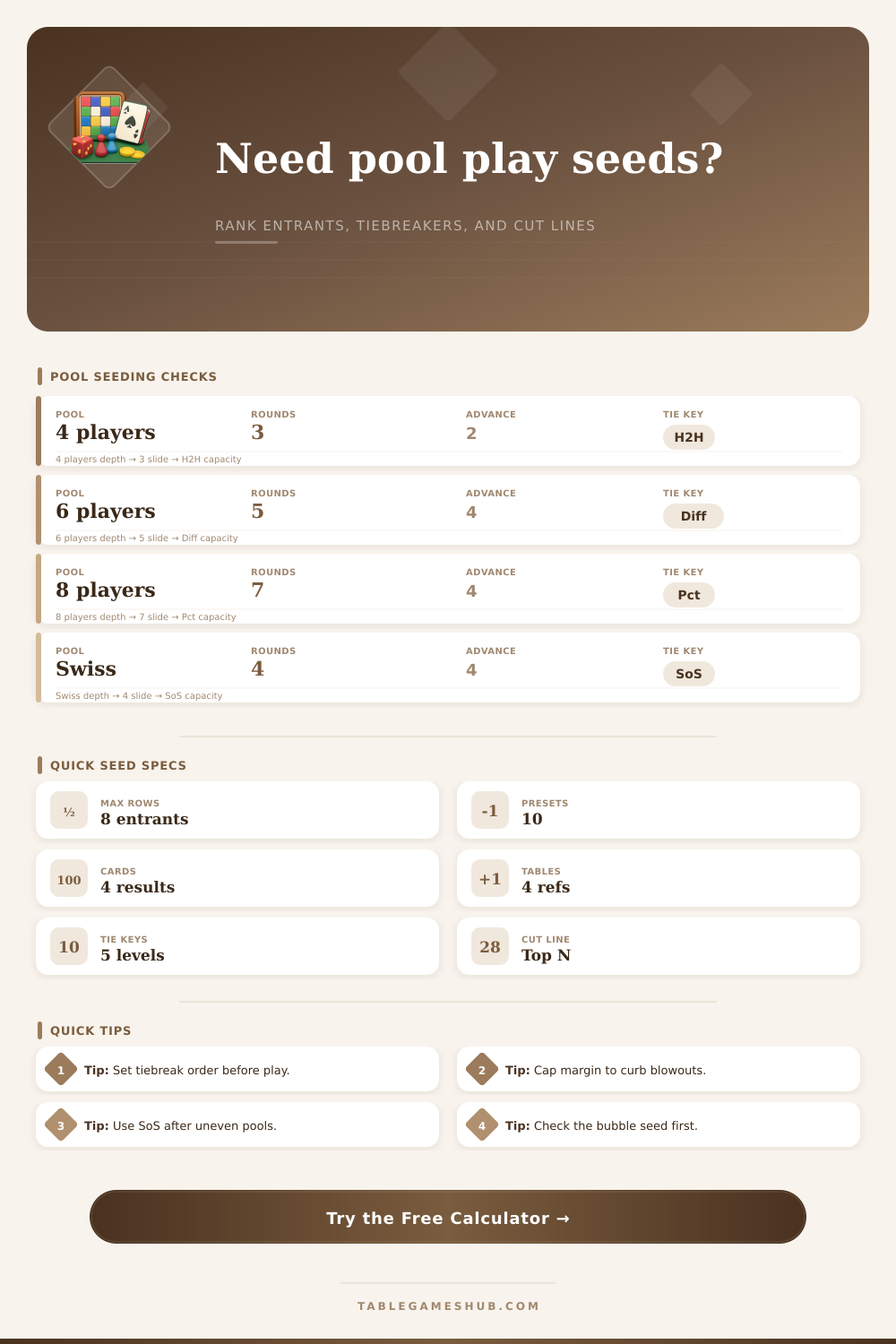
| Four-player round robin | 4 | 3 | Top 2 for final or semifinal |
| Six-player full pool | 6 | 5 | Top 2 or top 4 depending bracket |
| Eight-player pool | 8 | 7 or partial 4 | Top 4 when time allows semifinals |
| Swiss-style pool | 6 to 8 | 3 to 5 | Top N by match points then SoS |
| Step | Tiebreaker | Best use | Calculator input |
|---|---|---|---|
| 1 | Head-to-head | Two-player ties with direct match | H2H edge field |
| 2 | Capped point differential | Games with reliable scoring margins | PF, PA, margin cap |
| 3 | Point percentage | Uneven scoring totals or incomplete pools | PF divided by PF plus PA |
| 4 | Opponent strength | Swiss pools and uneven schedules | Opp% and SoS weight |
| 5 | Event penalty | Late drops, missed rounds, conduct penalties | Penalty field and weight |
| Pool size | Advance | Pressure point | Useful check |
|---|---|---|---|
| 4 entrants | 2 seeds | Second place bubble | Head-to-head usually decides ties |
| 6 entrants | 2 seeds | Top-heavy cut | Point spread matters after one loss |
| 6 entrants | 4 seeds | Fourth place bubble | Penalty and margin cap protect fairness |
| 8 entrants | 4 seeds | Middle table bubble | Opponent strength helps partial schedules |
| Game type | Scoring unit | Common record | Preferred tiebreak |
|---|---|---|---|
| Card tournament | Hand points or match wins | Best of round | H2H then point differential |
| Board-game pool | Victory points or table points | One game per round | Match points then point percentage |
| Dice league | Round score total | Multiple short games | Capped spread then percentage |
| Tabletop team pool | Team match points | Team wins and splits | Opponent strength after record |
✓Seeding Tips
Publish the tiebreak order before round one. Pool play feels cleaner when players know whether head-to-head, point differential, point percentage, or opponent strength comes first.
Cap margin for casual and family events. A per-match cap keeps standings from rewarding unnecessary blowouts while still recognizing clear wins.
When the last round finishes with three anglers tied, all hell break loose in the room. No one can understand a tiebreaker explanation and they want to know now who’s moving on. Tournament integrity hang in the balance in seeding pool play, and who gets to play who in the playoff rounds make a big difference.
Once you put your raw numbers into calculator, it will spew out the math for you. But knowing why you’re putting in what you are help keep you from making bonehead decisions down the road. Sure it’s about wins, but it’s also about deciding what is fair before the first card is drawn or die is rolled.
How to Pick Fair Tiebreakers for Your Tournament
Match points is simple to follow and intuitive; it’s what most organizers begin with. One point for a draw, three points for winning make sense and gives you a clear hierarchy in most pools. It becomes tricky when two of your entrants end up on equal footing with twelve points apiece at round five. This is where the tiebreaker stack come into play.
It feels naturaly to look at head-to-head records (player A beat player B), but direct matches between players can skew results if that match was an outlier or if player A dominated weak opponent to come out with as many wins. This is why the calculator allow you to weight each metric based off its importance to you.
Is it a game in which points scored shows how deep the skills go? Go with point differential. If teams play with different levels of aggression or conservatism, do you need to normalize the score? Then point percentage will serve better. Deciding the primary tiebreaker first makes all the other decisions flow. Do you want winner determined by consistency? Percentage wins then. Do you want the winner to be decided by who’s won and lost big? Spread is for you. The reference table on that page spells it out simply. It lets you select what suits your kind of games without guesswork.
The next wrinkle is that in a Swiss-style pool, the players aren’t facing each other evenly. That’s when opponent strength kick in. If two players both have three wins, but one faced three strong opponents while the other faced three weak ones, we should of probably rate the winner who played more games as stronger. In our tool, you can weight this as little or as much as makes sense for the balance of your early matchups. If you don’t weigh it at all in a Swiss format, people will accuse you of having an unfair bracket.
Seeding is unglamorous stuff, but nobody ever thinks about it till someone gets penalized for it. When a player quits a round early, or shows up late to one, it throw off the rhythm of the whole event. Penalizing such offenses show that the tournament is as much about showing up on time and being there when needed as it is about playing the game. It’s an administrative no-brainer that will keep players from feeling resentful of those waiting their turn at table.
For example: How far up the standings do you want to go? Are you going to make it four out of eight? That means the bubble seed will be in fourth place. You should know what score they need to secure that spot so that people can strategize through last few rounds. And then when there is transparency, you won’t have to deal with arguments if someone misses the cutoff by a hair. When there’s transparency, there won’t be any arguing after tournament.
For example, for more common scenarios (e.g., mixed skill levels, round robin groups), they includes some default presets. This gives you a starting point rather than having to create a seeding system from scratch each time. Additionally, tweaking the margin cap ensures that players is rewarded fairly even in casual events. It allows for wins where someone didn’t completely blow out their opponent, without skewing results too far toward blowouts.
In the end, seeding is nothing more than risk management for your tournament schedule. The better the players follow your rule set, the more likely you are to want them to move forward. Define the criteria ahead of time and stick with it, and the rest of the bracket falls in place. There’s no argument because we all agreed upon the math long before first roll was made. Now, there’s no need to defend the standings or even argue about them. Just enjoy playing the game. That simplicity makes an otherwise chaotic gathering a legit tournament where each seed feels like an accomplishment.