Everdell Point Salad Calculator
Total card points, events, journeys, city space efficiency, prosperity bonuses, and endgame modifiers for a clean final score.
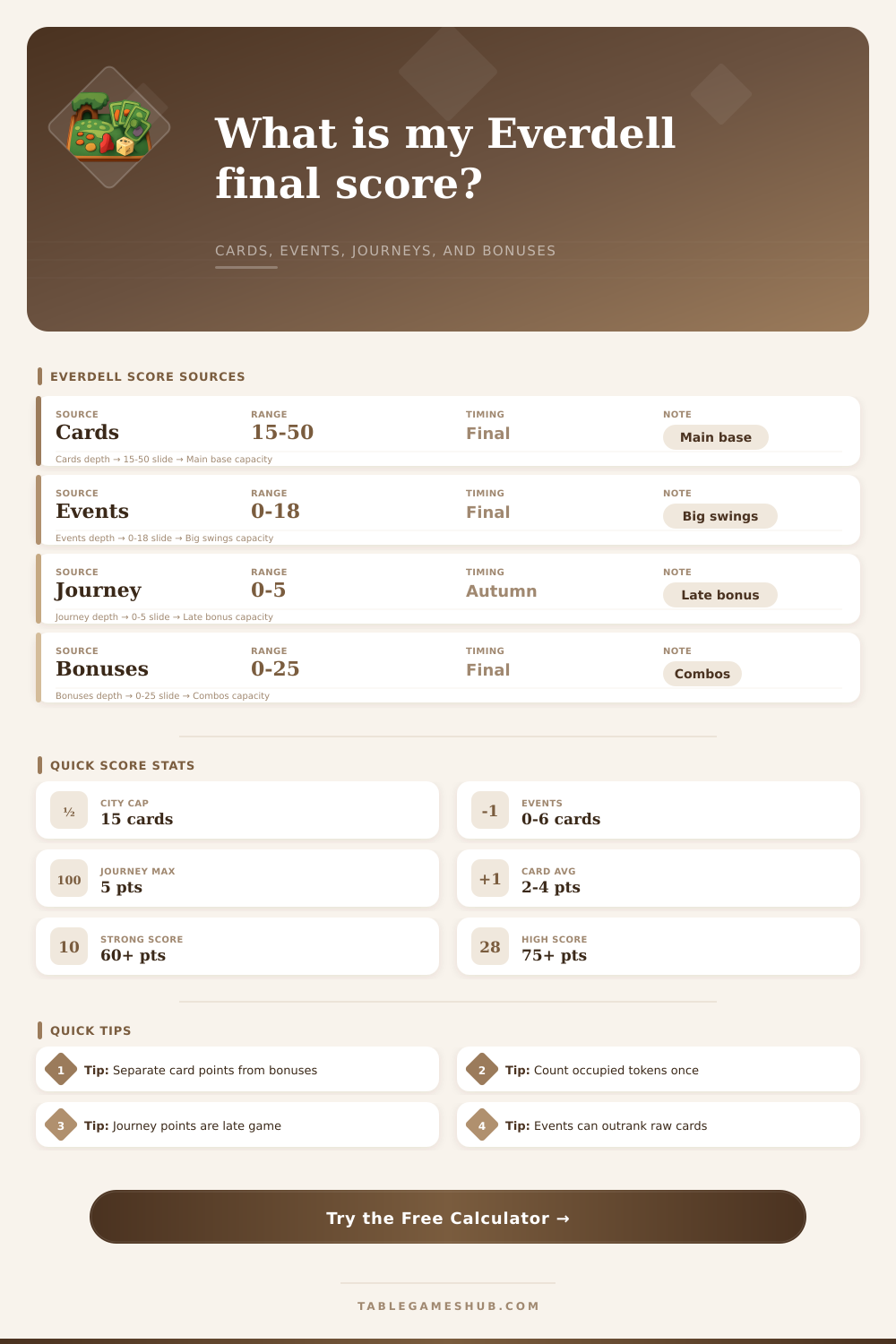
Enter your endgame score sources from the scoring pad, then use the breakdown to see whether your points came from raw cards, event pressure, city efficiency, or bonus engines.
| Score Source | How to Count It | Common Range | Calculator Field |
|---|---|---|---|
| Printed constructions | Add the printed point value on each construction. | 10 to 35 | Printed Construction Points |
| Printed critters | Add the printed point value on each critter. | 8 to 30 | Printed Critter Points |
| Basic events | Count three points for each basic event claimed. | 0 to 12 | Basic Events Claimed |
| Special events | Use the event card point value or table-agreed value. | 0 to 18 | Special Event Points |
| Prosperity effects | Total the conditional points from endgame bonus cards. | 0 to 25 | Total Prosperity Bonus Points |
| Journey | Use the point value of the journey space chosen. | 0 to 5 | Journey Points |
| Build Pattern | Primary Scoring | City Shape | Watch Point |
|---|---|---|---|
| High construction city | Large printed card values | Fewer critter chains | May miss events if icons are thin |
| Critter engine city | Free plays and linked effects | Many small point cards | Needs bonus cards to scale upward |
| Event collector city | Basic and special event points | Icon-focused card mix | Can score well before reaching 15 cards |
| Prosperity finish city | Conditional endgame bonuses | Precise card categories | Requires accurate final bonus counting |
| Journey sprint city | Late journey plus compact cards | Often 12 to 14 cards | Low city count can hide strong efficiency |
| Modifier | Use When | Score Effect | Example Note |
|---|---|---|---|
| Missed combo | A needed pair or bonus card never landed. | -6 | Castle without the expected support. |
| Cramped city | Early cards blocked better late scoring. | -3 | Several low-value cards stayed in city. |
| Neutral finish | All official score sources are already entered. | 0 | Best choice for strict final scoring. |
| Clean final prepare | The last season converted into a small score swing. | +3 | Extra token, resource, or final city slot. |
| Full combo finish | Multiple endgame cards completed together. | +6 | Bonus card plus event plus final point token. |
| Perfect close | A rare finish aligned city, event, and journey values. | +10 | Use only for table logs or variant modules. |
| Final Score | Typical Read | Likely Strength | Best Next Check |
|---|---|---|---|
| Under 40 | Incomplete or low-point city | Learning game | Compare card average and city count. |
| 40 to 54 | Functional city with light bonuses | Casual finish | Look for missed events or journey points. |
| 55 to 69 | Solid card base and several bonuses | Strong finish | Check event share and bonus share. |
| 70 to 84 | Excellent point salad conversion | Table-leading | Review which engine carried the score. |
| 85 plus | Rare high ceiling with stacked bonuses | Exceptional | Record the exact card combo for comparison. |
To calculate the scoring for the game Everdell, a variety of different type of points must be combined together. The process of scoring the game can become difficult for the individuals who is calculating the scores for various reasons related to the variety of different types of points. For example, players must track the printed construction values, the critter values, the conditional points from the King or an Palace, the journey points (which are separate from the other types of values), and a variety of other points.
Because there are so many different types of points for the game, it is easy for an individual to mix the different types of points together. If the individual mixes the points together, the total score will be incorrect. To avoid mixing the points together, it is better for the individuals to utilize the scoring tool for the game to ensure that all of the points are tracked separately.
How to Score an Everdell Game
The game utilizes specific input fields for the players to enter each of the different types of points for which the players score during the game. For instance, the printed construction and critter points will have their own field for entry into the game, the number of basic events will have its own field, the special event points will have its own field, the players will enter the prosperity and prosperity bonus values into its own field, and the journey points, occupied token values, and resource conversion points will have its own field for players to enter the number of points that they earned during that game. The game also includes a variety of output fields for the game that will display the calculated score of the game for each player.
For instance, one of the output fields will display a number that represents the city efficiency of the players, another output field will be the bonus share percentage, and the other field will display the target comparison for that game. Each of these fields will provide an individual with information regarding the score of their game, such as whether or not they had a high scoring game relative to other players, whether or not they should focus on certain aspects of the game relative to their score, and whether or not their score is above or below the target score for the game. Overall, the scoring tool can be used after the game is over to analyze the game that was played.
For instance, the individual can use the scoring tool to determine whether or not they focus on the proper aspects of the game to win the game, whether or not there were any issues with their game that would prevent them from winning in the same manner again, and to gain clarity in their minds regarding their game after it has been completed. Thus, utilizing the scoring tool removes the need for mental arithmetic in calculating the score of their game. Additionally, there are different fields that should be focused upon based off the type of game that is being played.
For instance, in a four player game, there are specific fields that should be observed relative to the two player game. Additionally, the solo game will focus upon a specific field relative to the other types of games, and each type of game will have its own important field related to the focused aspect of the game. In order to properly score the game, the different categories of points for the game should remain distinct within the minds of the players.
By mixing the categories of points, it can become difficult for the players to determine which of the strategies that they employed during the game were the most best relative to the other strategies that could of been used. Thus, by utilizing the scoring tool, the players can focus upon each of the different game elements and determine which were the best performing relative to the other elements of the game. Overall, then, using the scoring tool allows the players to gain clarity with their score at the end of the game, and having clarity enables the players to use their knowledge of the game to create a winning strategy for the game.