Scopa Score Calculator
Total a Scopa round with cards, denari, settebello, primiera, sweeps, optional Napoli scoring, previous match totals, and exact points needed to reach the target.
Choose a common table situation, then adjust the captured cards, primiera ranks, and match target for your house rules.
Enter each side's best primiera card value for every suit. Standard values: 7 is 21, 6 is 18, ace is 16, 5 is 15, 4 is 14, 3 is 13, 2 is 12, face cards are 10.
| Suit | Our best card | Our value | Opponent best card | Opponent value |
|---|---|---|---|---|
| Coins or Denari | ||||
| Cups or Coppe | ||||
| Swords or Spade | ||||
| Clubs or Bastoni |
| Scoring item | Point value | How it is awarded | Calculator field |
|---|---|---|---|
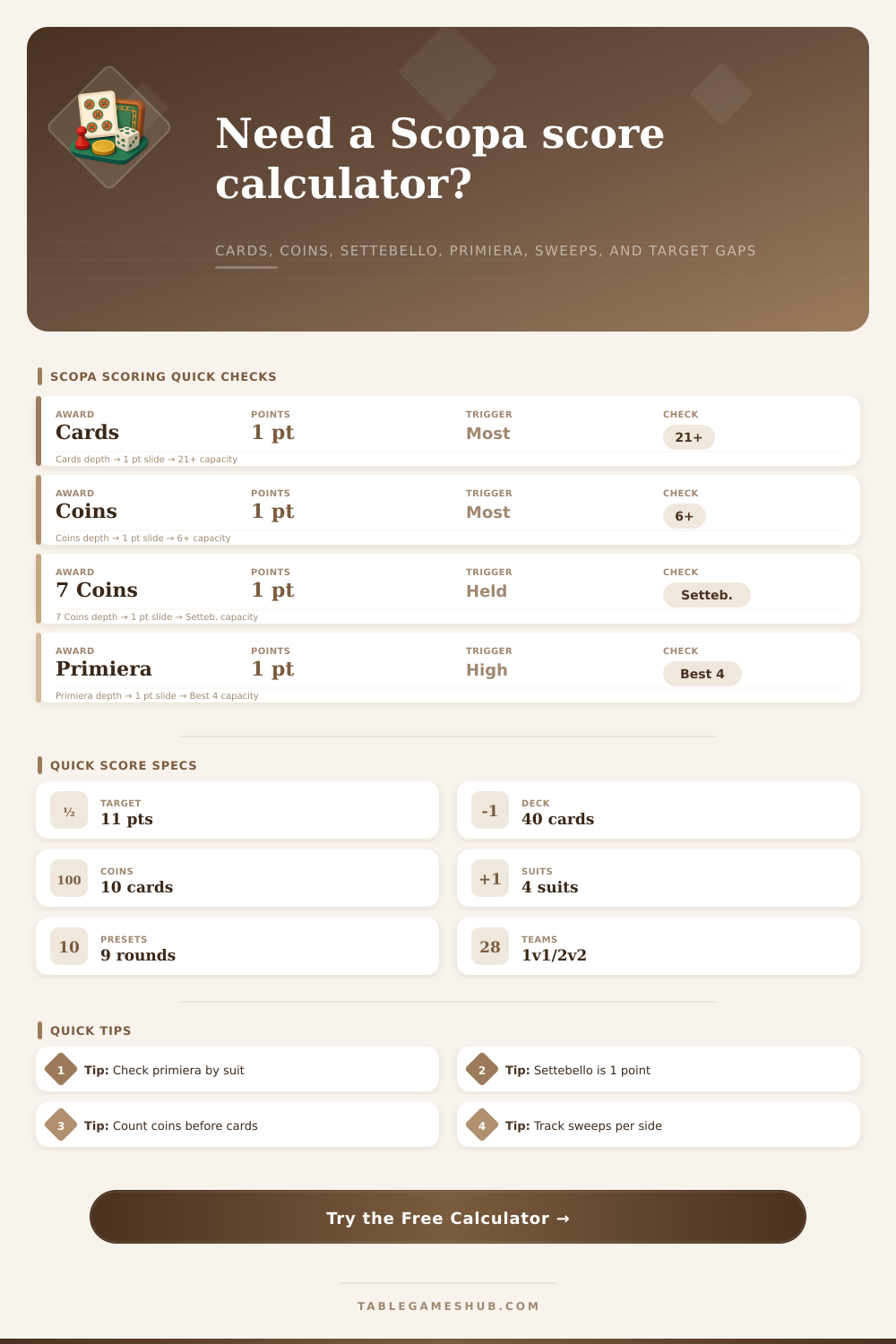
| Carte or cards | 1 point | Side with more captured cards; 20-20 is no point. | Our captured cards |
| Denari or coins | 1 point | Side with more coins; 5-5 is no point unless house rules differ. | Our captured denari or coins |
| Settebello | 1 point | Side that captured the 7 of coins receives the point. | Settebello held by |
| Primiera | 1 point | Compare the best card value in each suit, then total all four suits. | Primiera card values by suit |
| Scopa sweeps | Variable | Each clean sweep scores by the chosen house rule. | Our and opponent scopa sweeps |
| Primiera card | Value | Use in calculator | Notes |
|---|---|---|---|
| 7 | 21 | Strongest primiera card | Usually wins its suit for primiera counting. |
| 6 | 18 | Second best card | Often enough when the 7 is absent from that side. |
| Ace | 16 | Third best card | Ranks above 5 only for primiera value. |
| 5, 4, 3, 2 | 15, 14, 13, 12 | Middle values | Enter the exact best card held in that suit. |
| Face cards | 10 | Lowest counted cards | Use when no pip card from that suit was captured. |
| Match format | Typical target | Seat setup | Scoring emphasis |
|---|---|---|---|
| Classic kitchen-table Scopa | 11 points | 2 players | Fast totals, frequent one-point margins, sweeps matter. |
| Scopone scientifico | 11 or 21 points | 4 players in fixed partners | Team totals, careful primiera, fewer surprise hands. |
| Long club match | 16 or 21 points | 2 or 4 players | Target gap matters more than one isolated round. |
| Napoli house variant | 11, 16, or 21 points | 2 or 4 players | Coin runs can create large scoring swings. |
| Round pattern | Likely awards | What to verify | Common mistake |
|---|---|---|---|
| 21 cards and 6 coins | Cards and coins | Whether the 7 of coins is also captured. | Double-counting denari as settebello automatically. |
| Low cards but four strong suits | Primiera | The best card value in all four suits. | Adding all captured card face values instead. |
| Several table clears | Scopa sweeps | Whether the final pickup qualifies locally. | Recording sweeps after the deal is finished. |
| Ace through 7 of coins | Napoli bonus if used | That the run is consecutive from ace of coins. | Using Napoli in a table that does not play it. |
Primiera check: score only each side's best card in each suit, then compare the four-suit totals. The calculator keeps the primiera point separate from card majority.
House rule check: decide before play whether Napoli and final-pickup sweeps count. Those two choices are the usual source of score-sheet disagreements.
Scopa is all about margin, about a single coin that makes all the difference between winning and losing, and a forgotten coin means nothing unless you remember it when counting up the money. And now the deck is empty and everyone’s at the table, but no one wants to be the one to add it up. Arguments break out. Someone claims last pickup was a scopa. Someone else insists that the count for the primiera wasnt right. It’s not about the points. It’s about how we keep playing. Who wins? It’s about making sure everyone agrees on who actualy won. Everybody has to get on board with whoever did.
After plugging in your captured coin/total card number(s) into the calculator (above), it does the math for you. So no more fumbling around with mental math while your emotions is running high. The interface requests information that matches the moment of truth at the table. It asks how many cards are on each side, if you captured the seven of coins, and what the exact values of your best cards in each suit were for primiera.
How to Calculate Scopa Scores Without Arguing
This structure encourage separating out quality wins from majority wins, something that trips up many new player. That’s important since each of these inputs measure a different skill. If you hold over 21 cards, it means you did a good job on the board; you took volume. If you captured at least six coins, it means you dominated most valuable suit.
But what is primiera? That’s pure chance, a combination of timing and luck. Instead of focusing on just one suit (which would be a mistake), primiera rewards holding any high-pip value card (sixes and sevens) from all four suits. The calculator takes into account your best coin card, compared to your opponent’s best, then repeats the process with cups, then swords, then clubs. It total up these comparisons to give you one point.
And that’s what throws people off: they believe that if they have the seven of clubs, they’ve got the primiera point. But if the opponent has the seven of all three other suit, too, they lose no matter how good one of their cards might be.
Then there are the sweeps. You are awarded a scopa point each time you empty the table. Sweeps can be very volatile since they occur randomly throughout the game instead of at the close. In some house rules double points is given for sweeps; in others, they’re disregarded altogether. You’ll find that the app allows you to change the setting here to reflect your local customs.
For argument’s sake if you fail to record the sweeps as they occur, then the whole round is invalid. By far the most common causes for disagreements center on whether final card drawn swept the table or merely scooped up leftover cards and did not meet the sweep criterion. That’s enough variation already.
But to make things even more interesting, there is the Napoli variant which rewards back-to-back runs in the coin suit beginning with the ace. In one hand, depending on who catches the two through seven of coins in sequence, you could end up way out front or way behind. The calculator includes a field for this specific run length (recognizing that not all tables use such bonuses). If the Napoli variant is selected, it will automatically weight the optional bonus correctly. This prevents scores from being accidentally inflated when comparing the classic game to the more aggressive Napoli version.
Just as essential to the strategy is setting a match target. The importance of each round shifts significantly between a fast-paced game to eleven points and a longer game to twenty-one. It also tells you precisely how far off your total is from the finish line. With that knowledge, teams can make an educated choice about when to go for risky combinations and when to stick with simple stuff. Having two points feels very different then having five, even with the exact same cards in hand.
Scopa is a competitive card game, but it’s also a communal experience, a social ritual. It’s about who can make others laugh and who will groan when someone misses what should of been an easy sweep. And that’s where the fun lies: it’s all about making sure there are no ambiguities in the scoring. Seeing the same digits on the scorecard means we’re all looking at the same thing. We can forget the past hand and move on to the next deal.
If you’ve got a serious game going on, you don’t want to pause for ten minutes while people argue over whether or not they were cheated out of some imaginary points. A proper tool can take care of the math for us so we can remain in the moment, absorbing the rhythm of the game itself and appreciating the sense of friendship that only good competition provides. Because memories aren’t always accurate, having an outside reference makes for a clearer conclusion to the evening. No more wondering if you missed a sweep or miscounted a score; just go home happy.