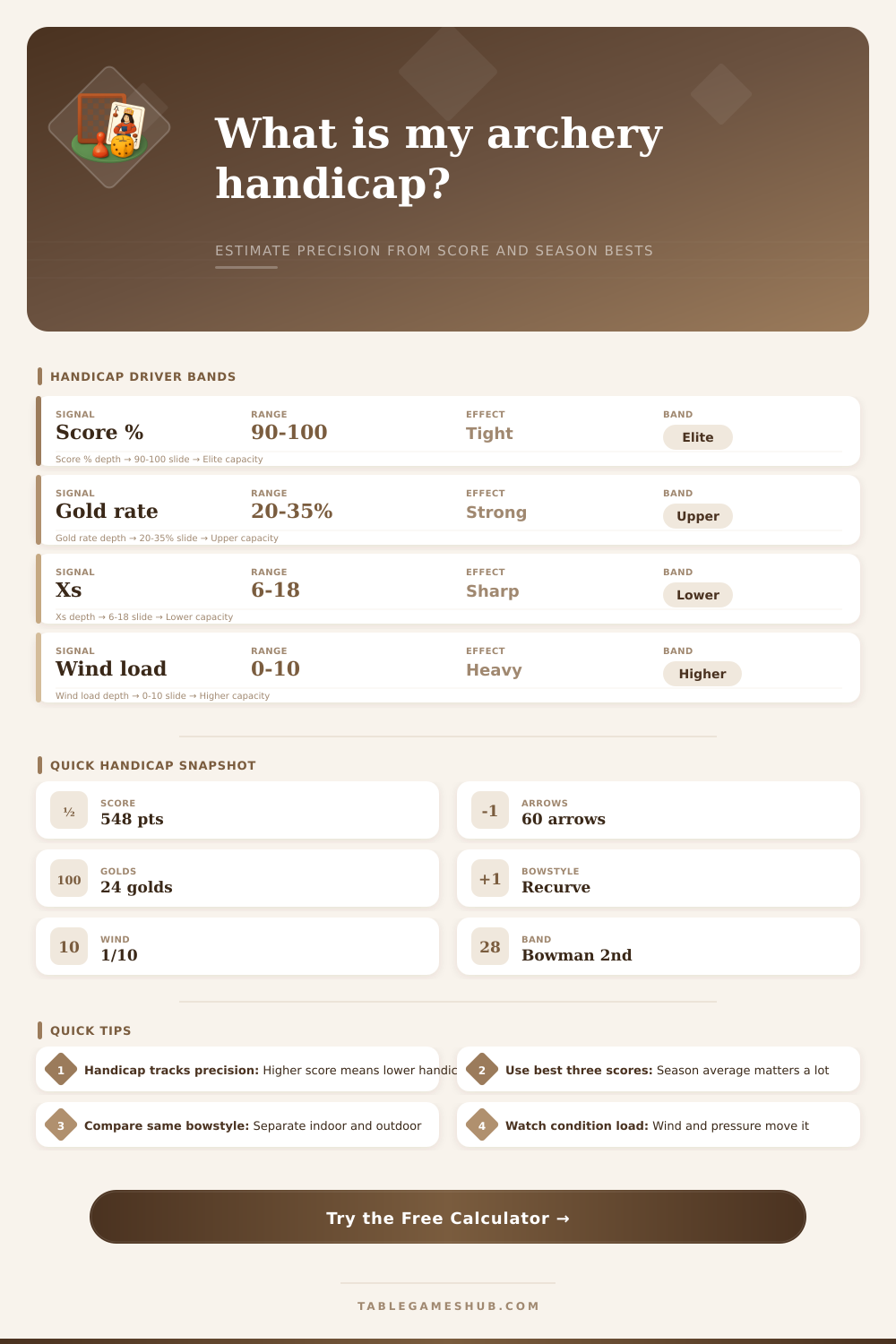
Archery Handicap Calculator for Precision Index
Estimate handicap from score quality, round difficulty, and your best three seasonal scores.
🏹Preset Rounds
💯Handicap Inputs
Your Handicap Estimate
📊Precision Drivers
📈Reference Tables
| Band | Range | Meaning | Next Goal |
|---|---|---|---|
| Elite Master Bowman | 0-9 | Very tight | Hold form |
| Grand Master Bowman | 10-19 | Elite edge | Stay clean |
| Master Bowman | 20-29 | Strong club | Trim misses |
| Bowman 1st Class | 30-39 | Advanced | Lift golds |
| Bowstyle | Factor | Style | Feel |
|---|---|---|---|
| Compound | 0.90 | Fast | Stable |
| Recurve | 1.00 | Neutral | Balanced |
| Barebow | 1.06 | Open | Workload |
| Longbow | 1.12 | Classic | Wide |
| Round | Ref | Face | Load |
|---|---|---|---|
| Indoor | 18m | 60cm | 0.92 |
| Outdoor | 70m | 122cm | 1.00 |
| Field | 42m | 40cm | 1.10 |
| 3D | 28m | 42cm | 1.14 |
| Load | Wind | Pressure | Use |
|---|---|---|---|
| 1.00 | Calm | Low | Practice |
| 1.08 | Light | Medal | Club |
| 1.16 | Gusty | Ranking | Event |
| 1.24 | Hard | Finals | Peak |
💡Tip Boxes
An archery handicap measure the precision of an archer. It doesnt measure the total number of points that an archer can score, as the total number of points that can be scored can vary with the distance of the target or the size of a target face. Instead, an archery handicap measures the consistency and precision of an archer’s shot.
An archery handicap allow an archer to compare their precision with other archer. Precision is important in archery because the archer who can group their arrows more close together scores more points. By calculating an archery handicap, an archer can determine their precision.
What Is an Archery Handicap and How to Measure It
The lower the number for an archery handicap, the higher the skill level of the archer. While official tables can calculate archery handisms, these official tables may not account for every variable. For instance, official tables may not account for the wind or the mental pressure that the archer feel during competitions.
A better system would account for these variables using the percentage of score and the number of golds or X-counts that an archer score. To calculate an archery handicap, one could use the archer’s score percentage. The score percentage is the archer’s total points divided by the possible total points for the round.
A high score percentage earned on a difficult round is more significant than one earned on an easy round. An archer can use the number of golds and X-counts that an archer score to improve the accuracy of the archery handicap calculation. If an archer can land their arrows in the tens consistently, they have precision, which is one of the components of an archery handicap.
The type of bow that the archer use can also impact their archery handicap. For example, compound bows are more stable than recurve bows or longbows. Therefore, archers who use compound bows have different adjustment to their scores compared to archers who use only recurve bows and longbows.
Environmental factor such as the weather can impact the outcome of an archery competition. If there is wind, arrows may go off target. Mental pressure may also impact an archer’s performance during competition.
A good archery handicap should account for these environmental variables. By adding a conservative buffer for environmental variables to the archery handicap calculations, an archer can realistically project their future performance in archery. Archers can use the concept of season average to account for the possibility of a single round not representing an archers true skill level.
Instead of one round, one can use the best three rounds to calculate an average skill level. This average can inform the calculation of an archery handicap. These averages allow an archer to see if their precision is increasing over time.
These averages can be used to determine where an archer’s skill level fall within a specific scoring band. For example, if an archer’s average score fall within a specific scoring band with a low number, that archer may be demonstrating skills comparable to a professional archer. In contrast, a higher number within a scoring band may represent a club level archer.
There are some mistakes that archers can make when calculating their archery handicap. One mistake is to focus exclusively on the total number of points that an archer score. If an archer only focuses on total points, they may not recognize that their score may appear high because they score many nine but no gold targets.
Another mistake is to mix bow style. For example, if an archer mixes the scores from recurve and compound bows, they may not accurately represent their true skill in either type of bow. It is better to calculate the skill level for each bow type separately.
Finally, archers should not calculate archery handicaps that use indoor range and scores with outdoor range scores and vice versa without accounting for the weather condition at each range. Indoor ranges do not feature the same weather variables as outdoor ranges. An archer can improve their archery handicap by focusing on slightly increasing the score percentage that they earn in each round of archery.
Archers can also improve their archery handicap by hitting more gold and X-counts in their targets. Improving the precision of an archer’s shots can take the same amount of time as improving any other component of an archer’s skill. For instance, archers can improve their precision by practicing specific drill that focus on the bow stance or on the aim of the arrow into the target.
An archery handicap can change according to an archer’s equipment or technique. For example, an archer may need to adjust their handicap according to the distance of the target. Such distance may be 50 meters or 90 meters, for instance.
The size of the target may also impact an archer’s handicap. An archery handicap is a living metric because it evolve according to an archer’s developing skill. While an archery handicap may not be a reflection of an archers character, it is a reflection of their precision with the bow.