Sankore Scholar Calculator
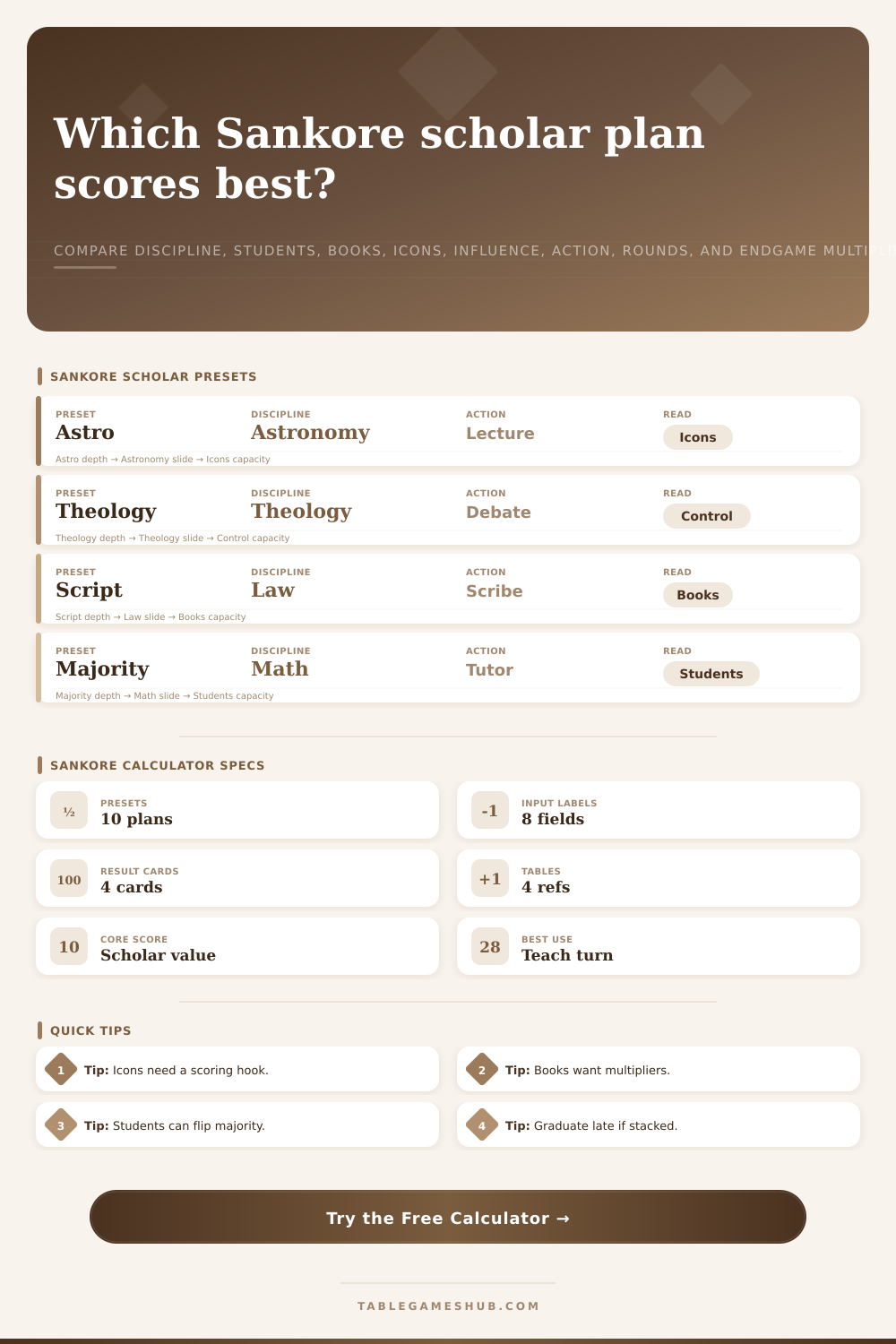
Compare a Sankore teaching turn by discipline, student count, books, manuscripts, lesson icons, influence, endgame multiplier, action type, and rounds remaining.
1Sankore Scholar Presets
2Scholar Inputs
Scholar Breakdown
3Calculator Specs
4Sankore Reference Tables
| Preset | Discipline | Best when | Risk |
|---|---|---|---|
| Astronomy Class | Astronomy | Lesson icons still have time to compound. | Low if students are ready. |
| Theology Chain | Theology | Influence converts into chained scoring. | Medium if majority is contested. |
| Manuscript Push | Law | Books or manuscripts cross a scoring threshold. | Medium if rounds are low. |
| Student Majority | Mathematics | One teaching action changes majority pressure. | High if opponents can answer. |
| Graduation Scoring | Mixed | Students, books, and multiplier are already aligned. | Low late, weaker early. |
| Discipline | Primary value | Secondary value | Calculator weight |
|---|---|---|---|
| Astronomy | Lesson icons | Rounds remaining | Icon value is boosted by tempo. |
| Theology | Influence | Students | Influence value rises with class size. |
| Law | Books and manuscripts | Endgame multiplier | Manuscripts receive stronger final scaling. |
| Mathematics | Student majority | Teaching action | Students receive a majority swing bonus. |
| Grammar | Balanced conversion | Icons and books | Values are steadier and less spiky. |
| Action | Immediate bonus | Best timing | Watch out for |
|---|---|---|---|
| Lecture | Icon and tempo value. | Early or middle rounds. | Icons without students can stall. |
| Debate | Influence and control value. | When majorities are open. | Overpaying for influence after locks. |
| Scribe | Books and manuscript value. | Before final scoring thresholds. | Low tempo if no multiplier exists. |
| Tutor | Students and majority value. | Before opponents can answer. | Class size without scoring hooks. |
| Graduate | Direct endgame conversion. | Last two rounds. | Graduating before books are ready. |
| Multiplier | Use when | Expected read | Decision nudge |
|---|---|---|---|
| 0.90 Low | Few final hooks are visible. | Tempo plan only. | Prefer flexible teaching. |
| 1.10 Standard | One scoring hook exists. | Solid if base value is high. | Take if it also denies tempo. |
| 1.30 Strong | Two hooks overlap. | Usually worth the action. | Push before opponents block it. |
| 1.55 Excellent | Majority and books align. | High scoring plan. | Commit resources now. |
| 1.80 Finale | Graduation converts a stacked board. | Premium endgame turn. | Protect the scoring window. |
5Scholar Tips
Tip: If a lesson icon does not improve students, books, or influence this round, discount it as setup unless you still have several rounds remaining.
Tip: Graduation scoring is strongest when you can name the exact multiplier before the action; otherwise a tutor or scribe turn may build a better ceiling.
These are influence markers. Books. There are tokens on a board before you. Should you go for a quick win or reserve some power for later when you’ll graduate and be unstoppable? That’s the Sankore conundrum. Do I bank these points now? They’re safe! Or do I play for tempo, gambling it will help me more later when everything falls into place?
The calculator does that heavy lifting for you. Enter your board state, and then let it do its thing. It spares you from keeping track of eight variables at the same time because this isn’t about plugging numbers into a spreadsheet: It’s balancing the present with what could (or won’t) come next in a time-sensitive game.
How the Sankore Calculator Helps You Decide
It requests some info such as icons used in lessons, number of students per class, and what discipline it’s measuring. Use inputs. Pick astronomy, for example. You’ve selected a style that emphasizes tempo with icons more than straight point conversion. Then it factors in how many rounds you have available to compound those icons into students or influence. Four rounds left? That increases the value of your first move since now the setup have time to work.
This is something most players fail to account for. An icon up means a point, right? Wrong. An icon sitting by itself are useless on your track. You should of plan to follow up.
Manuscript vs Law: Both manuscript and law scoring work differently because they are both less dependent on time and more dependent on thresholds. From the reference table, you see how books increase in value based off approaching the final scoring bands. Rushing through a manuscript turn isn’t necessary until crossing a critical point threshold that your opponent hasn’t crossed yet.
Stress test your plan via the multiplier input. Low setting indicates few synergies on the board. The Finale setting assumes you have majority control, books, and graduation all at the same time. This allows you to assess your confidence in the setup before taking action.
Another complication is that influence does more than just add points; it also shifts the pressure. Running a Theology chain through the preset will display increase in influence gain based on number of classes. It’s why debates are powerful with your students in place. Influence alone is too late in game and often won’t matter unless you’ve got student to back it up. Get those bodies on the board first and then get your voice heard.
The teaching action drop down helps you say whether you’re converting straight to VP, securing some resources, or even buying yourself some more time. Waste a lecture and there’s no gain for it. Waste a graduation move and your books aren’t ready yet to count. It breaks that out to endgame lift, tempo leverage and scholar value on the output cards. That gives you a quick read on whether you should push or hold. Usually if the plan says hold, it means you’re missing another hook to make the move efficient. Perhaps you need a better multiplier band or maybe another learner before committing.
The tool doesn’t play the game for you. But it removes any confusion in how you make decisions. It forces you to articulate precisely what you are scoring and why it matters this round. More than anything else Sankore is about making smart decisions about points in terms of how they help or hurt you on other tracks. While a single high value turn might win you the game, if it leaves you open on two or three tracks, then it’s a bad move.
The calculator allows you to see that before putting your hand down on the token. It forces you to realize that every decision you make comes at the expense of another opportunity. Knowing this helps you sometimes realize the best move may be no move. The math isn’t there yet, there are still things like reading your opponent and feeling the pulse of the game. But having a solid number to fall back on for what your own score would be makes it easier to go after someone on the other side of the table. Your judgement is what bridges the gap between a sound plan and a winning one, but the numbers informs the plan.