Runebound Score Calculator
Compare a hero snapshot using trophies, adventure deck mix, attribute tests, combat tokens, market tempo, gear slots, and Act progress.
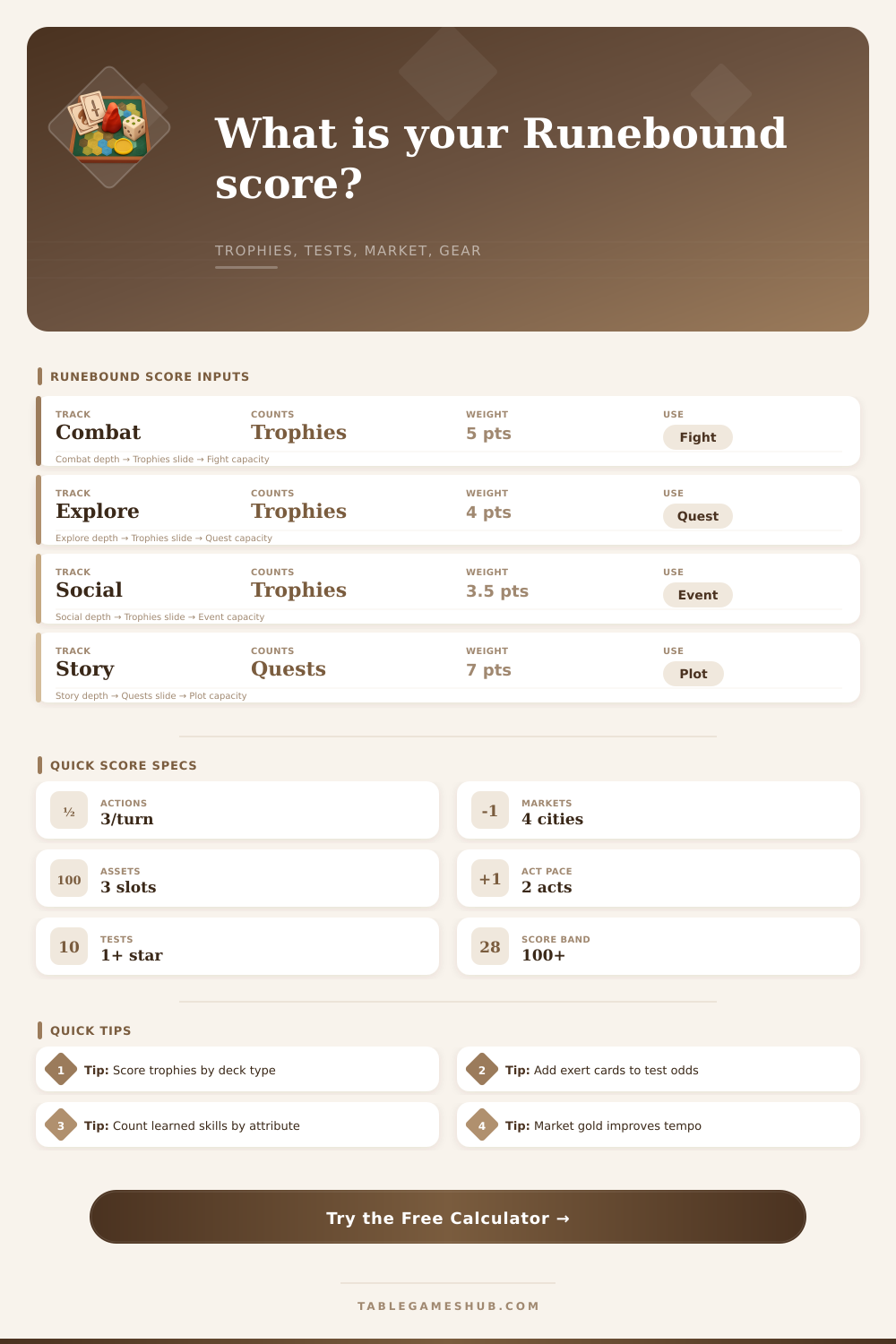
| Adventure Track | Typical Source | Score Weight | Calculator Role |
|---|---|---|---|
| Combat | Orange enemy adventures and combat rewards | 5 points each | Raises score and combat readiness together |
| Exploration | Green quest adventures and map outcomes | 4 points each | Raises story route and movement confidence |
| Social | Purple event choices, deals, and negotiations | 3.5 points each | Supports market tempo and skill access |
| Story | Scenario quests, villain steps, or milestone cards | 7 points each | Best signal for closing the scenario |
| Reveal Cards | With 25% Stars | With 33% Stars | With 40% Stars |
|---|---|---|---|
| 2 cards | 43.8% | 55.1% | 64.0% |
| 3 cards | 57.8% | 69.9% | 78.4% |
| 4 cards | 68.4% | 79.8% | 87.0% |
| 5 cards | 76.3% | 86.5% | 92.2% |
| Hero State | Gear Signal | Market Signal | Score Impact |
|---|---|---|---|
| Early Act I | 0 to 1 asset, base tokens | Few gold, city not guaranteed | Low gear score, trophy score leads |
| Midgame Builder | Weapon plus protection or movement | Enough gold to shop once | Balanced score across all cards |
| Combat Specialist | Improved weapon and extra combat tokens | Market used to fill missing defense | High readiness even before red cards |
| Finale Candidate | Strong weapon, protection, and support asset | City access for last upgrade or heal | High score plus low fatigue penalty |
| Band | Snapshot Meaning | Common Inputs | Comparison Note |
|---|---|---|---|
| 0 to 45 | Opening build | Few trophies, basic gear | Use for early table pacing |
| 46 to 85 | Stable midgame | Mixed trophies, learned skills | Strong if test odds are above 70% |
| 86 to 125 | Red-ready hero | Weapon, armor, high attributes | Usually competitive in Act II |
| 126+ | Scenario closer | Story progress plus combat safety | Compare fatigue before rushing finale |
The Runebound score calculator allow you to track your progress in several different ways at once. You may feel great about your number of green quests completed, but you may have a low number of combat tokens and a rising number of red adventures completed. The Runebound score calculator help you to see your overall progress in the game because it allow you to view all of your progress.
Each of the categories into which you enter your stats for the calculator represent a decision that you have made within the game. Combat trophies represents the number of orange enemy cards you have defeated. Exploration trophies represent the number of green quest rewards that you have collected.
Use the Runebound Score Calculator to Check Your Readiness
Social trophies represent the number of purple event that you have participated in, as well as the number of gold or favors that you have recieved as a result. Story trophies are incorporated into the score as they indicate if the scenario is nearing it’s end. Red adventures are tracked in a separate category because they indicate that you have crossed into the final Act of the scenario.
The attributes and learned skills within the game are incorporated into the score because they determine your capabilities during tests. For example, you may have more body skills than mind skills, or you may have learned more skill cards during the game as a result of earned trophies. The cards in your hand are also incorporated into the score to indicate whether you will succeed or fail in any tests that you encounter during your turns.
Finally, the number of test odds that you have are incorporated into the score; these are your attribute scores, any modifiers, and the number of reveals that you have purchase with exertion. Combat readiness is incorporated into the score as a separate value because it takes into account the number of fights that you have won, the tier of your weapon and armor, and the number of combat tokens that you have available for use during your next encounter. It is important to calculate this number as it will help you to prepare for your next encounter without running out of health.
Market access and the amount of gold that you have on hand are also incorporated into the score. A hero that can visit the markets to upgrade an asset will have a better score than a hero with weak gear. Health and fatigue percentages are incorporated into the score to provide an accurate indication of your readiness.
Health impact every other number in the game, as well as the number of heroes that are currently at the table; both a four-hero game will move at a faster rate than a game of three heroes. This score calculator allows you to compare two different states of your hero before you commit to a potential action. For instance, you can enter your heros status into the calculator, and then change one variable to determine how that may impact your readiness.
The calculator will show you how the score and readiness change as a result of that change. Thus, you can use the score calculator to determine if a risk is worth taking, or if visiting the market will be more valuable than another action. The tables on the page refer to the different weights of each trophy, as well as the chance of success on tests.
Each of these tables can help you to understand why some choices produce more of an impact on the score than others. For example, combat trophies have the highest individual value, but story trophies may have a higher impact on the score during the final Act of the scenario. Additionally, including one exertion card to increase the odds of a successful test is more valuable than any flat bonus to a score.
Some of the most common mistake with the score calculator is to treat each trophy as if it has the same value, or to ignore the fatigue level if you have a high score. For example, a hero with eight combat trophies but two fatigue levels and low health is still much less ready for the next stage of the scenario than a hero with the same number of combat trophies but more health and fewer fatigue levels. The score calculator will make these comparisons visible for you in both the raw score and the readiness percentage.
While the score bands provide you with a quick reference point for your readiness to take on the next adventure, you are not required to move into any of these bands; rather, you are provided a goal of what your readiness means for the scenario. For example, being in the red-ready band means that you have enough gear and strength for the next number of red adventures without needing to rest. The scenario-closer band indicates that you are on an even keel in the scenario.
However, you must still pay close attention to the round count and your health percentage before you attempt to move into the ending band. The value of the Runebound score calculator is that the score calculator provides you with one clear comparison within the game. Thus, you can spend less time guessing at your standings in the scenario, and you can devote your focus to determining what your next useful move should of been.