♟ Chess Win Probability Calculator
Calculate win, draw, and loss probability based on Elo ratings, color, game type, and match conditions
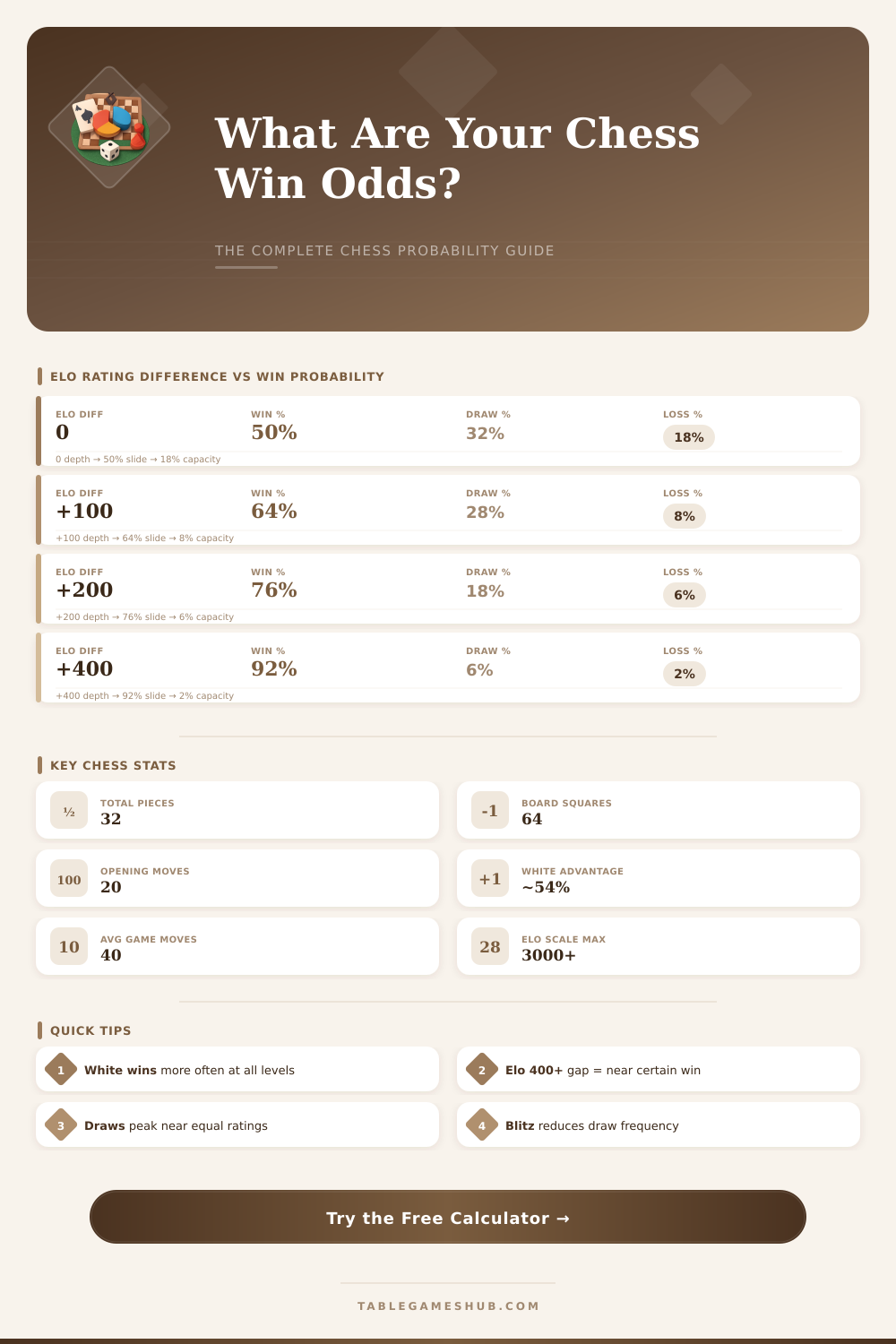
| Elo Difference | Expected Win % | Approx Draw % | Expected Loss % | Elo Points Gained (Win) |
|---|---|---|---|---|
| 0 (Equal) | 50.0% | 32% | 18.0% | +16 |
| +50 | 57.1% | 30% | 12.9% | +12 |
| +100 | 64.0% | 28% | 8.0% | +8 |
| +150 | 70.0% | 24% | 6.0% | +6 |
| +200 | 75.7% | 18% | 6.3% | +4 |
| +300 | 84.9% | 11% | 4.1% | +2 |
| +400 | 90.9% | 7% | 2.1% | +1 |
| +500 | 94.7% | 4% | 1.3% | +1 |
| +600 | 96.8% | 2% | 1.2% | +1 |
| Game Type | Time Control | Avg Moves | Draw Rate (GM) | Color Advantage |
|---|---|---|---|---|
| Classical | 90 min + 30s/move | 40–50 | ~55% | White +4% |
| Rapid | 15–60 min | 35–45 | ~40% | White +5% |
| Blitz | 3–10 min | 30–40 | ~25% | White +6% |
| Bullet | 1–2 min | 25–35 | ~15% | White +8% |
| Correspondence | Days/move | 45–60 | ~60% | White +3% |
| Rating Class | Elo Range | Win % vs 1500 | Avg Game Duration |
|---|---|---|---|
| Beginner | 100–800 | 1–5% | 20–30 min |
| Novice | 800–1200 | 5–25% | 25–40 min |
| Intermediate | 1200–1500 | 25–50% | 35–50 min |
| Club Player | 1500–1800 | 50–76% | 45–70 min |
| Advanced | 1800–2000 | 76–90% | 50–80 min |
| Expert / Candidate Master | 2000–2200 | 90–96% | 60–90 min |
| FIDE Master | 2200–2300 | 96–98% | 60–120 min |
| International Master | 2300–2499 | 98–99% | 90–150 min |
| Grandmaster | 2500+ | 99%+ | 90–180 min |
The probability to win in Chess is simply the skill to foresee whether you will beat, draw or lose before one move becomes made. Here comes the Calculator of Chess Winning Probability: it receives your ELO-rating and that of your opponent, then gives the probabilities. The math that stands behind it does not have magic, but only formula based on decades of data about players.
The ELO-ratings are a kind of system in Chess for tracking score according to skill. A full beginner usually has around 800, while folk that plays average can have close to 1500. And the elite of the world?
How Chess Winning Chances Work
They reach 2600 and more. A Chess master and physicist professor created the system, and here is the nice part: the difference between two ratings of players says to you almost everything what you need to know about how the game will end. Two players with same rating, fully equal, should have wins in almost equal chances.
When you start to play with those numbers, it becomes really funny. If the rating difference is nothing, that is like a tossed coin. 50-50 at the table.
If the higher rating beats by hundred points, the favorite has around 60%, while the other falls to 40%. In 200 points apart, you fdin 70-30 territory. At 300 points, everything moves more strongly to 80-20.
When you reach 400-point difference, the stronger player beats almost 90% of time. Quite a lot silly, but only a hundred-point advantage only raises your wins to close to 57%; not as strong as it seems. So losing against some that has 300 points less than you is not the end of world; there still are around one in five chance that they will take it.
When the difference becomes really big, those numbers seem almost unreal. A player with 800 rating against 1500? There is almost 0.4% of winning chances.
A 1700 player against a 2500 grandmaster would be something close to a miracle. Such 800-point gaps are rare, except in open tournaments, where the pairings become fully random.
Expected points affect both the winning percentage and half of the draw percentage. So, if you enter ratings for too exclusive players and receive 61%, that shows winning probability for the stronger plus half of the draws matching 0.61. Here it becomes weird: the winning probability depends on the level of skill.
Two players with 2600 rating are much more likely to draw than two with 800, even if the expected points match perfectly.
White has a clear advantage in the starting position. Looking at actual data from games, White wins happen around 37.5% of time, draws 34.9% and Black wins 27.6%. That is a real edge built in the game itself.
If you consider draws as half a point, the winning rate of White reaches between 52% and 55%, according to the used database.
Leela Chess Zero is one engine that really can guess winning probability during the game. It works because it relies on a neural net trained to read positions. Adding more factors, rating of opponent, number of moves, material swing, could improve thosepredictions, although you need much more data to do it reliable.