Round Robin Schedule Calculator
Build a table-game round robin with circle-method pairings, odd-team byes, repeat cycles, table waves, time blocks, and a printable preview schedule.
◎Round Robin Presets
Load a common tournament layout, then adjust team count, tables, match length, breaks, and repeat format.
⚙Schedule Inputs
∑Formula Cards
n(n - 1) / 2
Every player or team meets every other entry once. Repeat cycles multiply the match count.
n' - 1
Odd fields add a bye slot, so the effective field n' is the next even number.
ceil(m / tables)
Each round has m simultaneous pairings. Limited tables split those pairings into waves.
rounds x waves x slot
Slot time equals match length plus changeover, with long breaks added after selected rounds.
▣Schedule Spec Grid
☷Generated Schedule Preview
| Round | Wave | Table | Pairing | Bye | Start Estimate |
|---|---|---|---|---|---|
| 1 | 1 | 1 | Team 1 vs Team 8 | None | 6:30 PM |
▦Reference Tables
| Field Size | Single Rounds | Single Matches | Byes | Typical Use |
|---|---|---|---|---|
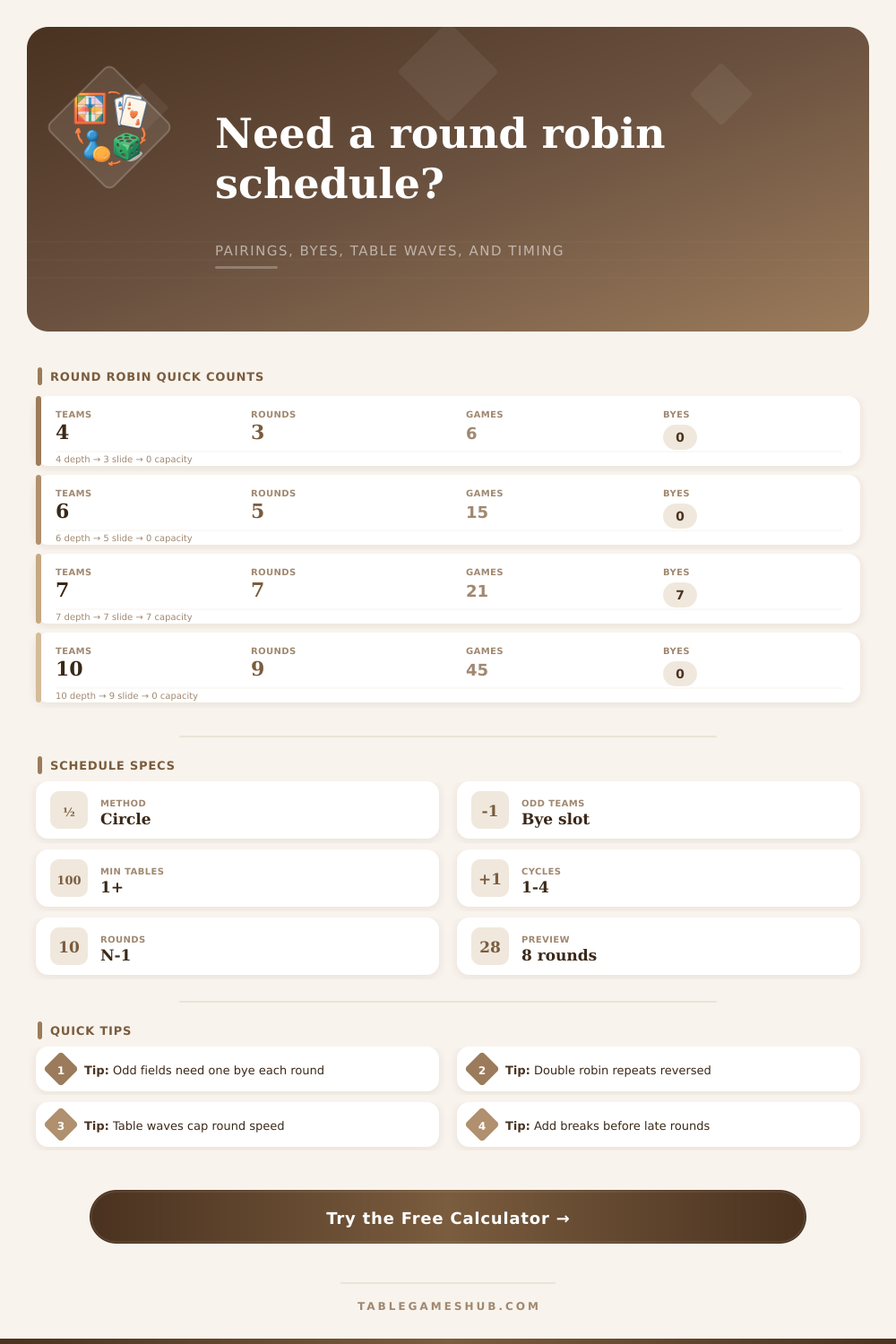
| 4 players | 3 | 6 | 0 | Small chess, word games, quick card league |
| 6 players | 5 | 15 | 0 | Poker night league, abstract games, dice ladder |
| 7 players | 7 | 21 | 7 | Odd club turnout where each player sits once |
| 8 players | 7 | 28 | 0 | Pairs, mahjong tables, balanced game-night bracket |
| 10 players | 9 | 45 | 0 | Long-form league or two-table rotation |
| 12 players | 11 | 66 | 0 | Miniatures league, extended board-game club season |
| Game Type | Common Match Length | Setup Buffer | Table Load | Scheduling Note |
|---|---|---|---|---|
| Chess or abstracts | 20-60 min | 3-5 min | One board per match | Color alternation matters across repeat cycles |
| Word games | 25-50 min | 5 min | One board per match | Score entry can be the slowest changeover step |
| Card games | 30-75 min | 5-10 min | One table per match | Dealer or first-seat balance can replace home/away |
| Board games | 45-120 min | 10-15 min | One table per match | Use longer slots when teardown is component-heavy |
| Miniatures | 60-180 min | 10-20 min | Large table per match | Low table count creates many waves per round |
| Repeat Format | Cycles | Pairing Repeat | Best For | Balance Effect |
|---|---|---|---|---|
| Single round robin | 1 | Once | One-day tournament or short league | Fastest complete comparison |
| Double round robin | 2 | Twice | Home/away or color fairness | Reverses first-seat advantage |
| Triple round robin | 3 | Three times | Small fields needing more games | One side gets extra start; rotate carefully |
| Quad round robin | 4 | Four times | Ongoing league nights | Strong balance, longer calendar |
| Tables Available | Pairings in Round | Waves Needed | Round Pace | Use Case |
|---|---|---|---|---|
| 1 | 4 | 4 | Serial | One featured board or shared deluxe setup |
| 2 | 4 | 2 | Moderate | Small venue with limited table space |
| 4 | 4 | 1 | Parallel | Eight-player field at full speed |
| 6 | 6 | 1 | Parallel | Twelve-player field without wave delays |
ℹSchedule Tips
Bye check: When the field is odd, every round has exactly one bye. A fair single round robin gives each player or team one bye across the full cycle.
Table check: If tables are fewer than pairings per round, each round becomes multiple waves. That affects finish time more than adding one extra team often does.
Your board game night went off the rails when three of your friends argued over the rules no one could remember, while pizza grew cold. There were two player sitting around waiting forty minutes for empty table. Hosting any kind of tournament, whether it’s a casual night with friends or a larger event, requires planning, because if you don’t plan things out, your schedule can quickly slip into chaos.
A round robin schedule sounds easy enough on paper, but put yourself through trying to shoehorn eight players into four hours with only three table. Suddenly the math get pretty messy. The calculator does all the heavy lifting. Plug in your constraints, number of players, and let the calculator do the rest. You won’t have to guess about coefficients or when waves will be timed.
How to Plan a Perfect Game Night
This brings us to center of the round robin: the circle method. Sounds fancy, right? Well, it’s really nothing more than a way for each team to play all other teams exactly one time before anyone plays each other again too soon. With an odd number of team, there will be a single team sitting out in each round. That’s known as a bye. The challenge is spreading these byes out evenly. You don’t want one team stuck on the bench while everyone else gets to score points.
You don’t just want action, you want balance. And that’s what the tool does: spread those byes around evenly throughout the schedule so competition remains tight from beginning to end.
Most organizers drop the ball when it comes to time management. Sure, a 45-minute game seems like it would fit inside an hour, so let’s do two rounds! Unfortunately, things don’t finish right on time. Players need to get from their seat, find their pieces, and tally score. That’s why having a buffer for changes over is so important. Don’t ignore that five-minute transition window between waves? Your whole event go into overtime. Those buffers are added automatically by the calculator. You are no longer livig in a fantasy land, but are working with a realistic finish time.
Another bottleneck is how many tables you have. Running multiple pairings at once is impossible if you can’t fit them in room. And even then, there’s table-changeover time for every round, in addition to the length of each match. Add a second cycle and you’ve doubled your number of matches, with twice as much pressure on your schedule. Want to play more games? Sure! But do you have the hours (and physical space) to fit your ambition? The interface’s reference tables let you see the tradeoff before committing to a double or triple robin format.
Table games aren’t exempt from this home/away balancing either. Home field advantage is well known in sports. Board games translate it into dealer position, first color, or first seat. Some games gives the first player a slight edge. By alternating who gets those advantages between teams, you avoid one team steamrolling their way to victory solely due to having gotten on a good start. There are options within the calculator to flip pairings in future rounds, so any initial momentum doesn’t skew the final results. Small thing, but preserves competition’s integrity.
These are extra thoughts about long breaks. You plan to run three rounds and figure participants can take breaks as needed. That doesn’t happen very often. People becomes tired, their attention fades, and scoring gets messed up. A planned break between every couple of rounds resets the mental clock of all parties and provides time to confirm whether the event is pacing well enough or if subsequent matches should be shortened. Downtime planning matters just as much as gameplay planning.
What’s neat is that once you get it set up, you don’t need to do it again, its true value isn’t creating a spreadsheet of “people and when they will show up,” but understanding what happens when. What will happen if you have four tables? Will that be too many? How will it impact things if you add another couple of players? Will your game run long? If so, does it push out the end time different than you want? Get all these systems under your belt and hosting stops being an exercise in chaos and starts feeling like design.
Running a tourney involves both hospitality and logistics. And sometimes you get that schedule right, and no one sees it happen at all. It’s simply competitors laughing, playing, competing, and leaving happy instead of tired from waiting. The trick is getting that intangible flow to work. And you don’t have to be a mathlete to make it happen. Simply let the tools manage the constraints and concentrate on the games. What happens is an evening when the only thing that runs behind time is the clock itself, and even then it feels earned, not an accident.