Star Realms Trade Value Calculator
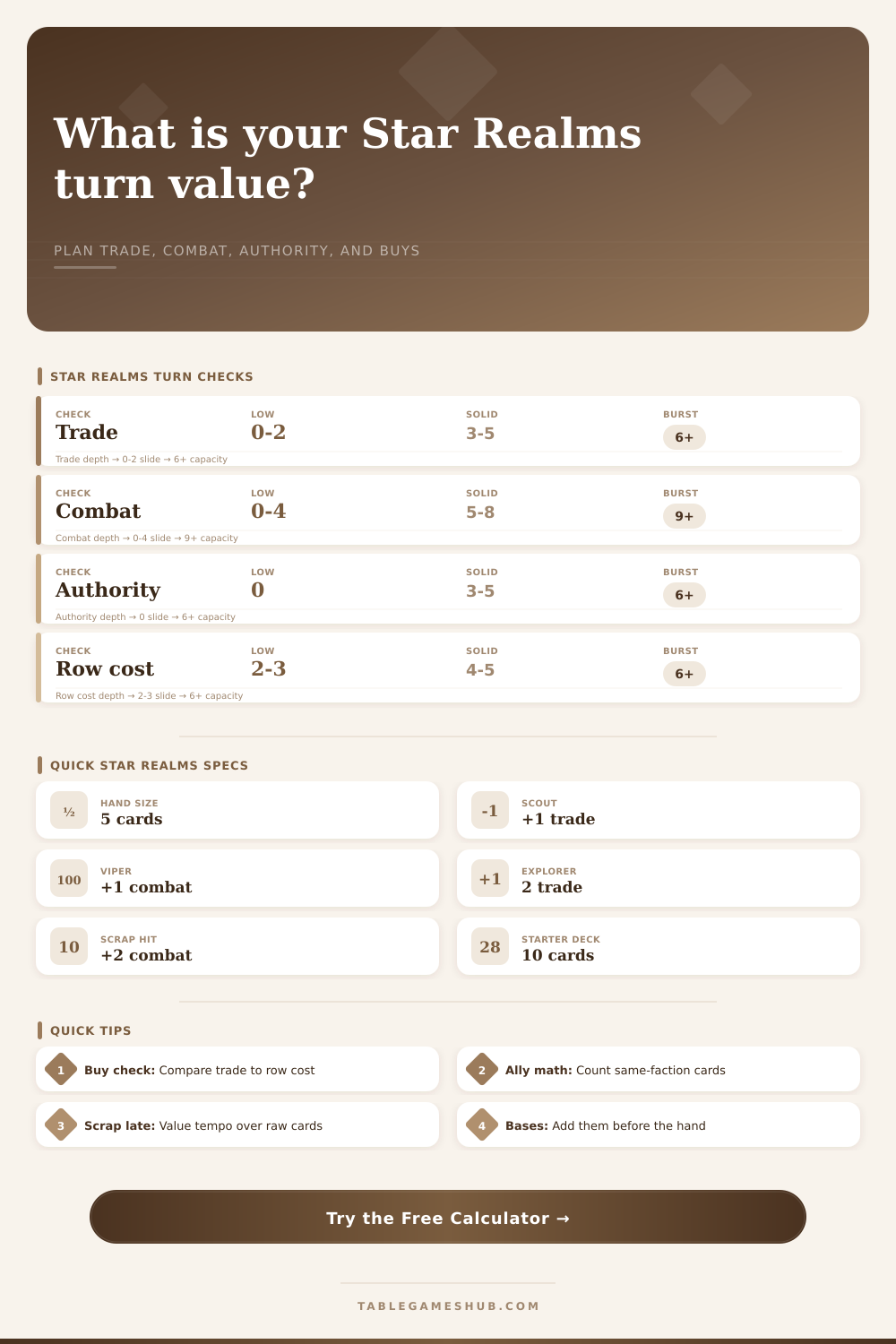
Total a Star Realms turn across trade, combat, authority, faction ally triggers, scrap choices, bases in play, and trade row buying reach.
| Card or Zone | Typical Value | Planning Use | Calculator Input |
|---|---|---|---|
| Scout | 1 trade | Opening buys, faction setup, Explorer fallback | Scouts in hand |
| Viper | 1 combat | Base clearing and authority pressure | Vipers in hand |
| Explorer | 2 trade or scrap for combat | Row smoothing when no clean faction buy appears | Trade ships or scrap plan |
| Trade Row | 5 visible cards | Compare total trade to target cost | Target cost |
| Faction Focus | Common Ally Payoff | Best Turn Signal | Risk to Check |
|---|---|---|---|
| Blob | Combat spikes, occasional trade and row cycling | Two or more green cards can convert a plain hand into pressure | Overbuying combat when a key row card is affordable |
| Trade Federation | Authority gain with steady trade support | White pairs can widen the authority gap while still buying | Counting authority but missing lethal combat math |
| Machine Cult | Scrap thinning plus efficient combat | Red pairs improve future hand density even on modest turns | Scrapping a card needed for this turn's buy threshold |
| Star Empire | Draw pressure, discard pressure, and combat | Yellow pairs can add a card before final totals are locked | Forgetting to include the drawn card in hand size and values |
| Scrap Choice | Immediate Output | Future Deck Effect | Use When |
|---|---|---|---|
| Explorer for combat | +2 combat | Removes a temporary economy card | You need base damage, lethal reach, or tempo now |
| Trade burst ship | +3 trade estimate | Loses a buy card after the turn | A specific 6-cost or 7-cost row card changes the deck |
| Combat burst ship | +4 combat estimate | Loses a damage card after the turn | Opponent authority or outpost math is tight |
| Starter thinning | No immediate resource | Raises future average hand quality | You can still buy and attack after removing Scout or Viper |
| Target Cost | Turn Meaning | Typical Source | Planning Note |
|---|---|---|---|
| 2 trade | Explorer or low-cost setup card | Two Scouts, one good economy card | Good fallback when factions do not line up |
| 3 to 4 trade | Early faction commitment range | Scout-heavy hand plus one economy card | Check whether the card adds trade, combat, draw, or scrap |
| 5 to 6 trade | Premium ship or strong base range | Economy ship, ally trigger, or base support | Do not scrap trade before confirming the threshold |
| 7 to 8 trade | High-impact capital ship range | Multiple trade cards plus ally or scrap boost | May justify a one-turn trade burst if the card is decisive |
Losing is not the worst part about playing a game of Star Realms. Losing because you purchased the wrong card three turns ago is.
You stared down the trade row, saw that shiny combat ship, and snatched it up without even glancing to see whether or not you can actualy afford the follow-up. How do games get away from us? Games slip away in the stillness between turns, because the mental math fails to account for the hidden costs of faction synergy and deck thinning.
Why Planning is Better Than Guessing
This calculator does that math for you, as soon as you enter your target cost and plug in your hand composition. You will no longer guess at the conversion rate or fumble with coefficients. The trick comes in knowing what numbers to input, beforehand.
For novices, each of those turns is a separate deal: “I have these 5 cards. How much will I get for them? What’s the highest cost card within my reach?” Sounds good! It is usually wrong.
In Star Realms, each turn is a link between the previous one and the next one. If you spend everything on something that doesn’t help you attack or upgrade next round, it is like playing with fewer cards in your deck. Think in terms of sequences rather than snapshots.
Use this tool by entering allies and even base support to see what might happen as a result of your purchases. Those unseen bonuses can transform a meh hand into a deadly burst or a steady economy machine.
Take for example the conflict between trade and combat. You have a hand full of Vipers and Scouts, which sounds balanced. But they’re doing twice the work. They’re helping you win at both trade and combat. And with Trade Federation, they’re helping you win the all-important authority race, too.
You get extra points for trading when you have two or more copies of any card in your hand. If you don’t play it for that (and who would?), you may well scrap one to go for combat, then wish you’d hung on just another round so you could take control while you had them in your hand.
That’s a tiny detail, and yet it transforms everything, makes you think less about what’s right there in front of you and more about what’s coming up in your next draw.
Intuition also trips up on Scrap. Two combat for an Explorer sounds like a good trade. Not only does it hurt the enemy, it cleans out one of their bases too. Except that now you’ve got a trade out of your deck. Unless you fill that spot back with a trade, subsequent turns will take longer. Sure, maybe you win this turn, but you’ve slowed yourself down. You’ve lost momentum.
With the calculator, you can model various options and get a sense of how much immediate damage vs. It has a delayed tempo cost. Is the damage worth the delay? In some cases, absolutely (if you’re already at the point of winning). In other cases, nope (especially early when each Scout counts).
Your deck has silent partners: bases and outposts. Bases don’t draw as much attention as big ships. Outposts don’t draw much attention. But they give you the foundation to make your turns. A good base placement triggers ally abilities before you ever play your hand. It turns a single faction card in your hand into a pair.
That’s where people go wrong. They focus on counting the cards in their hand, forgetting about the cards on the table. The tool considers that when it comes to base support. They reminds you that what’s on the table is part of your hand.
And no: You’re not trying to max out everything. You can’t get more authority, more combat, and more trade all in the same turn. Pick your lane. Are you chasing the authority win? The combat burst? The economic snowball?
The calculator turns your hidden potential into something real. You know when you are slightly behind in a trade. Or you know your combat is just barely enough to win against other guy. And that’s the difference between being a good player and a great player: They don’t guess. They plan.
Star Realms is ultimately a game of constraints. You have limited time, limited resources, and limited space. Each choice makes the road narrower. To think that you can leave all doors open is to make a mistake. You can’t. You need to commit.
And when you do, you should of be able to determine whether or not what you just committed to will work. That’s what the tool does. It gives you a check to say whether or not your bridge can support the load of your strategy. If it doesn’t, then you’re walking across thin ice, crossing fingers that the math comes up right for you. With it, you can see the cracks before you step on them.
It does not stop you from taking risks, but it lets you take ones you understand. The game rewards thoughtfulness. Thinking two steps ahead. It punishes those who do not think ahead.
When you complete your turn, don’t just wonder if you played well; know why you played that way. Then know why. Know what you’re giving up to gain what you gained. That’s what makes a roll of the dice into a calculated move.
The math isn’t difficult. The thinking is. And when you get it, everything else about the game gets so much easier. You begin to direct instead of react.