Relay Race Split Calculator
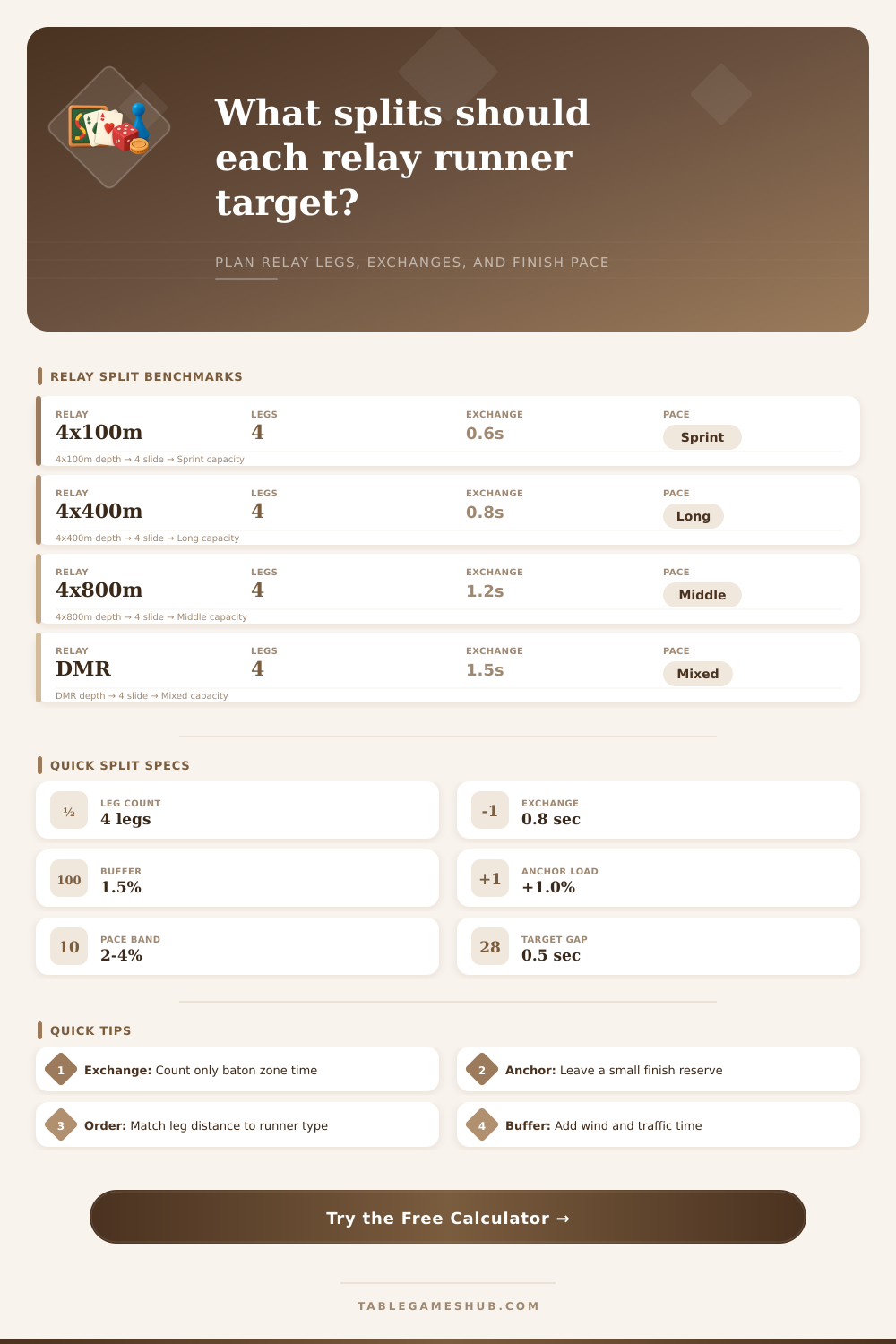
Build leg targets from runner ability, relay distance, exchange loss, pacing buffer, anchor demand, and race-day adjustment.
| Leg | Distance | Target | Projection | Pace |
|---|
| Relay | Leg Pattern | Common Exchange Loss | Split Focus |
|---|---|---|---|
| 4 x 100 m | 100 / 100 / 100 / 100 | 0.3 to 0.7 sec each | Acceleration and handoff timing |
| 4 x 200 m | 200 / 200 / 200 / 200 | 0.5 to 0.9 sec each | Curve speed and exchange rhythm |
| 4 x 400 m | 400 / 400 / 400 / 400 | 0.6 to 1.0 sec each | Even pressure with anchor reserve |
| 4 x 800 m | 800 / 800 / 800 / 800 | 1.0 to 1.8 sec each | Lactate pacing and pack traffic |
| DMR | 1200 / 400 / 800 / 1600 | 1.0 to 2.0 sec each | Mixed-distance runner matching |
| Split | 100 m Pace | 400 m Equivalent | 1600 m Relay Total |
|---|---|---|---|
| 48.0 sec 400 | 12.0 sec | 48.0 sec | 3:12.0 before exchanges |
| 52.0 sec 400 | 13.0 sec | 52.0 sec | 3:28.0 before exchanges |
| 56.0 sec 400 | 14.0 sec | 56.0 sec | 3:44.0 before exchanges |
| 2:00 800 | 15.0 sec | 60.0 sec | 8:00.0 for 4 x 800 m |
| 5:00 mile | 18.6 sec | 74.6 sec | 20:00.0 for 4 miles |
| Adjustment | Typical Range | When to Use | Calculator Effect |
|---|---|---|---|
| Exchange loss | 0.3 to 2.0 sec | All baton or tag relays | Adds fixed time per exchange |
| Race-day buffer | 0% to 4% | Wind, traffic, tactical rounds | Multiplies leg projections |
| Curve factor | 0% to 1.8% | Tight lanes or indoor turns | Raises distance-based load |
| Anchor bias | -1% to +3% | Kick finish or pressure leg | Shifts only final leg target |
| Pace band | 1.5% to 5% | Target tolerance planning | Creates low and high split range |
| Setup | Best Runner Placement | Exchange Priority | Use Case |
|---|---|---|---|
| Fast start | Best starter on leg 1 | Clean first outgoing step | Short sprint relays |
| Steady middle | Most reliable runners on legs 2 and 3 | Low-risk pass in traffic | 4 x 400 m qualifying |
| Anchor close | Best finisher on final leg | Safe final exchange | Finals and tactical races |
| Distance blend | Match runner to leg distance | Controlled tag and acceleration | DMR and SMR events |
A relay team consist of four runners who must run the same race and exchange the baton between each runner. A relay team has to account for many different variable in addition to the fact that a relay team doesnt consist of four separate running times that are to be added together to determine the teams total relay race time. The relay team’s total time will be affected not only by the speed of each team member, but by the time lost during the baton exchanges, as well as by factors like wind.
Each of these different variable can be accounted for with the split calculator for a relay team. To calculate the relay team time with accuracy with the split calculator, several different value must be input into the split calculator. A coach must enter the baseline running times for each member of the relay team, as well as the expected exchange loss time for each passing of the baton between runners.
How a Relay Split Calculator Works
Additionally, a coach will need to enter a race-day buffer into the split calculator to account for the variables of the race day that may impact the relay team’s performance. The split calculator will account for each of these variables to provide a projected time for the relay team. The exchange loss variable is used to account for the time lost during a baton exchange between runners.
The exchange loss isnt the time that the baton spend in the air between runners, but the time that the outgoing runner loses when they must both slow down to recieve the baton, and then speed up after receiving the baton to begin running again. Each exchange loss between runners will impact the total time of the relay team. Therefore, by entering different value of exchange loss into the split calculator, a coach can determine how much time can be lost by using different baton exchange techniques during a relay race.
A race-day buffer is used to account for all of the variable that may impact the relay team during the relay race. Factors like wind, starts, and other variables may impact a relay team’s performance during the race, so coaches may add a buffer to account for these variables. For example, a coach may use a small race-day buffer if the relay team will run in variables that are likely to remain the same during the relay teams race, but may use a larger buffer if the relay race is more unpredictable.
The split calculator will use this race-day buffer to calculate the relay team’s time, so that the team has an idea of the total time that may be required for the relay race. Anchor bias is another setting that may be used within the split calculator for the relay team. Some coaches may use this bias to indicate that the fourth (anchor) runner for the relay team should be running with a reserve of energy left for the relay team’s final leg of the race.
Other coaches may not use this bias if they believe the anchor runner should have a consistent running speed throughout the relay race. This bias will only impact the time for the fourth (anchor) leg of the relay race, allowing coaches to understand how each member of the relay team may impact the relay team’s total time. In addition to all of the other settings within the split calculator, the reference tables can provide additional information to the coach of the relay team.
The reference tables can indicate information about the different types of relays that may be run, such as 4×100 relays or 4×800 relays. For instance, the reference tables may make clear that a 4×800 team will have a different window of allowed exchange loss then a relay race sprint team. These reference tables will not make any decision on behalf of the coach, but they will provide the data needed for the coach to make those decisions.
The runner placement for a relay team is another variable that the coaches and relay team must set. The fastest member of the relay team doesnt always have to be selected to run the anchor leg of the race, as that fastest runner may have a slower exchange of the baton with the third member of the relay team. While the split calculator will not place each member of the relay team, the split calculator will calculate the time for each possible placement for the runners.
Thus, the split calculator can help the coach to determine the best placement for each runner on the relay team. Finally, the split calculator will help relay team coaches to understand the margin of error that their relay team will have during the relay race. The margin of error will account for the amount of extra time that the relay team may lose during the relay race without causing them to miss there target time for the relay race.
If the split calculator indicates a large margin of error, the team will be able to make mistakes during the relay race without impacting their ability to achieve a good time. Conversely, if the split calculator shows a small margin of error, any mistake will impact their relay time and cause them to miss their target time. The split calculator makes these different costs of mistakes in the relay team visible to coaches, allowing them to prepare the relay team accordingly.