Call of Cthulhu Sanity Calculator
Parse SAN loss expressions, compare success and failure outcomes, track session loss, and flag temporary or indefinite insanity pressure.
| Branch | Chance | Loss Range | Average Loss | 5+ Loss |
|---|
| Session Point | SAN Lost | Threshold Share | Indefinite Flag |
|---|
| Roll Mode | Success Chance | Expected Loss | 5+ Loss Chance | Bout Risk |
|---|
| Scene Type | Typical Expression | Average Failure | Use Case |
|---|---|---|---|
| Unsettling clue | 0/1 | 1.0 | Minor dread |
| Corpse or shock | 0/1d3 | 2.0 | Investigative horror |
| Mythos creature | 0/1d6 | 3.5 | Combat reveal |
| Tome revelation | 1/1d4 | 2.5 | Studying lore |
| Major entity | 1d6/1d20 | 10.5 | Severe encounter |
| Cosmic horror | 1d10/1d100 | 50.5 | Campaign climax |
The sanity calculator is an tool that will help you understand the risks of sanity rolls. Sanity rolls will determine how much sanity the investigator lose. The loss of sanity can lead to temporary insanity or indefinite insanity.
These two type of insanity are triggered by different level of sanity loss by the investigators. The calculator will show the different levels of madness that can occur so that players can make informed decisions during there game session. The inputs represent the specific values that is used during the game sessions.
How to Use the Sanity Calculator
The current sanity level is one of the values that must be entered into the calculator. The current sanity level will determine the target number that is rolled on the d100 die. The higher the sanity level that the investigator has, the more higher the chance that they will lose the sanity roll.
The Mythos skill is another of the inputs. If the investigator has a high level of skill in the Mythos skill, their sanity will be capped at a certain number. The players must enter the session loss field as another of the inputs.
This field is used to track how much sanity the investigator has lost during the game session. The intelligence target is another of the inputs for this sanity calculator because this target will help to determine whether the investigator lose sanity to a bout of madness. The loss expressions will show the investigators how much sanity will be lost during each roll.
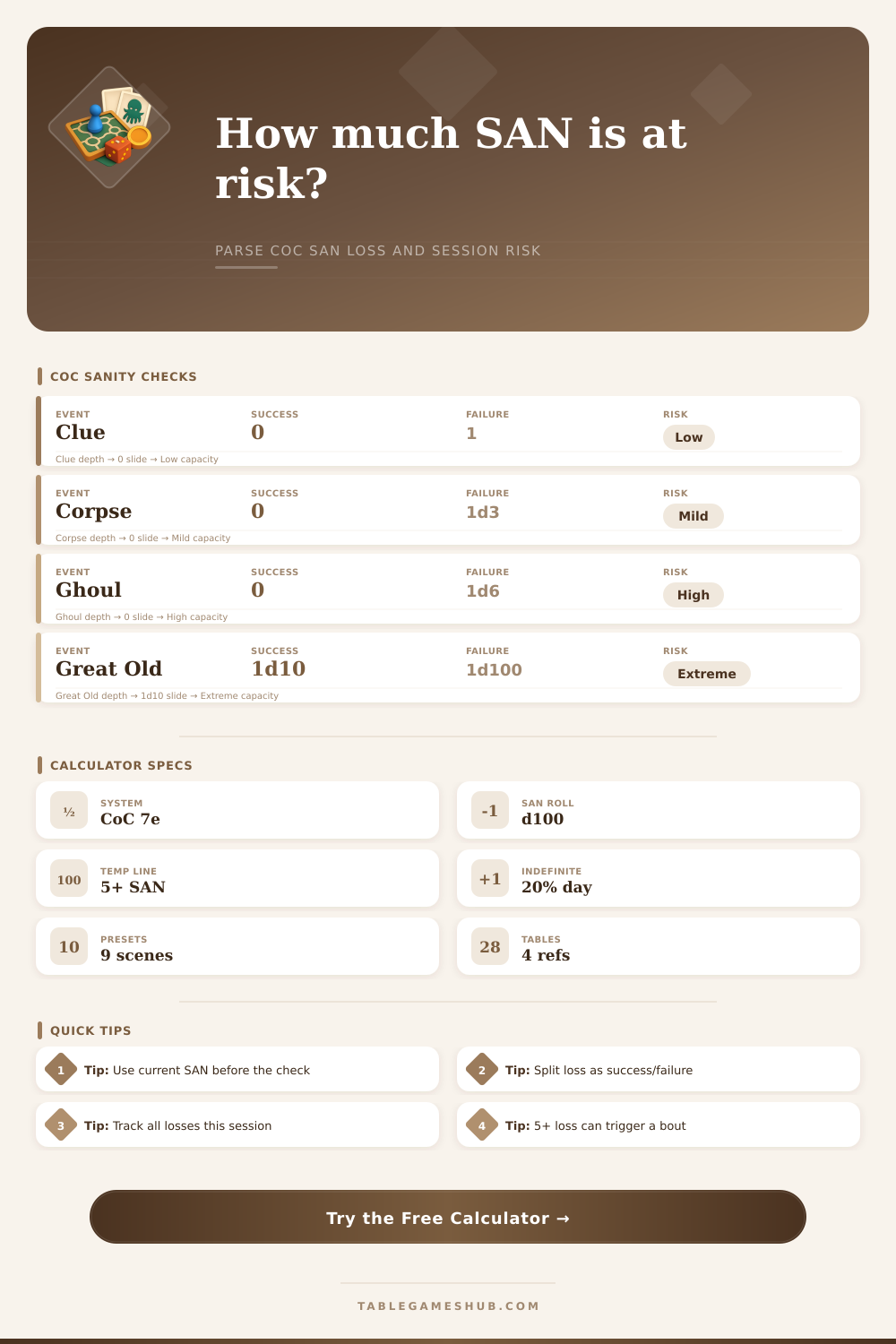
Each loss expression will contain two values. Each of these values will represent the loss of sanity if the investigator rolls a success or a failure on the dice. For example, a loss expression of 0/1d6 will show that the investigator will not lose any sanity if they roll a success on the dice.
However, should the investigator roll a failure on the sanity roll, they will lose 1d6 of their sanity. A loss expression of 1d10/1d100 indicates that if the investigator rolls a success on the sanity roll, they will lose 1d10 of their sanity. However, should they roll a failure, they will lose 1d100 of their sanity.
The sanity calculator parses these loss expressions so that the success and failure outcomes of the rolls can be separated. Players often focus on the average loss of sanity for each loss expression. However, this value does not indicate the full range of possible outcomes for each roll.
The calculator displays information regarding the five-point threshold for temporary insanity. Temporary insanity will be triggered if the investigator lose five points of sanity. Additionally, the calculator can calculate the risk of a bout of madness for the investigator.
Multiplying the chance that the investigator will roll a failure and lose five or more sanity points by the chance that the investigator will roll a success on their intelligence skill roll will calculate the risk of madness. This risk of madness will tell the investigator how close they are to losing narrative control of the game to the Keeper. The check count field is another of the inputs for the sanity calculator.
Players use this field to indicate how many sanity checks will be performed during the game session. The more checks that are performed, the closer the investigator will come to indefinite insanity. The roll mode choices allow investigators to account for bonus dice and penalty dice.
If investigators choose to roll bonus dice, the investigator’s chance of success on the sanity roll increase. Therefore, the investigator is less likely to lose sanity. If investigators choose to roll penalty dice, the investigator’s chance of success on the sanity roll decreases.
As such, the investigator is more likely to lose sanity. A comparison table is used to display the different effects of bonus and penalty dice on sanity loss and the risk of madness. This table allows investigators to decide whether to seek a bonus die or to roll with a penalty die.
The reference tables provide examples of the different types of loss expressions that can be used in the game. For example, Mythos tomes will have a loss expression of 1/1d4. This means that if the investigator rolls a success on their sanity roll, they will lose one point of sanity. However, if they roll a failure, they will lose 1d4 of their sanity.
The averages indicated in these reference tables are not predictions of how many sanity points investigators will lose on any given roll. Instead, they give investigators of players an idea of the scale of sanity loss for certain game objects. Many players of Call of Cthulhu will make mistakes with the use of sanity rolls.
Some investigators will only look at the value of the success portion of the loss expression. This is a mistake in that if investigators do not account for the possible loss of sanity on a failure of the sanity roll, they will not have a true idea of how likely they are to lose sanity. Players who only look at the average loss of sanity for a given game object are also making a mistake.
The average loss of sanity does not indicate how often investigators will roll a failure with enough sanity loss to trigger a bout of madness. The calculator helps to prevent these mistakes by displaying the probability that investigators will roll a success or failure with enough sanity loss to reach the five-point threshold for temporary insanity. The threshold for indefinite insanity is not a fixed value.
Instead, the threshold for indefinite insanity is based off the current sanity level of the investigator. The lower the sanity level of the investigator, the lower the threshold for indefinite insanity. The session loss field is another of the fields that is used to calculate the threshold for indefinite insanity.
This field accounts for all of the sanity that the investigator has lost during the session. This field is used to prevent investigators from making the mistake of assuming that each sanity roll will have the same level of sanity as the investigator’s starting sanity level. This field ensures that investigators can plan their actions for the session effective.
In the end, the sanity calculator transforms the opaque dice rolls for sanity checks into mathematical probabilities for investigators. This transformation allows investigators to plan their actions during the game session.