Rapid Rating Calculator
Estimate expected score, rating change, and new rapid chess rating from current rating, K-factor, opponent rating, score, and game count.
| Player vs Opponent | Expected Score | Score Needed to Gain | Rapid Rating Note |
|---|---|---|---|
| Player 400 lower | 0.091 per game | Any draw or win is a major over-score | Large upset swing |
| Player 200 lower | 0.240 per game | Draws usually gain rating | Underdog chance |
| Even ratings | 0.500 per game | More than half points | Balanced update |
| Player 200 higher | 0.760 per game | Must score strongly | Protecting points |
| Player 400 higher | 0.909 per game | Nearly a sweep | Draws can lose points |
| K-Factor | Typical Rapid Use | Maximum One-Game Gain | When to Select It |
|---|---|---|---|
| 10 | Very stable established rating | 10 points before expected score | Use only if your rating list assigns K = 10 |
| 20 | Common established rapid rating | 20 points before expected score | Good default for many club calculations |
| 32 | Fast-moving local rapid pool | 32 points before expected score | Use for systems that publish K = 32 |
| 40 | New, young, or provisional player | 40 points before expected score | Use when the official rule gives a high K |
| Result Type | Score Entry | Three-Game Example | Calculator Use |
|---|---|---|---|
| Loss | 0 | 0 losses = 0.0 points | Add nothing for each loss |
| Draw | 0.5 | 2 draws = 1.0 point | Add half a point per draw |
| Win | 1 | 2 wins = 2.0 points | Add one point per win |
| Mixed mini-match | Total points | Win, draw, loss = 1.5 | Enter the total score across games |
| Rapid Scenario | Input Pattern | Expected Behavior | Best Check |
|---|---|---|---|
| Single rated game | Games = 1, score 0, 0.5, or 1 | One clean Elo update | Opponent rating is exact |
| Rapid mini-match | Average opponent rating, total score | Batch estimate from one average | Average rating is reasonable |
| Swiss rapid event | Games equals rated rounds played | Approximate event change | Do not include unrated byes |
| Provisional listing | Flag provisional, enter official K | Marked as provisional estimate | Do not invent extra multiplier |
Practicing puzzle problems at home give you the confidence to go into a local quick tournament; however, sitting down next to someone who types as fast as computer may not be a good thing. That’s when math overtakes intuition. There are rating systems for events like that that try to anticipate those moments.
A rating system can takes 20 minutes of time pressure and distill it down to a number that represents your level of strength. This page will help you visualize what that number is after an event. It will help you gauge how much progress you made.
How Your Chess Rating Changes
Your rating is not a stagnant badge, but most people think of it as such: they glance at it once a month, then forget about it until next months update. Your rating is actualy a fluid estimate, one that updates after each rated game you play.
How much does it move? It depends based off how surprising your result was. Did you crush someone rated two hundred points higher than you? Then the system has to adjusts quite a bit, since that was a statistically unlikely outcome. Did you draw a person with similar strength? Well, now your rating hardly shift.
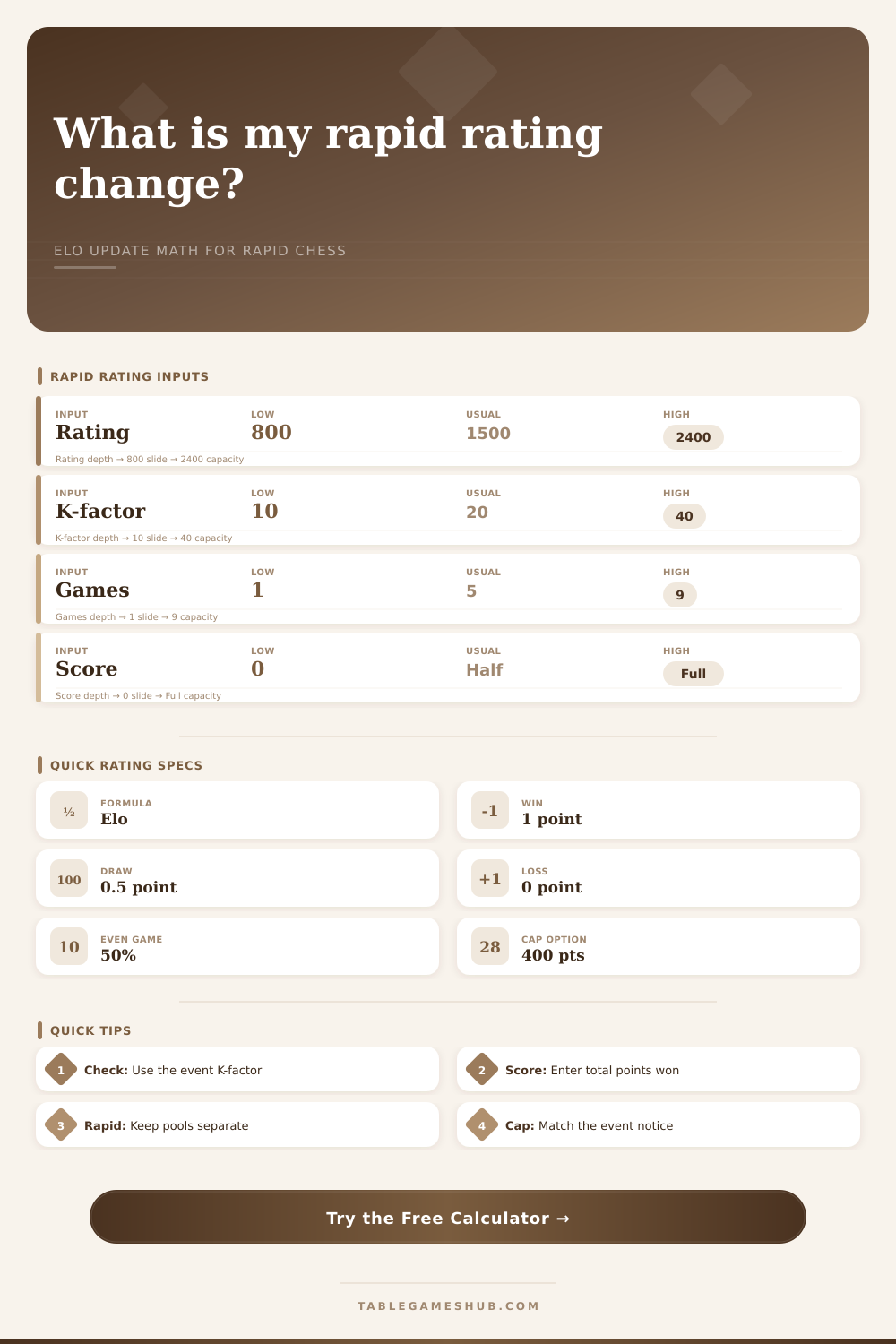
The calculator above performs this math for you, removing any guesswork as to what kind of score will improve (or worsen) your standing. Each of these results will be multiplied by the K-factor, which is the variable that determines how sensitive you are to each result.
For example, a result with a smaller difference between your score and your expected score will have a smaller impact on your rating different than a more surprising result. Your true strength won’t be known initially so novices will begin with a high K-factor. Perhaps at 40. With experience they’ll fall back down to 20 (or lower), making them less sensitive to quick fluctuations in rating.
This is important, because it explains why a junior player can rocket up 50 points over the weekend whilst a club regular barely moves despite both having won the same amount of games. The system isn’t biased; it just weighs different levels of performance based off what is stable.
It takes discipline to input accurate info. If you played several rounds against different opponents, enter their average rating. It’s important not to mix rapid with blitz ratings. They’re separate pools as players performs at very different levels across time controls.
The page has a reference table detailing how shifts in expected scores work depending on rating gaps; this helps you quickly grasp what’s an upset versus an expected outcome. Contrary to intuition, winning against someone higher rated give fewer points than defeating someone much lower rated. But it ensures the system remains honest.
There’s one more wrinkle: provisional ratings. Typically these are applied when someone has not played enough to have an accurate average rating, or they is a new entrant. You can flag this on the calculator, and it will treat your ratings accordingly. Any change from here on out should of be volatile accordingly.
I know, it’s tempting to put some numbers in the box anyway and go with whatever comes back. But that won’t give you good predictions. Provisional ratings are treated as changing wildly until they become solid numbers.
The psychology of ratings anxiety is one thing (beyond just the math). People gets too attached to keeping their number and don’t make some of their best plays because they’re afraid to lose points. If you realize that losing to someone rated below you will happen at some point along the distribution curve, then you’ll be able to play riskier chess. You want to let the number settle where you belong.
Your job isn’t to maintain the number, but to allow it to find your true level. If your number is all over the place, it’s not a failed rating system: it means the rating system are working to find your balance.
All that being said, the score is simply one point-in-time look at how well you are playing compared with some other people. It’s got nothing to do with your creativity, nothing to do with what you might be able to play.
Run it through the calculator if you’d like to check out how the math works on whatever change you made, but don’t let the digits dictate your confidence. Take the odds at face value, play the pieces on the table, and know that the numbers will shake out over time accordingly. The metadata isn’t the game; the moves is.