Race for the Galaxy Tableau Value Calculator
Estimate how much your current tableau is worth by combining printed VP, card count pressure, production base, consume engine quality, military reach, hand fuel, VP chips, and remaining turns.
| Engine Shape | Input Signal | Value Source | Calculator Read |
|---|---|---|---|
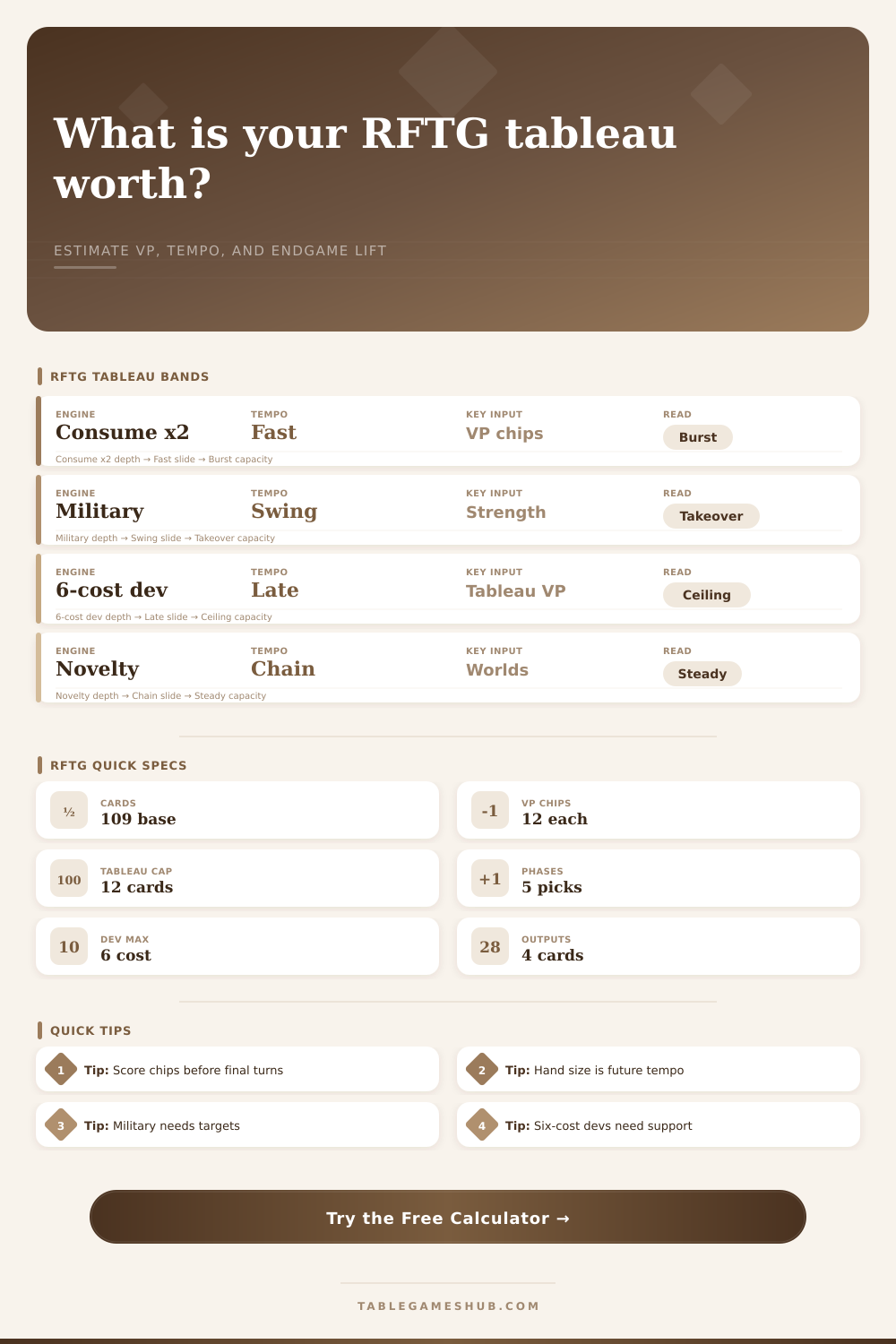
| Consume x2 engine | 3+ consume powers, 3+ worlds | Repeated VP chips | High future lift if turns remain |
| Military takeover | 5+ military, playable hand | Free worlds and tempo | Strong if targets are live |
| Six-cost development | High tableau VP support | Bonus points at scoring | Needs matching tags and cards |
| Novelty world chain | Several blue goods worlds | Fast trade and consume | Steady if hand refills |
| Thin tableau | Few cards, low hand | Low secured value | Requires draw or cheap settle |
| Cards In Tableau | End Pressure | Build Flex | Best Result Unit |
|---|---|---|---|
| 1 to 4 | Low | Many builds remain | Engine seed |
| 5 to 7 | Medium | Shape is visible | Development check |
| 8 to 10 | High | Few slots left | Closing tempo |
| 11 | Very high | One card from cap | Immediate sprint |
| 12 | Ended | No more tableau slots | Final score only |
| Consume Powers | Goods Needed | Estimated Lift | Warning |
|---|---|---|---|
| 0 | None | 0 to 1 VP per turn | Needs a new outlet |
| 1 | One good | 1 to 2 VP per turn | Can be phase dependent |
| 2 | Two goods | 2 to 4 VP per turn | Watch refills |
| 3 to 4 | Three goods | 4 to 7 VP per turn | Best with Produce support |
| 5 | Four goods | 7+ VP per turn | End may arrive first |
| Military Strength | Likely Target | Tempo Effect | Calculator Use |
|---|---|---|---|
| -2 to 1 | Mostly non-military | Pay for worlds | Little military lift |
| 2 to 4 | Small military worlds | Occasional free settle | Moderate flexibility |
| 5 to 7 | Major military worlds | Strong tempo swing | High if hand has targets |
| 8+ | Large alien or rebel worlds | Can close quickly | Great with card flow |
| Specialized | Tag-limited worlds | Powerful but narrow | Lower if no target visible |
Take a look at those dozen cards spread before you… They impress from three feet back, but up-close they’re just a point-counting exercise in futility. That’s the core of the Race for the Galaxy problem: The board shouts power; the scoreboard whispers reality, and sometimes it’s a grim one.
You’ve got four turns into an engine and then the dude who was busy dominating military phase all this time comes by and smacks you down. Or you flooded the market with cheap worlds, only to have your opponent quietly eat up victory points with consume powers.
Understanding Your Real Score in the Game
Once you know where you currently sit, the calculator does the counting for you. This is a big improvement over doing math in head. However, you still have the mental work of trying to estimate how much lift you can get out of next few turns. What’s there now and what do you wish you had?
That’s the difference between winners and losers, and why most people don’t realize they lost until it’s too late. The VP chips and printed VP values they’re holding are safe. These are things that actualy exist on table at this moment. Unless they steal a card with military strength, nothing you do in terms of phase selection can change that. The tool considers them the baseline for you. It roots the calculation in something real instead of hypothetical.
But that’s not where the game happens. That’s not even what the game is about. In between the phases is where action is. Without a production phase, your production worlds sits there doing nothing. Without any goods to burn, your consume powers don’t fire.
That’s why hand fuel matters so much in input fields. Momentum and optionality is worth a lot. Having a big hand tells you that you’ll be able to adapt as the phase pool rearranges itself against your engine. If you have an empty hand then you’re stuck on one track where you cannot deviate and players who know this can block out certain phases to throw you off course. Flexibility is weighted very heavily by the calculator because even a good-looking engine that gets stalled creates zero value.
Any equation can be thrown off balance by military power. Big military numbers can wipe away someone else’s hard work, but only if you have targets (and the right time). Military worlds with no other people to hit are simply dead weights in your picture. The reference table on page spells it all out, showing how much military strength correlates to tempo swings. Be strong enough to take a critical world or get them to fold, but don’t go overboard as you might slow down your development pipeline.
Six cost developments gives you a huge number of points at the end of the game; but only if you can support them. Having a lone six cost floating around doesn’t help if you didn’t have the hand size or the tags to play it then. The calculator takes this into account, considering the overall look of your tableau, not just the isolated strength of your big cards. Do you have the support to unleash that heavyweight?
The last variable is endgame time. Each turn, as players get closer to having 12 cards in their hand, they’re counting down to game ending. This rigid cap makes each turn one more opportunity to pick up points before the proverbial door closes. So in those final few turns, players frequently have five turns worth of building to do with three left on the clock.
The calculator estimates how many turns you have by checking your number of phases and cards. This gives you a rough idea of whether you should push for more productivity or take victory points you can grab now and play conservatively. Every decision becomes different once you know you’re approaching the cap. Maybe you’ll take an easy win just for some instant points instead of continuing to build out a long-term consume chain. Or maybe you realize your opponent’s racing towards her own tableau limit so you double-down on military.
Each archetype is a lesson in tradeoffs: a heavy consumption engine is valuable in the late game (provided there’s still time left on turns) but can be costly if the game doesn’t go long. A thin tableau has no value to speak of, yet remains nimble enough to adjust at will. Each preset isn’t just a template, but a pattern that teaches you to read your board more closely.
What cards do I have? Sure, but also how do those cards fit within the context of turn phases and available time? How much closer am I to winning now than before? You don’t put this thing on Autopilot and let it win the game for you, but it highlights where your current position stands relative to victory.
In Race for the Galaxy, victory doesn’t come down to which cards you have but rather when you play them. There’s an art to juggling the need for instant gratification against the promise of long-term gain, all within the threat of possible military interference. When time runs out, you discover that sometimes you’re better off settling for a one-step card than risking a complicated chain.
While cards themselves don’t change, the tool provides a mirror for your strategy. They become a window into how well (or poorly) you’re doing, revealing your weaknesses as well as your advantages. Suddenly, your intuition regarding the state of game becomes data, real, actionable data.
Knowing what you truly own empowers you to make decisions: attack now or hold back? Whether you are leading or trailing, knowing your actual worth helps you decide when to hold back and when to strike. If you’re behind, you’ll know exactly when it’s time to charge. The point isn’t to get as many cards in your tableau as possible. It’s to get the most valuable ones in there before the final tick of the clock.
Once again, you glance over the tableau. But this time you’re no longer seeing colors. Now you see the numbers.