⚔️ Pathfinder RPG Ability Score Calculator
Build characters with Point Buy, Standard Array, or Rolled scores — with full modifier & racial bonus calculations
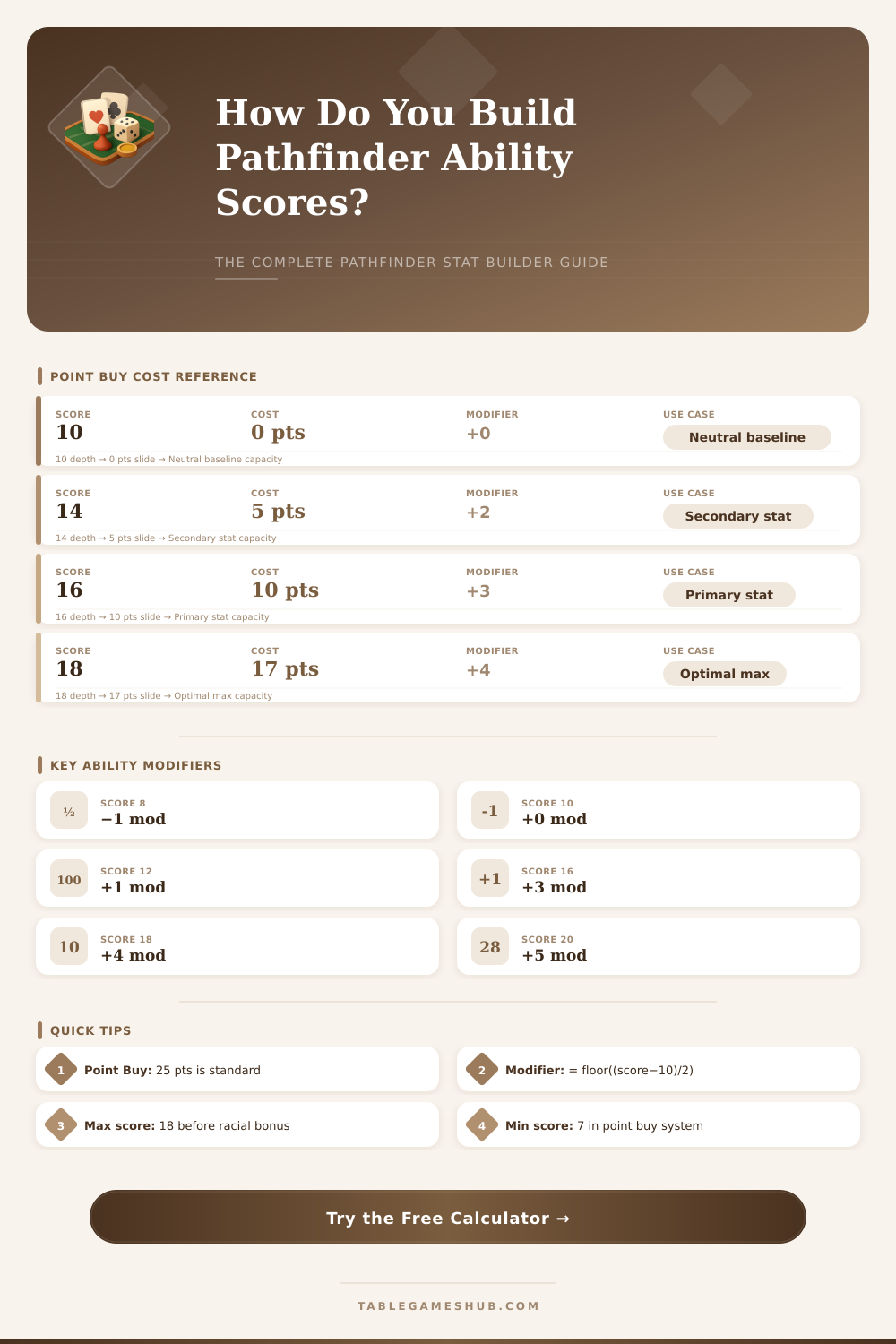
| Ability Score | Point Cost | Modifier | Notes |
|---|---|---|---|
| 7 | –4 (gain 4 pts) | −2 | Dump stat territory |
| 8 | –2 (gain 2 pts) | −1 | Common dump stat |
| 9 | –1 (gain 1 pt) | −1 | Slight penalty |
| 10 | 0 | +0 | Neutral baseline |
| 11 | 1 | +0 | Marginal benefit |
| 12 | 2 | +1 | Good secondary stat |
| 13 | 3 | +1 | Solid secondary |
| 14 | 5 | +2 | Strong secondary stat |
| 15 | 7 | +2 | Good primary stat |
| 16 | 10 | +3 | Strong primary stat |
| 17 | 13 | +3 | Very strong primary |
| 18 | 17 | +4 | Maximum before racial |
| Race | STR | DEX | CON | INT | WIS | CHA |
|---|---|---|---|---|---|---|
| Human | — | — | — | — | — | +2 any |
| Elf | — | +2 | −2 | +2 | — | — |
| Dwarf | — | — | +2 | — | +2 | −2 |
| Halfling | −2 | +2 | — | — | — | +2 |
| Gnome | −2 | — | +2 | — | — | +2 |
| Half-Orc | +2 | — | +2 | −2 | — | — |
| Half-Elf | — | — | — | — | — | +2 any |
| Aasimar | — | — | — | — | +2 | +2 |
| Tiefling | — | +2 | — | +2 | — | −2 |
| Class | Primary Stat | Secondary Stat | Recommended Primary | Casting Stat |
|---|---|---|---|---|
| Fighter | STR or DEX | CON | 16–18 | None |
| Wizard | INT | CON/DEX | 18 | INT |
| Cleric | WIS | CON/STR | 16–18 | WIS |
| Rogue | DEX | INT | 16–18 | None |
| Ranger | DEX/STR | WIS | 16–18 | WIS |
| Paladin | STR & CHA | CON | 16+ both | CHA |
| Barbarian | STR | CON/DEX | 17–18 | None |
| Bard | CHA | DEX/CON | 18 | CHA |
| Sorcerer | CHA | CON/DEX | 18 | CHA |
| Druid | WIS | CON | 16–18 | WIS |
| Monk | WIS/STR | DEX/CON | 16+ WIS | None |
| Alchemist | INT | CON/DEX | 18 | INT |
| Score | Modifier | Score | Modifier | Score | Modifier |
|---|---|---|---|---|---|
| 1 | −5 | 8–9 | −1 | 18–19 | +4 |
| 2–3 | −4 | 10–11 | +0 | 20–21 | +5 |
| 4–5 | −3 | 12–13 | +1 | 22–23 | +6 |
| 6–7 | −2 | 14–15 | +2 | 24–25 | +7 |
| — | — | 16–17 | +3 | 26–27 | +8 |
Every character in the Pathfinder RPG gets six Ability scores, that form the base for everything else about that build. Those scores show the natural talent and basic skill. That with what one is born or that one develops in early age.
One has Force, Dexterity, Constitution, Intellect, Sense and Charisma. Although one rarely does a check based on only one from those scores alone, the six scores and their modifiers affect almost every action and skill, that your character can use.
The Six Ability Scores in Pathfinder
The scales go from 0 to 20 which is pretty simple really. Zero means, that you really can not do anything with that Ability. On the other hand, 20 shows the top of human possibility, the best, that folk can reach in anything.
Normal human Ability sits at 10, so even average set of scores lays you above the skills of usual folk.
Sense deals with intuition, with reading of situations and with making of clever choices based on experiences. It is not about book smarts, more about insight of folks and about that, what really happens around you. Charisma matters a lot for some classes, and in Pathfinder one did interesting change here.
One moved the paladins to basing magic on Charisma, while older versions depended on Sense. Some builds end up so specialized, that they can invest everything in one alone stat. Really, one could start with something like 8, 8, 14, 12, 10, 20, if your class allows channeling Charisma in attacks, damage, AC, initiative, magic and every skill, that deserves attention.
There are several ways to create Ability scores. Between them is the score purchase, the standard set (15, 14, 13, 12, 10 and 8) and the roll of four six-sided dice with dropping of the lowest. In a 20-point buy system most players aim for something around 17, 14 and 12 for the main, second and third stats before racial bonuses.
Choosing a race that boosts your highest stat is very commonly used optimization.
Even numbers have bigger wait than odd here, what could seem weird. The modifier changes only every two scores, and most of game benefits depend on that modifier, not on the raw score. Even so, odd scores actually make a difference in some limited cases.
When you level upward and boost a skill, reaching a pair does increase the modifier. Boosting Constitution helps, because you receive more hit points. Raising Intellect gives more skill ranks.
Every four levels you can add one point to any Ability score, that you choose.
Various spells and special skills can also briefly or always boost scores. Short boosts, that last a day or less, only give brief bonuses. For every two-point jump to one Ability one gets +1 to skills and checks tied to it.
Gear also does big difference, stuff like Belt of Physical Perfection can push your scores higher than usual. In the first version there was not really a hard score cap for Intellect written in the rules. Aging works the other way for physical and mental stats.
Mental ones rise whilephysical ones drop. Newer versions of Pathfinder also changed, how drain affects scores, with double modifiers, that consider both heritage and bloodline.