Race for the Galaxy Score Calculator
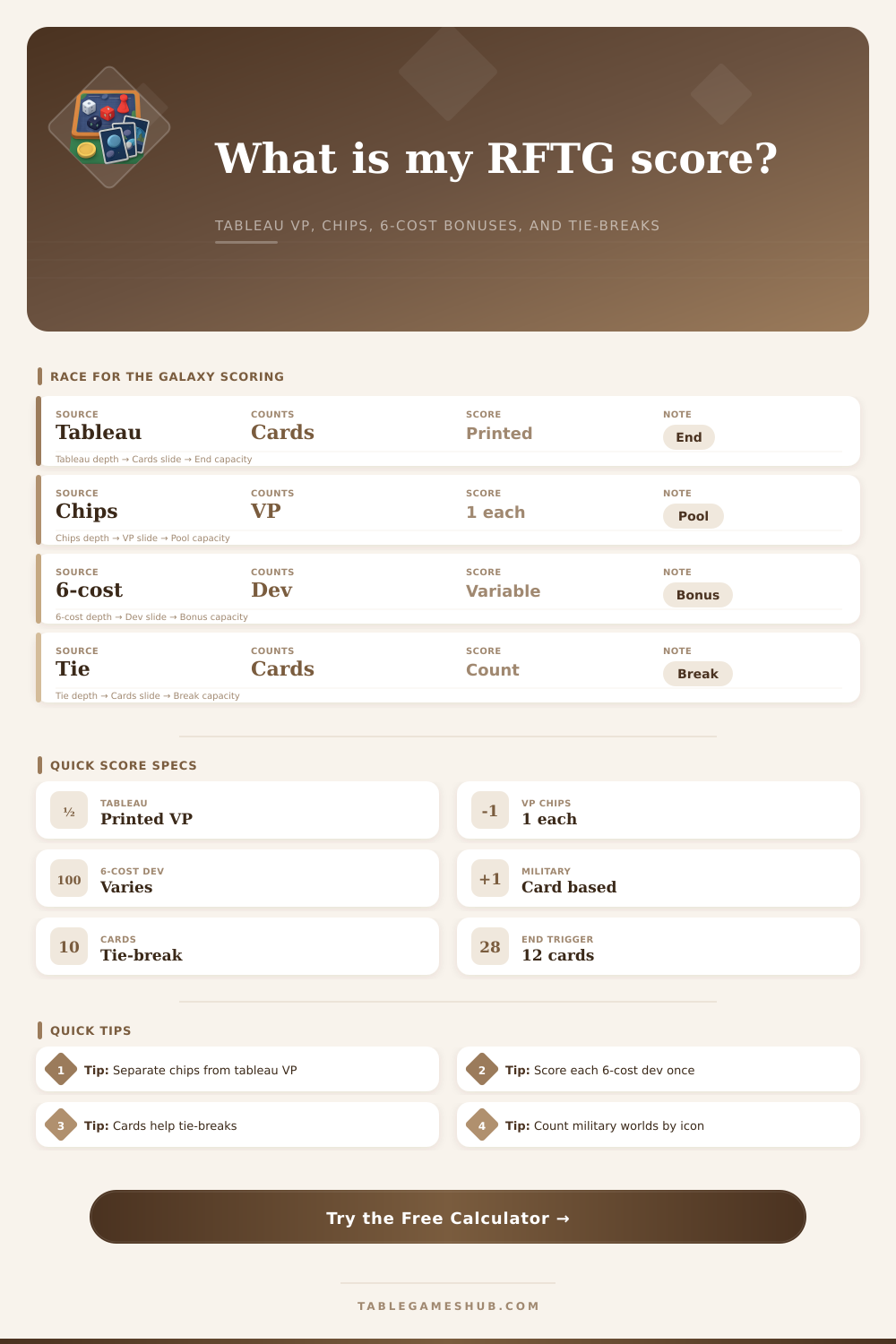
Score tableau VP, VP chips, 6-cost development bonuses, military worlds, production engines, and card-count tie-break strength.
| Development focus | Typical scoring input | Calculator formula | Best used when |
|---|---|---|---|
| Galactic Renaissance | Developments plus engine diversity | Developments x 2 + consume lanes | Tableau has many development cards |
| New Galactic Order | Military strength | Max military x 2, capped at 20 | Military strength is the main plan |
| Free Trade Association | Novelty, consumer, and consume cards | Novelty / rare + consume powers x 2 | VP chips came from repeated Consume |
| Mining League | Rare and alien windfall worlds | Novelty / rare x 3 + alien cards | Brown or alien good worlds dominate |
| Alien Tech Institute | Alien worlds and alien tech cards | Alien / gene cards x 3 + 3 | Alien card cluster is visible |
| Merchant Guild | Production worlds | Production worlds x 2 + consume lanes | Several producing worlds remain active |
| Galactic Imperium | Military and rebel worlds | Military worlds x 3 + military strength | Rebel or military world count is high |
| Terraforming Guild | Uplift, gene, and transformed worlds | Alien / gene x 2 + production worlds | Gene and uplift tableau cards cluster |
| Lane | Input to count | Score behavior | Common audit mistake |
|---|---|---|---|
| Printed tableau VP | All face-up worlds and developments | Direct VP total | Missing 0-cost or low-VP utility cards |
| VP chips | Chips taken from shared pool | 1 VP per chip | Mixing chips into printed VP before checking |
| Variable 6-cost VP | Icons and categories named by the card | Multiplier-based bonus | Scoring the same tableau card twice incorrectly |
| Tie-break count | Cards in hand plus tableau cards | Not added to VP total | Adding tie-break cards as victory points |
| Engine profile | Typical chip line | Typical tableau line | Warning sign |
|---|---|---|---|
| Consume x2 engine | High VP chip count | Moderate printed VP | Low tie-break cards after heavy discard spend |
| Military rush | Low to medium chips | High world VP and 6-cost bonus | Military strength overcount from temporary powers |
| Six-cost tableau | Medium chips | Large variable bonus | Unclear category counts for the 6-cost card |
| Production web | Medium to high chips | Strong Merchant or Mining score | Counting windfall worlds as full producers when not applicable |
| Step | What to verify | Calculator field | Result affected |
|---|---|---|---|
| 1 | Printed VP icons on every card | Printed tableau VP total | Base score |
| 2 | All VP chips collected | VP chips collected | Chip share and total |
| 3 | Each 6-cost development condition | Primary and other 6-cost fields | Bonus VP |
| 4 | Military, production, consume, and alien counts | Engine detail inputs | Multiplier accuracy |
| 5 | Cards left for tie-break | Tableau cards and hand cards | Tie-break strength |
To score effectivly in the game Race for the Galaxy, you need to understand the total value of your tableau when the game end. The value of your tableau is represent by the victory points on the cards in your tableau. However, the victory points printed on the cards are only one part of your total score.
The total score also include the number of chips you have collected from the pool, and the total score also includes the bonus points that you may have received from any six cost developments on the board. The calculator included here will help you to calculate these values, and the calculator will help you because it will allow you to calculate these values without having to remember each of the possible multiplier for each of the other players. The total victory points that you earn from your tableau are the sum of the points represent by each of the individual worlds and developments in your tableau.
How to Score in Race for the Galaxy: Points, Chips and Bonuses
This total victory point value is only one part of your total score, though, because your total score also includes the number of chips that you have collected from the shared pool on the board. Many players tend to forget that these two values is separate, but the chips that you have earned are another separate component of your total score. Six cost developments in the game will provide bonuses based on the number of specific icon that you have in your tableau, so you must remember to calculate each of these values separately from your victory points and your chips.
The icons that are already on your tableau calculates the values of six cost developments. These can be military strengths, the number of alien cards that you have in your tableau, or the total number of developments that you have in your tableau. Each of these values may provide different value to your six cost developments, so you must be careful to remember which values each six cost development require.
The reference table included on this page will help you to remember which components of your tableau each six cost development requires to calculate its bonus. Both military and consume engines and production will have different values to your tableau. For example, a military engine will provide you with fewer chips but a higher value of your tableau and six cost bonuses, while a consume engine will provide you with more chips but a lower value of your tableau.
You can use the calculator to test out these different engine type to determine if you are ahead in the game than other players with similar strategies. Some production worlds will earn you bonuses for the resources that you produce, but windfall worlds will only earn you bonuses when you have the correct type of goods on the board. You must remember to separate your production worlds from your windfall worlds.
Tie break strength is calculated different than your victory point total. Your tie break strength is based on the total number of cards that you have in your tableau and in your hand at the end of the game. Any player who has triggered the twelve card end condition may have a high number of total cards in there possession, but the player must remember that the leftover cards in a player’s hand are used to calculate the tie break, and they do not provide any additional victory points for the player.
It is important for players to separate their victory point total from their tie break strength, as the leftover cards in a player’s hand should of not been considered victory points for the player. Every strategy within the game have its identity, and there are specific numbers that indicate a player’s strategy. Players with a consume strategy will have a high number of chips on the board, while players with a military strategy will have a high tableau value and a high total of six cost bonuses.
The game calculator will classify a player’s strategy after they enter their strategy components, and this will allow the player to understand if their numbers indicate the type of strategy they are employing. If the indicated strategy does not match the strategy that the player intended to create, the player may have incorrectly entered their strategy components into the calculator. Each of the score components should be audited individual.
In scoring your game, you should verify your printed victory points, your chips collected from the pool, and your six cost bonuses. Each of these components must be verified individual, then totaled at the end. This process will allow you to catch any errors in your scoring, and it will allow you to view your strategy as separate engine instead of a single group of cards on the table.
Finally, using the calculator to determine each of these components is the fastest way to complete the scoring process, and it will help you to provide scores to other players when the game is over.