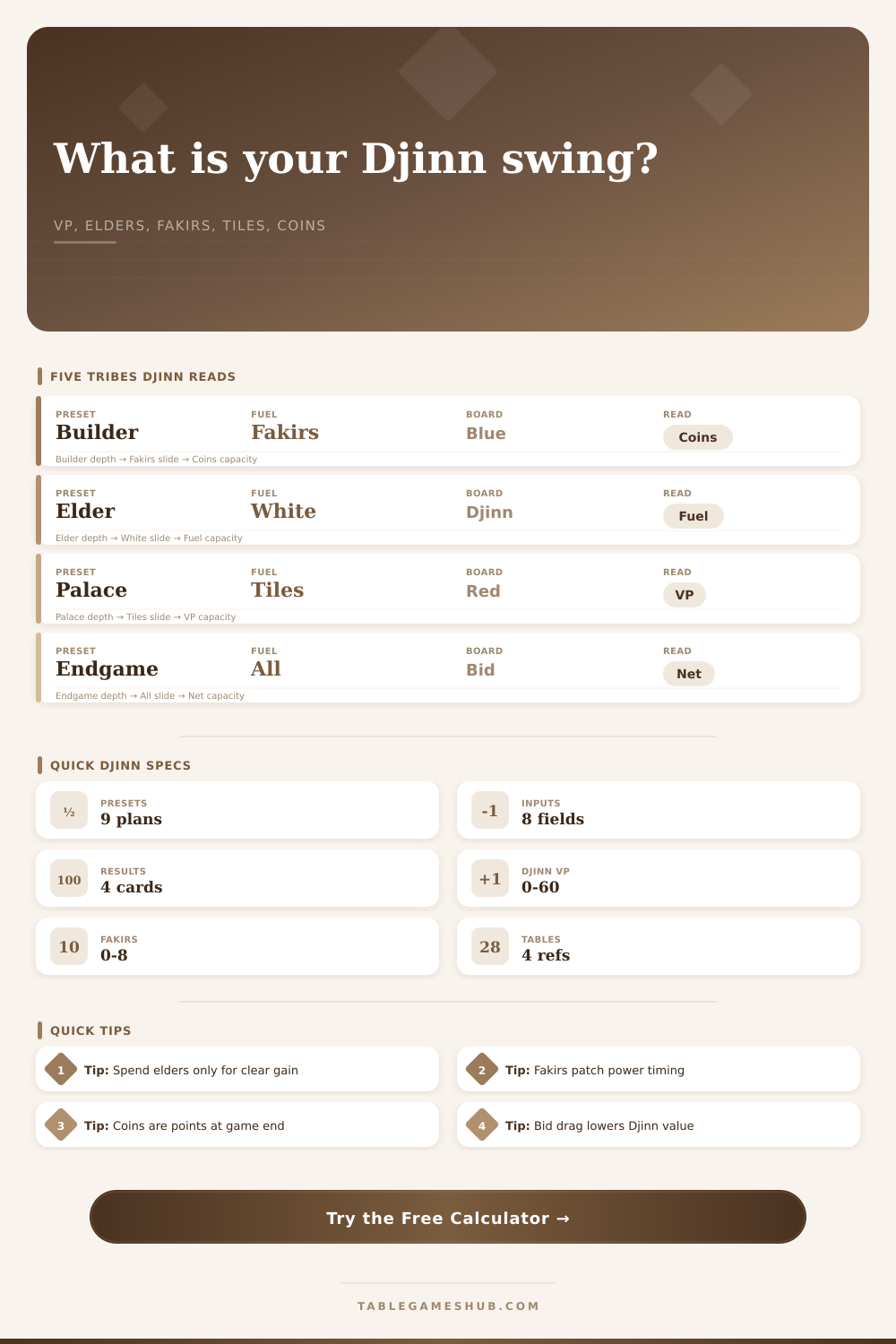
Five Tribes Djinn Calculator
Estimate the point swing of a Five Tribes Djinn line from printed Djinn VP, elder fuel, fakir timing, meeple color support, tile value, palms, palaces, coins, and turn order bid drag.
Use this as a planning tool for Djinn-heavy turns in Five Tribes. It treats coins as endgame points, elders as either fuel or saved VP, fakirs as flexible boosts, and the selected meeple color profile as the likely source of the Djinn payoff.
Five Tribes Djinn result
| Source | Calculator input | Score treatment | Planning read |
|---|---|---|---|
| Printed Djinn VP | Djinn VP printed on cards | Counts directly | Best when the bid is low and the card does not consume key elders. |
| Saved elders | Elders available | 2 points each if unspent | Spending elders is correct only when the ability beats the saved value. |
| Fakirs | Fakirs available | Flexible boost value | Strongest with builders, elder replacement, or exact timing turns. |
| Coins | Coin income from the line | 1 coin equals 1 point | Builder bursts can outscore low printed Djinn VP if blue tiles line up. |
| Meeple profile | Modeled role | Ability factor | Watch point |
|---|---|---|---|
| Blue builders | Coin burst and fakir lift | High coin conversion | Needs blue tile count or surrounding blue tiles to matter. |
| White elders | Djinn activation fuel | High fuel value | Each elder spent gives up 2 saved points. |
| Green merchants | Goods path support | Moderate endgame value | Goods must be different types to scale well. |
| Red assassins | Tempo and denial swing | Moderate tactical value | Point swing is strongest when it also wins a tile. |
| Yellow viziers | Majority and stable VP | Low direct Djinn boost | Good floor, but often less explosive than coins or elders. |
| Preset | Typical input shape | Main driver | Calculator warning |
|---|---|---|---|
| Builder Coin Burst | Builders, fakirs, blue tiles, coins | Coin income | High bid can erase the burst. |
| Elder Sacrifice | Many elders, high printed Djinn VP | Activation payoff | Compare ability value against saved elder VP. |
| Fakir Boost Turn | Moderate elders, several fakirs | Timing flexibility | Fakir value drops if the Djinn is already affordable. |
| Endgame Djinn VP | High printed VP, low remaining tempo | Printed card points | Tile and coin add-ons matter less than net bid value. |
| Palace Palm Stack | Controlled feature tiles | Board support | Djinn claim is secondary if feature points dominate. |
| Input | Clamp range | Rounding | Calculation role |
|---|---|---|---|
| Djinn VP printed on cards | 0 to 60 | Whole VP | Base Djinn score before ability and fuel adjustments. |
| Elders available | 0 to 12 | Whole elders | Activation fuel and saved 2-point elder value. |
| Fakirs available | 0 to 8 | Whole fakirs | Flexible boost, builder support, or elder replacement pressure. |
| Tile value controlled | 0 to 80 | Whole VP | Board control attached to the Djinn line. |
| Palace and palm bonus | 0 to 60 | Whole VP | Feature points on controlled tiles, usually 3 or 5 each. |
| Turn order bid spent | 0 to 40 | Whole coins | Point drag subtracted from the final Djinn swing. |
The appearance of Djinn cards in Five Tribes are deceptively straightforward. There they are, printed with victory points, promising to slowly lead you up to victory. And there lies the trap: Those point values don’t represent the complete picture. A 12-point Djinn may cost you 20 if the bidding for it saps your coin income. Or it could be worth thirty if the elders you spend to activate its power unlock a builder payout that covers half the board.
That’s when the math gets fun; you can’t count pips on cards. You have to keep track of overall swing instead. Feeding this into the calculator above does all the math for you under whatever set of circumstances you want it to address. Each input is a combined part of same system rather than separate statistics.
How to Use the Five Tribes Calculator
First you’ll enter your Djinn VP, simply the face value of the cards you currently possess or intend to grab next. More interesting are fuel inputs. White meeples are elders. They act as currency for activating effects and as score as long as they stay on their starting tile.
There’s always the question of whether to save or spend. Is the static value of the elder greater then the ability trigger? Does spending one elder on a Djinn power for three more coins makes sense? That’s what you need to ask yourself.
The tool accounts for this in its efficiency rating by showing you a percentage that shows how effectively you’re converting your fuel into actualy gain. In other words, it prevents you from doing the lazy move of throwing down an elder simply because you can.
Fakirs add yet another wrinkle to all of this. The neutral meeples can replaces nearly any need to complete a color combo. So they’re the final wildcard in the djinn line. Specifically, they’re extremely useful when there’s a call to build up a pile of blue builders but not enough tiles to do so directly.
Because their value shifts depending on what other tiles might be in play, the calculator gives them a flexible boost value. Fakirs is less important if you already have a stack of elders. But if you’re short on fuel, they’re the key that opens the door.
But here’s the thing: What colors you choose to play is much more important than most people think. Blue builders drives coin bursts, which convert into points at game end. White elders feed their djinn powers. Yellow viziers gets majority votes. Red assassins deny stuff from other players, which can swing tempo. Green merchants help goods paths.
The calculator assigns weightings based off each of these colors… So that you could have a good plan that looks bad in the short term but comes roaring back thanks to coin income and a low bid.
And speaking of bids, that’s what can kill good plans if left unaccounted for. Maybe you snagged a sweet Djinn card and won big, but at the cost of paying ten points in turn order position to get there. That makes your net gain much smaller than you think. The calculator will reflect that by removing that bid drag from your tally, giving you an accurate picture of how good (or bad) that decision realy was.
In other words, it will force you to account for opportunity cost, something most casual players don’t notice until they’re already down on points.
The final score includes some influence from tiles, such as palaces and palms. Although the activation of those Djinn may be minor, it still add a bit of static value to whatever areas you control and strengthens your hold even further. Because it helps you visualize exactly which points is originating from where, the tools come with reference tables that break all this stuff down.
It’s tempting to get caught up in eye-catching Djinn abilities. You might forget how important gradual tile control becomes, as it is often the deciding factor in the game. This approach changes the way you think about the game from being reactive (getting whatever VP card is next) to planning out strategy. Instead of just taking best VP card available, you are forced to build most efficient engine.
It makes you question how many elders you have left. Can I fill that gap in my color with a fakir? Is it worth paying that much now for a longer term benefit? Every point should of matter. It is not because you’re taking Djinn cards. But making them count. And that change in thinking is what distinguishes a good player from someone who really understands how the game flows.