🃏 Yu-Gi-Oh Consistency Calculator
Balance the main deck, test opener odds, and see whether your list leans combo, control, or pile.
Type share
Track how much of the main deck is monsters, spells, traps, and flex.
share = category copies / main deck size
Starter access formula
Use the hypergeometric distribution to measure starter access in the opening window.
P(X = k) = C(K,k) C(N-K,n-k) / C(N,n)
Two-card line
Check lines that need both a starter-side card and an extender-side card.
P(A and B) = 1 - P(no A) - P(no B) + P(no A and no B)
Target copies
Scan upward until the desired consistency chance is reached for the chosen seen cards.
needed copies = smallest count that meets the goal
Deck Structure
Target Copies
Consistency Table
Brick Profile
Counting rule
Count each card in one primary bucket. That keeps the hypergeometric opener math exact and makes the consistency score easier to read.
Reading the result
If starter odds are short, add starters first. If starter odds are fine but your combo line is weak, push extenders or interaction before adding more bricks.
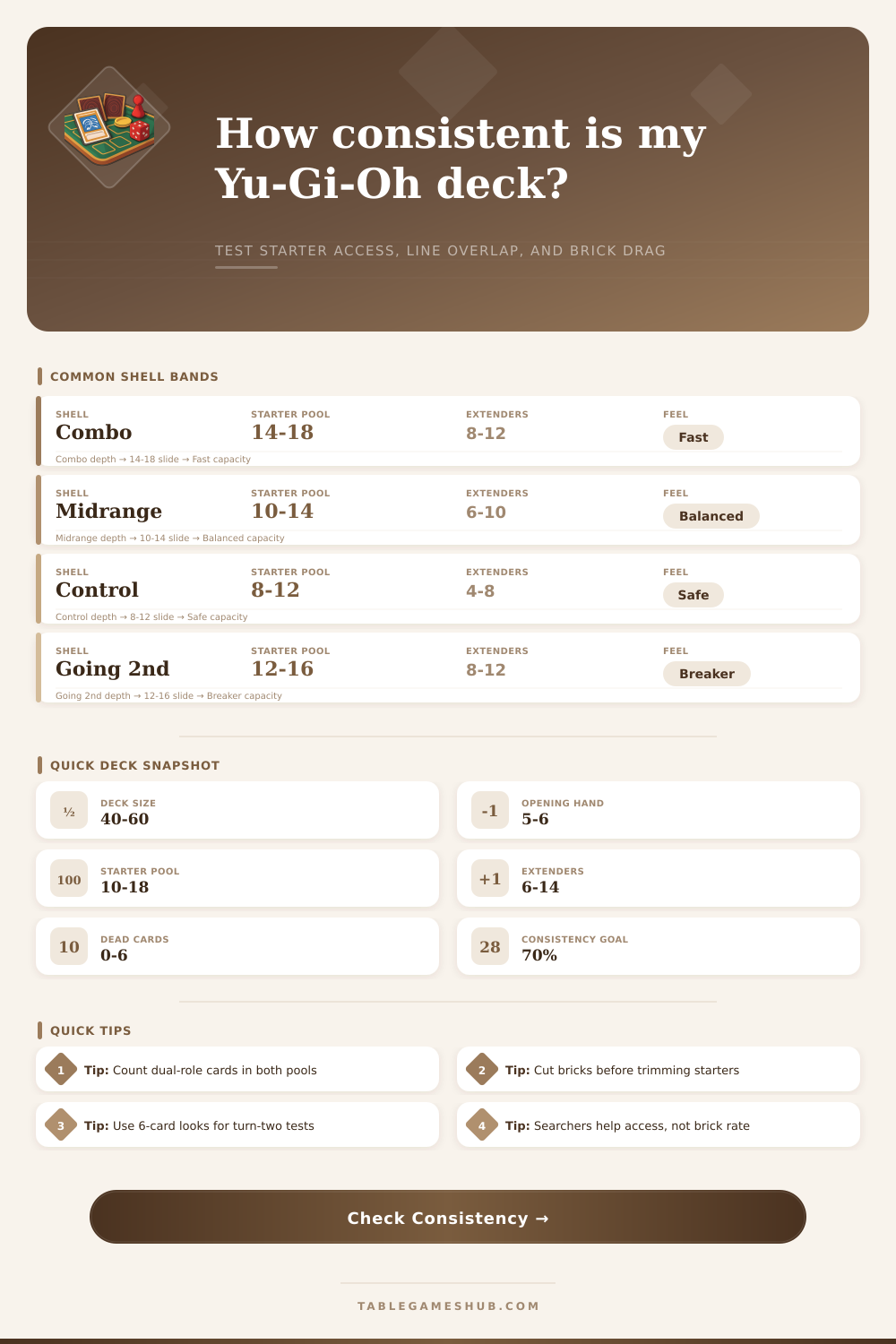
A consistent deck in Yu-Gi-Oh! TCG is any deck, whether strong or weak, powerful or niche, that commonly succeeds to reach a combo, play or precise game state. Basically, consistency means that the deck fits to do its plan in most matches.
For that, players should include cards of the engine, the classical consistency spells and starters.
How to Make a Consistent Yu-Gi-Oh Deck
Samples of consistent decks are PK Fire, Zoodiacs or alike Dragon Rulers. Interestingly, their force came from plenty of starters and searchers, that progressed the game state and meant the big plays. Archetypes where all cards do the same task or have many searchers for the main parts tend to be reliable.
Crusadia, Tenyi and Burning Abyss show that with cards with identical effects. Monarch well illustrates decks with good searchers, draw engines, recycles and consistency elements.
Some decks regularly access various plays, while others are reliable only for one particular combniation. The first work well if all plays are powerful, but the second is good only if that alone play is extraordinary strong.
From a number viewpoint, in 100 test hands consistent decks brick only 0 until 5 times, so 95% or more consistency rate. Widely top meta decks want at least 85% reliability, which means no more than 15% of bricks. The best way to estimate consistency is to observe how often a good hand comes from the whole deck, not from casual five card draws, because removing five cards strongly alter probabilities for the next hands.
Tools like yugioh.party help with figures about ratios, that must correct themselves. Also exist probability calculators for multiple combinations, that improve consistency for particular decks. They use hypergeometric analysis to count chance of key cards in the initial hand.
Decks still have 40-card minimum for the Main Deck, but now max at 60 cards here. Running 60 cards is not advised because of consistency reasons. The Extra Deck maxes at 15 cards.
Card Destruction is a minus one, but for consistency it could be useful. It is a real gamble… Well timed it can messup the opponent, or rather help them advance.
In OTK strategies with discards it can be worth it. Tabletop Simulator allow you to play Yu-Gi-Oh! with physical feel of cards, although setting of mechanics requires work.