Qwirkle Qwirkle Bonus Calculator
Total a Qwirkle turn with main-line length, matching color or shape mode, six-tile bonuses, cross-line score, tiles played, bag remaining, and refill pressure.
| Final Line Length | Base Score | Qwirkle Bonus | Line Total |
|---|---|---|---|
| 1 tile line | 1 | 0 | 1 |
| 2 tile line | 2 | 0 | 2 |
| 3 tile line | 3 | 0 | 3 |
| 4 tile line | 4 | 0 | 4 |
| 5 tile line | 5 | 0 | 5 |
| 6 tile Qwirkle | 6 | 6 | 12 |
| Tiles Played | Main Length | Cross Pattern | Typical Total |
|---|---|---|---|
| 1 | 5 | One 3-line | 8 points |
| 2 | 4 | Two 2-lines | 8 points |
| 3 | 6 plus bonus | Three 3-lines | 21 points |
| 4 | 5 | Four 2-lines | 13 points |
| 5 | 6 plus bonus | Five 4-lines | 32 points |
| 6 | 6 plus bonus | Six 3-lines | 30 points |
| Bonus Situation | What To Count | Bonus Added | Common Check |
|---|---|---|---|
| Main line reaches six | Full main row or column | 6 points | No duplicate color or shape |
| One cross reaches six | That crossing line only | 6 points | Played tile belongs in both lines |
| Multiple crosses reach six | Each completed cross | 6 each | Enter cross Qwirkles count |
| Five-tile line | Line length only | 0 points | No bonus until six |
| Rack empty at game end | Turn score first | Game rule bonus | Add separately if used |
| Bag Before Refill | Tiles Played | Drawn Back | Bag After |
|---|---|---|---|
| 42 | 6 | 6 | 36 |
| 18 | 4 | 4 | 14 |
| 6 | 6 | 6 | 0 |
| 3 | 5 | 3 | 0 |
| 0 | 2 | 0 | 0 |
The last tile in a row of six gets laid down, the room falls silent and you notice the pattern snap into place as your mind tallies up extra points. That’s when you realize how good that instant gratification feels; it’s so great that it hides the arithmetic truth behind the move. How much did it gain you against other player? Did it simply look good, or was it good?
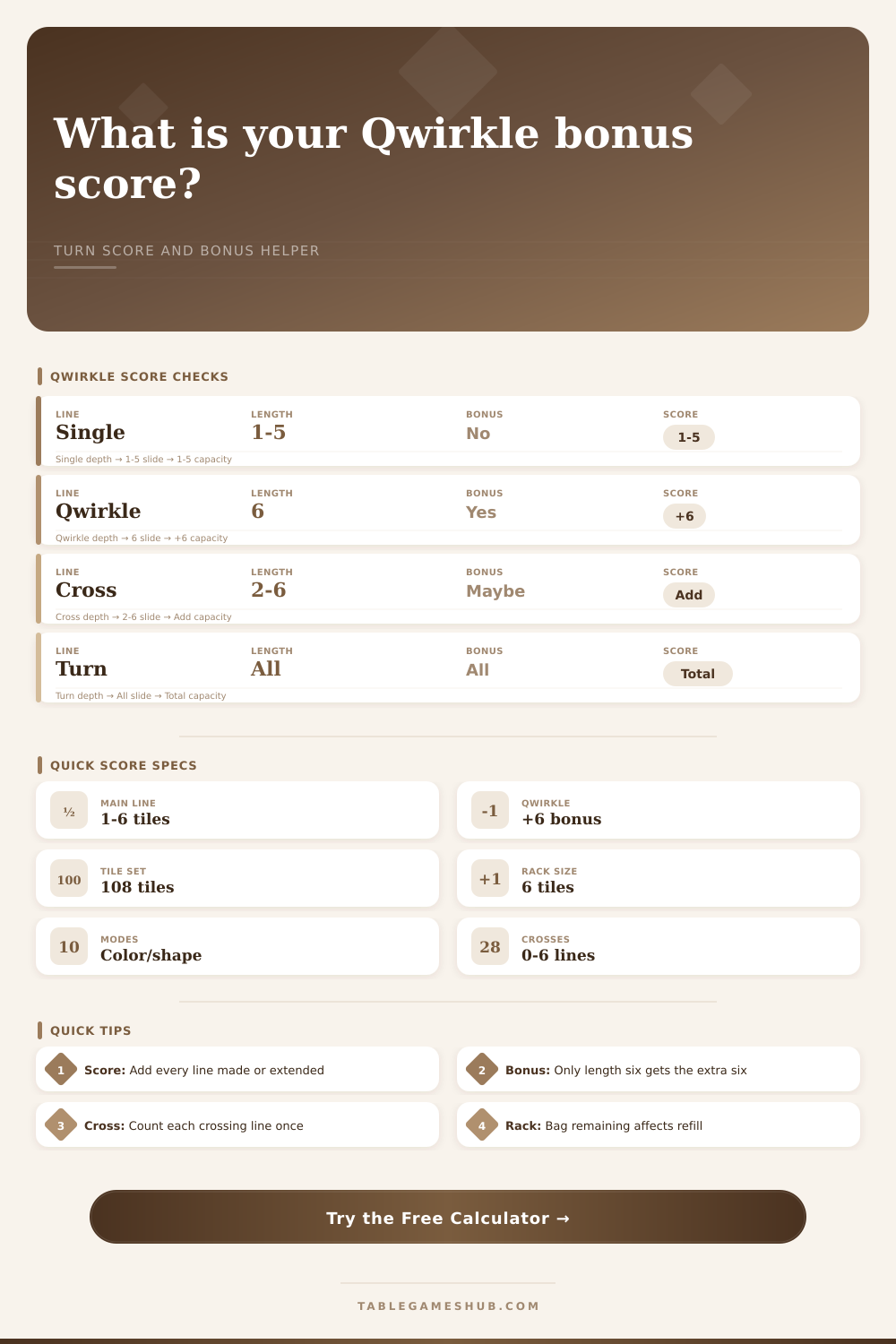
On surface, scoring Qwirkle seem straightforward, but there is more going on underneath different than many casual gamers can see. Here’s how it works: One point per tile in a formed line. You gets a bonus if you make a complete line of 6 tiles. That’s six more points. Six points for the tiles plus a six-point bonus, that’s a dozen-point swing from one move.
How to Count Points in Qwirkle
Most people think about the bonus and forget about being efficient with other portion of their turn. Sure, that one six-tile line look good, but two five-tile lines? That is ten points with no bonus. That’s nearly just as good. It takes fewer resources.
The calculator handles all the math when you enter your line lengths and count how they cross. No need to juggle multiple perpendicular score at once.
It’s not enough to make lines in Qwirkle, you must control the intersections where they meet. Each time you play a tile, it join the row/column where it lands. So if playing that tile also finishes off a three-tile column and a six-tile row, then you get two scores for one move: twelve points for the row plus another three for the column. That’s fifteen points from a single play. Because your eyes will be locked onto completed pattern, most people fail to include the column score at all. Use this page as a reminder not to leave any free points on the table; force yourself to think explicit about these cross-lines.
The time factor is also affected by the bag status. Once there’s no room in the bag for new tiles, and someone can’t make a move, it’s over, game done. Long-term possession of key tile becomes more valuable than short-term point-scoring. When there’s only a handful of tiles left in the bag, sometimes a cautious three-pointer that doesn’t risk losing your best-formed shape would of been the better bet than a dicey twelve-pointer that results in a bunch of nothing in your hand. You’re not just playing to win points; you’re playing to survive. There’s a field in the calculator where you enter how many tiles remain in the bag so you’ll know where you are in the game. Getting a high score isn’t worth anything if you wind up with zero tiles left to play and your opponent get another three turns.
Qwirkle’s another game where efficiency is a key measure. You begin with six tiles and you’d better make good use of them. Six tiles in a row on your first play might be efficient. However, they are worth less than their individual values added together if that single row does not total enough to get you anywhere. Spread those six tiles across different lines instead to create multiple scoring opportunities. You have three chances at earning points instead of one. That could put you farther ahead.
That’s a small detail, but details matter. A few extra points here or there make the difference between a decent score and a game-winner during mid-play. Seeing that a split move get you more points than trying to concentrate your score is what makes the difference. These situations are laid out in detail in the reference tables included with the calculator, which demonstrate how a single row of 5 tiles yields no bonus, making it clear why you want that sixth tile or settle for less strategically. And it illustrates that cross-lanes each gets their own score, meaning that a cluttered board filled with lots of tiny spots might be better than a neat one with only a couple of long lines.
Examine your board position prior to going. Count the number of possible crosses and look at the intersections. Is it worth exposing yourself for that bonus? To win at Qwirkle, you have to move from pattern spotting to resource management. You’re not only keeping track of your hand (which contains six tiles), but also the state of the board (shared with everyone) and what’s left in play, or out of play. It’s all about balance: the carrot (bonus points) versus the stick (cross lines that make it competitive). When you no longer view the board as a problem to solve but instead as a group of overlapping investments, that’s where the scoring start to climb.
You’ll still get that same nice tile-click feeling at the end, but this time around you’ll know precisely how much it meant.