Queendomino Tax Calculator
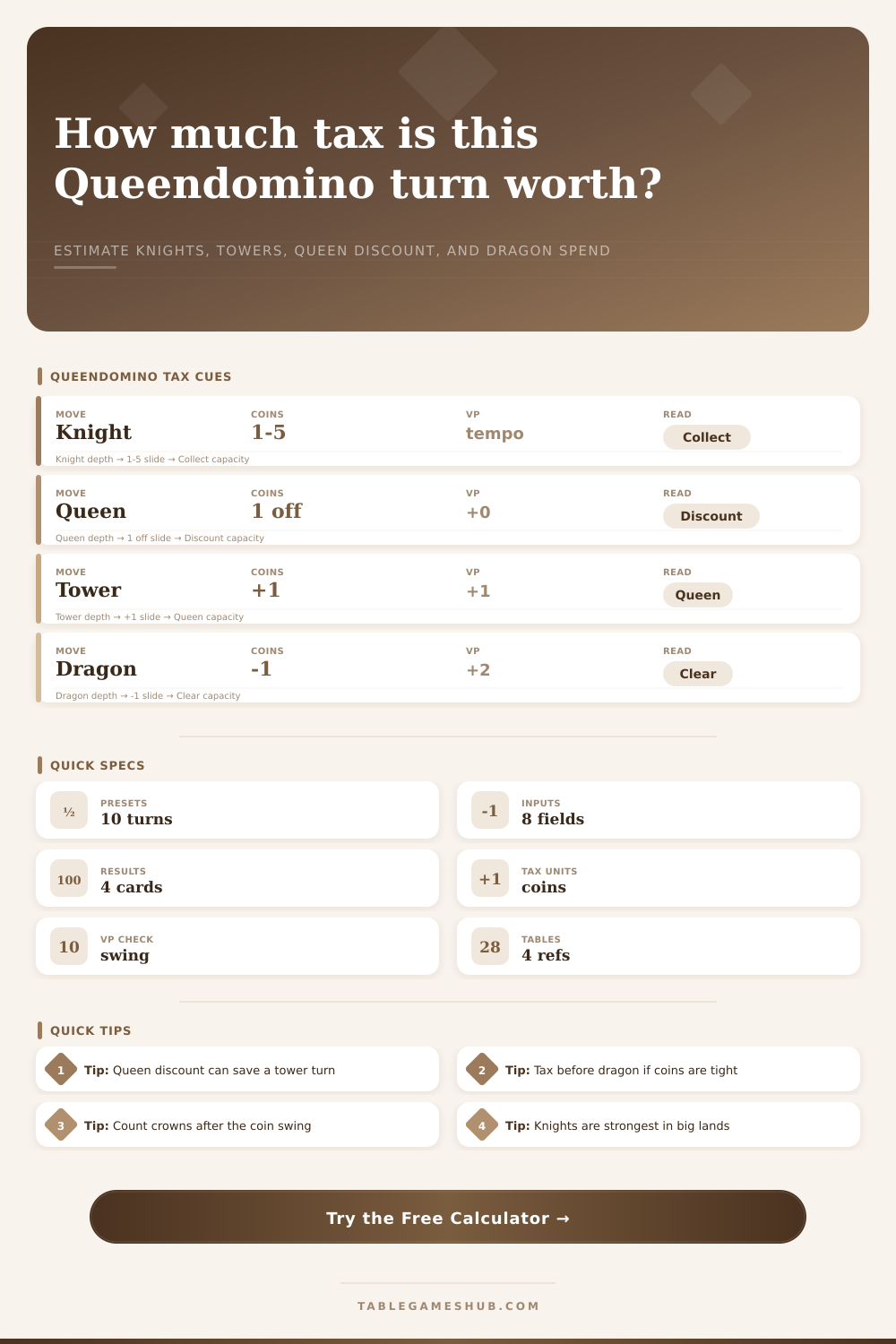
Estimate a Queendomino tax turn by combining knights, taxable buildings, towers, queen discount position, coins in hand, building VP, dragon spend, and territory type.
Use this as a planning model for the coin tempo around a building purchase, knight collection, queen discount, or dragon clear. The calculator separates tax income, saved coins, net coins, and the point swing created by the building and territory.
Queendomino Tax Result
| Territory | Tax density | VP pressure | Best use |
|---|---|---|---|
| City | High | Building VP | Queen discount and tower timing |
| Field | Medium | Crown scale | Large territory collection |
| Forest | Medium | Tile quality | Balanced tower and knight turn |
| Water | Low | Continuity | Small tax with safe expansion |
| Mine | High | Coin tempo | Funding expensive buildings |
| Swamp | Swingy | Crown chase | Only when the VP tile is strong |
| Queen state | Saved coins | Tower link | Calculator read |
|---|---|---|---|
| No queen | 0 | No effect | Taxes must fund the full buy |
| Same city | 1 | Stable | Best discount reliability |
| Tower lead | 1 | Needs lead | Discount counts but risk remains |
| Other city | 0 | Future pull | Towers add VP pressure only |
| Preset | Main lever | Coin pressure | Card to watch |
|---|---|---|---|
| Queen Discount City | Discount | Low | Net coins |
| Tower Tax Round | Towers | Medium | VP swing |
| Dragon Clear Buy | Market clear | High | Efficiency |
| Knight Collection | Tax income | Medium | Tax income |
| Mine Money Round | Coin tempo | Low | Net coins |
| Efficiency band | VP per coin | Turn read | Warning |
|---|---|---|---|
| Excellent | 3.0+ | Strong buy | Protect the city |
| Good | 2.0 to 2.9 | Likely worth it | Check dragon spend |
| Thin | 1.0 to 1.9 | Needs tempo | Queen may be required |
| Poor | Under 1.0 | Usually delay | Tax first or pivot |
In Queendomino, there are dragons; you can use taxes on your turn to expand your kingdom. Or risk it all against a dragon who rids you of what you’ve built. You look down at your hand. Count your coins. Every decision feels like a gamble. Money is now just as valuable as land, not for point value alone. Managing cash flow is half the battle here.
While most players plan where they want to place their tiles, they fail to realize they can’t afford them without the resources to begin with. While it’s still a board game with castles and farms to build, this one also makes you think like an accountant, you’re operating a small economy and you need to carefully budget.
How to Manage Your Money in Queendomino
Rather than worry about getting the right number each turn, know what calculator is measuring, which will shift the way you approach the game. Recognize when something burns through your resources for short-term gain and when it’s worth it in the long run. Let the calculator do the math for you.
The problem with knights is that they make money from the buildings they’re guarding, but their value actualy depends on how those buildings are placed… So just having more buildings isn’t enough! The value of a knight vary widely between locations. You can’t put a knight in a tiny grouping or else it’s not worth anything at all; meanwhile, putting one in the middle of a crowded district of cities will earn you a literal goldmine.
So when you input your knights and taxable buildings, what you’re essentially doing is asking yourself: Does my current configuration justify collecting coins? Maybe your kingdom is now big enough that your knights would produce less then the price of acquiring new tiles, in which case you should save them up for next turn. That’s why people mess this up, they’re collecting taxes too soon, before their infrastructure generates large amounts of money.
This might seem like a small discount for the queen, until it means the difference between being able to afford a castle or going broke. The calculator lets you run the numbers and weigh the queen’s discount against your current coin reserves. If you’ve got lots of coin saved up, saving a single coin won’t matter much. But if you’re strapped for cash, that single coin will be enough to save an entire turn. That gives you wiggle room to use that coin to buy a tile you actualy wanted instead of clearing some unwanted tiles off the board using the dragon.
Timing is key here. You’ll want the queen running whenever you need to make a large purchase, not just sitting around as you watch your pockets overflow.
The other thing is towers. Towers are complex because they provide pressure rather than direct income. This pressure help establish the queen’s perch and creates more scoring opportunities in the process. More towers = more effective queen = more stable discount environment. That’s important because it allows you to think further ahead, and instead of reacting from one turn to another, you’re executing on a strategy. That enables you to start seeing moves as part of a sequence, versus standalone actions.
Dragon spends coin from your treasury when you clear away bad tiles. The calculator will tally how much you spend against the amount of money it earns for you in taxes, giving you an idea of what your net position is. Generally speaking, if you’re losing more money cleaning the board than you’re gaining in taxes, then you’re bleeding yourself dry. You’ll need to turn things around somehow.
You could of tried waiting for better collection opportunities, or using the dragon carefully to clear some of the way out first so you can expand later.
Different types of land create different pressure; for example, forests are balanced because they provide both points and coins, whereas a mine yields a lot of coin but not much point value. These profiles will help show where to focus efforts over time. They can help you decide how to manage each turn of taxes and when to skip a mine whose gold you don’t need to pick fields that add more to your crown count.
The goal here is efficiency: You want to get the most points with the least amount of coins spent, and the calculator quickly checks your ratio. It will tell you if your next move helps your cause, or hurts it, so run through your hunches in the calculator first before committing them to board.
When you start keeping track of these flows, you’ll find yourself understanding the hidden money currents driving each decision. What had been a chaotic game of laying out tiles suddenly turns into a manageable puzzle. The calculation replaces the gamble.