Ticket to Ride Europe Score Calculator
Total your routes, destination tickets, train stations, European Express bonus, tunnel extras, ferry locomotive spaces, and failed-ticket penalties.
Enter your claimed route lengths, ticket totals, station count, and European Express status. The calculator follows the standard Ticket to Ride route scoring ladder and keeps Europe-specific station, tunnel, and ferry details visible in the final breakdown.
| Route Length | Printed Score | Cars Spent | Score Efficiency |
|---|---|---|---|
| 1-car route | 1 point | 1 train | 1.00 point per train |
| 2-car route | 2 points | 2 trains | 1.00 point per train |
| 3-car route | 4 points | 3 trains | 1.33 points per train |
| 4-car route | 7 points | 4 trains | 1.75 points per train |
| 5-car route | 10 points | 5 trains | 2.00 points per train |
| 6-car route | 15 points | 6 trains | 2.50 points per train |
| 8-car route | 21 points | 8 trains | 2.63 points per train |
| Europe Element | Score Treatment | Calculator Input | Endgame Note |
|---|---|---|---|
| Train stations | 4 points per unused station | Train Stations Built | Built stations do not score their unused bonus. |
| European Express | 10 points if awarded | European Express Bonus | Only award when longest continuous route is confirmed. |
| Tunnels | Route score by length only | Extra Train Cards Paid on Tunnels | Extra cards affect hand pressure, not route points. |
| Ferries | Route score by length only | Locomotive Spaces Used on Ferries | Locomotives are tracked for route difficulty context. |
| Destination tickets | Completed positive, failed negative | Completed and Failed Ticket Points | Failed tickets are the largest common final swing. |
| Ticket Audit Step | What to Add | What to Subtract | Common Check |
|---|---|---|---|
| Completed tickets | Printed value for each success | Nothing | Both endpoint cities connected by your trains or valid station use. |
| Failed tickets | Nothing | Printed value for each failure | Do not offset failures before entering them here. |
| Station-assisted tickets | Ticket value if station completes the path | Lost station bonus if built | Remember a station points to one adjacent opponent route. |
| Manual correction | Nothing | Penalty adjustment entered | Use only for agreed scoring corrections. |
| Scoring Area | Base Game Role | Europe Detail | Calculator Output |
|---|---|---|---|
| Route points | Length-based score ladder | Tunnels and ferries still score by route length | Route Score and Cars Used |
| Ticket points | Hidden objective swing | Long routes and station assists can change net value | Ticket Net and Failed Penalties |
| Stations | Not in the original base map | Three station pieces per player, 4 unused points each | Station Bonus |
| Longest route | Continuous route bonus | European Express is 10 points | Bonus Line in Breakdown |
| Endgame pressure | Train count matters | Ferries need locomotive spaces and tunnels can drain cards | Hand Pressure Note |
This calculator is for endgame scoring and score-sheet checking. It does not replace the table decision about whether the European Express bonus is shared or awarded to a single player under your rule interpretation.
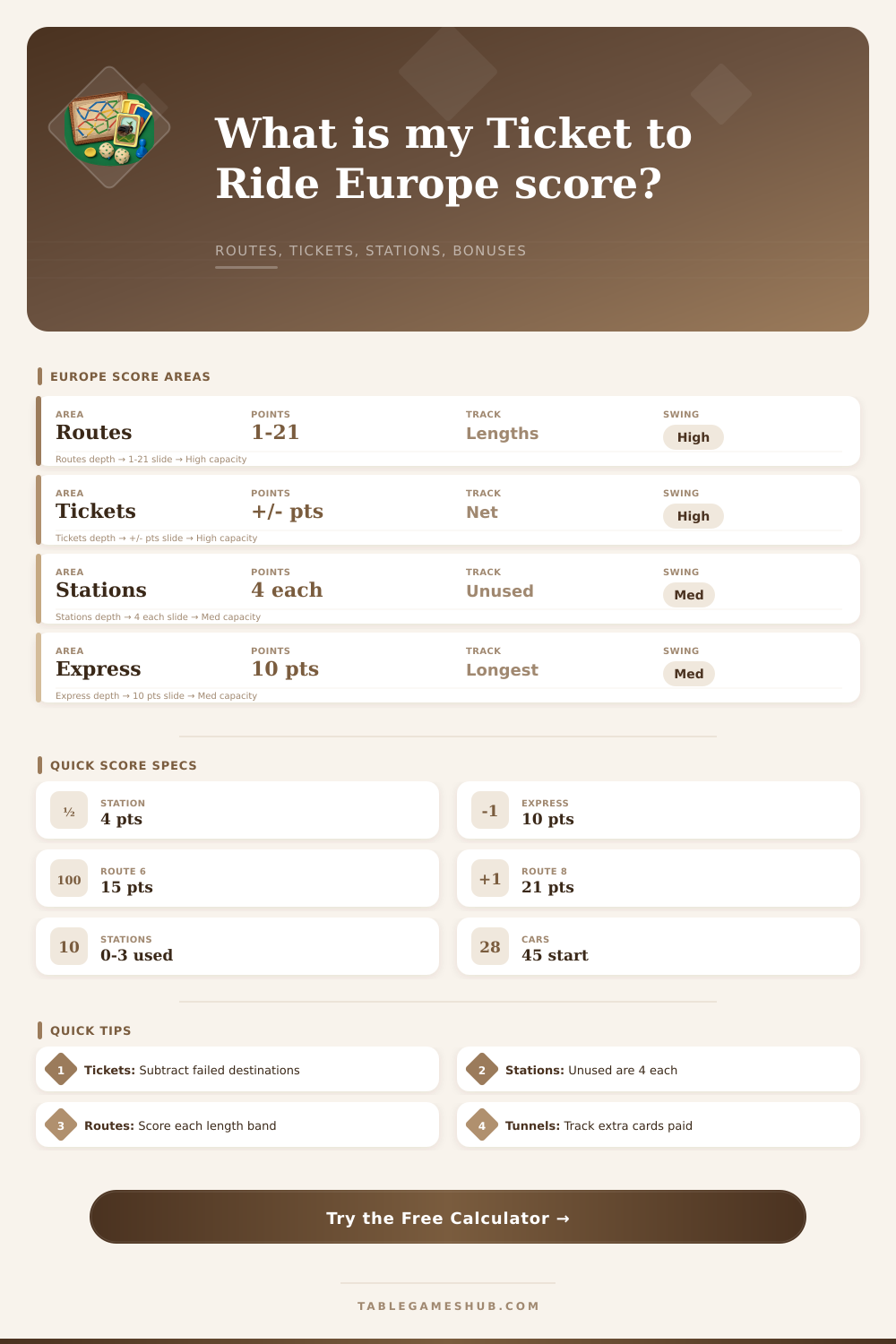
Scoring a game of Ticket to Ride Europe requires that you add many different type of points together. Beyond calculating the points that you earned from your routes, you must also calculate your points from your destination tickets, your unused stations, and the European Express bonus. Because there are so many different types of point to calculate, most player use a scoring tool to ensure that there score is accurate and that they have not forgotten to add any points to their total score.
The first type of points that you calculate are the points from your routes. Each route contains a certain number of train car that are used to build that route. The more train cars in a route indicates that the route is worth more point then a route that contains fewer train cars.
How to Count Points in Ticket to Ride Europe
Thus, each player should calculate the number of route of each length that they built, and enter that information into the scoring tool to calculate the total points that they earned from their routes. The second type of points that you calculate are the points from your destination tickets. Each destination ticket can either add to or subtract from your score.
If you completed a destination ticket, you earned points equal to the value of that ticket. However, if you did not earn the destination ticket, you will lose points equal to the value of that destination ticket. Thus, each player should write down the number of completed and fail tickets to input into their scoring tool.
The third type of points that you calculate are the points from the unused station. Each player starts the game with three station. Each station that is unused by the end of the game is worth four points.
Thus, if you did not use a station to earn any destination ticket, you will earn four points for each unused station. You should count all of the unused stations and add their points to your total score. The fourth and final type of points that you calculate is the European Express bonus.
The player who has the single longest continuous route of train cars receives the European Express bonus. The European Express bonus is worth ten points. Thus, each player must determine who has the longest continuous route to award the bonus of ten points to that player.
All of these point categories must be combined to determine a player’s final score for the game. To calculate your score, add the points from your route tickets to the points from your destination tickets. Add the points from your unused stations to that total score.
Finally, add the European Express bonus to that total score if you earned the bonus. Using a scoring tool helps to ensure that a players score is correct, and makes the game scoring process more faster for the players. It’s also alot more easy than manual math.