Piquet Score Calculator
Total a Piquet deal from declarations through trick play, including carte blanche, point, sequences, sets, cards, capot, pique, repique, match targets, and swing.
1Preset Piquet Deals
Pick a realistic score sheet, then adjust any claim or trick result before calculating.
2Match and Rule Settings
3Player Score Lines
Enter the declaration values your table accepts. The calculator then adds trick points, cards or capot, and any pique or repique bonus.
Elder Hand
Younger Hand
4Piquet Component Grid
5Reference Tables
| Declaration | Typical score | When it is counted | Calculator field |
|---|---|---|---|
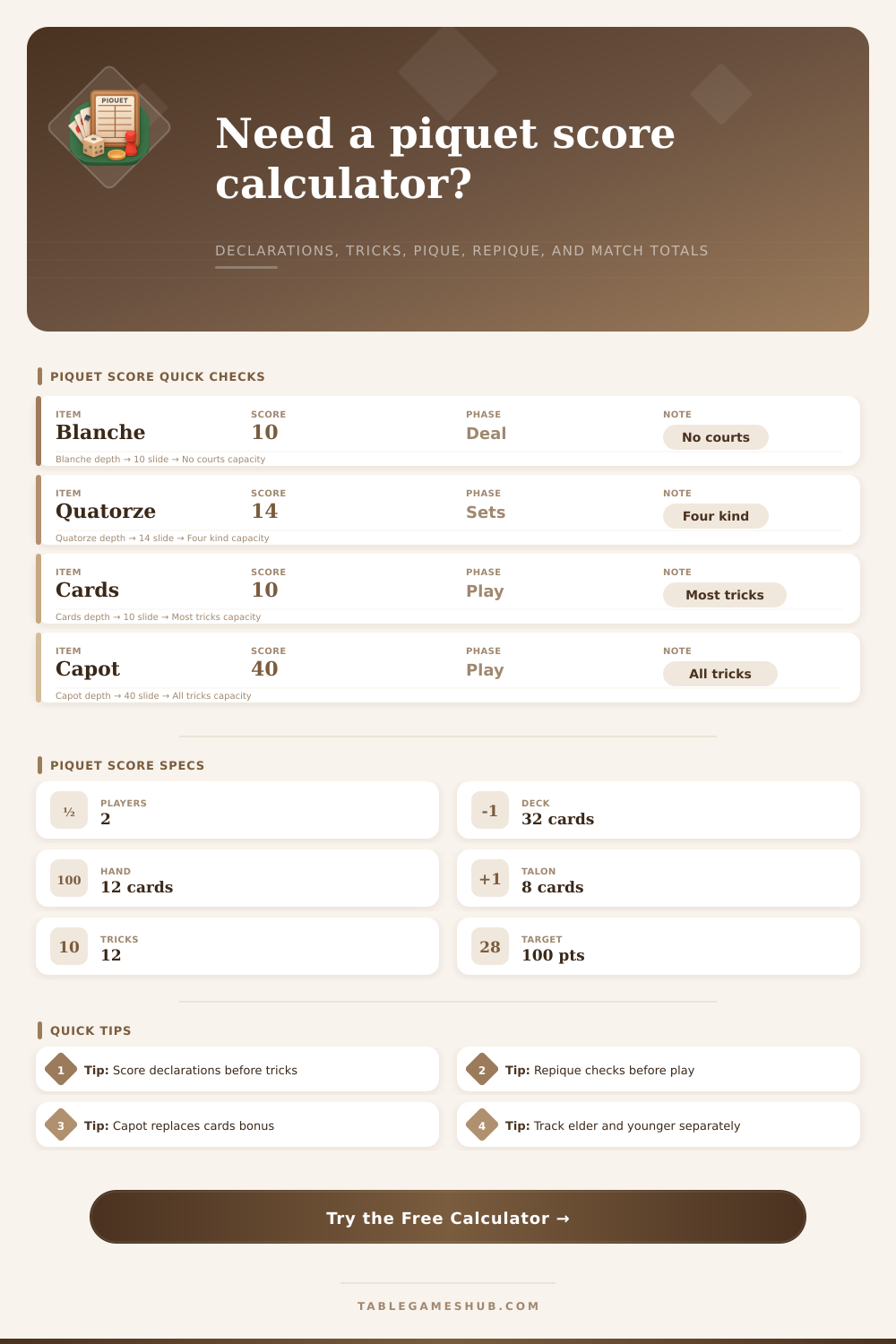
| Carte blanche | 10 | Before exchange, if a hand has no court cards | Carte blanche selector |
| Point | Suit length | Best suit length; ties compare pip totals at the table | Point claim |
| Tierce, quart, quint | 3, 4, 15 | Best valid run by rank order | Sequence claim |
| Sixieme to huitieme | 16 to 18 | Longer declared sequence | Sequence claim |
| Trio | 3 | Three aces, kings, queens, jacks, or tens | Set claim |
| Quatorze | 14 | Four aces, kings, queens, jacks, or tens | Set claim |
| Play item | Default score | Who receives it | Calculator handling |
|---|---|---|---|
| First lead point | 1 | Elder hand, if your table scores it | Rule setting toggle |
| Trick won | 1 each | Winner of each trick | Tricks won fields |
| Last trick | 1 | Winner of trick twelve | Last trick selector |
| Cards | 10 | Player winning more than six tricks | Auto-added unless capot applies |
| Capot | 40 | Player winning all twelve tricks | Replaces cards bonus |
| Bonus | Default value | Trigger checked | Practical note |
|---|---|---|---|
| Repique | 60 | 30 or more from declarations before opponent scores | Checked from blanche, point, sequence, and set totals |
| Pique | 30 | 30 or more before opponent scores during play | Checked after adding early play points |
| Manual bonus | Variable | House correction or adjudication | Use the bonus mode or adjustment fields |
| Match closeout | Target gap | Total equals or passes target | Reported in the result breakdown |
| Preset | Main feature | Expected swing | Best use |
|---|---|---|---|
| Repique Before Play | High declaration score | Large elder gain | Testing declaration-only bonus timing |
| Capot Sweep Hand | All twelve tricks | Major play gain | Checking cards versus capot replacement |
| Balanced Declarations | Close claims and split tricks | Small margin | Normal match bookkeeping |
| Final Deal to 100 | Both players near target | Winner check | Endgame score verification |
6Scorekeeping Tips
Declaration order: Write blanche, point, sequences, and sets before trick play starts. That keeps repique checks clean and avoids mixing play points into declaration totals.
Cards versus capot: If one player wins all twelve tricks, use the capot value instead of the normal cards majority bonus, then keep any last-trick point separate.
“Piquet is an arithmetic and memory test under fire. A two player duel where every point count toward a traditional target of one hundred. Counting pips in your hand while trying to remember what just happened, which was the last trick? Mistakes is made quickly.
“The maths are done by the calculator. Plug in result of each trick along with your declaration and it will do the work for you. No need to make a mistake with mental arithmetic when dealing is at stake. Concentrate on strategy instead.
How to Score Piquet Using a Calculator
Scoring logic change based off the two types of games: there are declaration rounds, which are scored separately from trick rounds. During the former, each player add up what they have (sets, sequences, and points held) before any cards is played for tricks. Before the next person can make any declaration, or win any tricks, it determine if a pique or repique bonus is in play. A repique is when the older hand earn at least thirty points through only their declarations. This provides a large sixty-point bonus to whoever is ahead so far. This effectively shuts off the other player’s scoring for the round. If your system is set to auto-detect, the software will check that limit for you. You won’t skip a big shift in scoreline.
Without the repique, the game continues on with trick taking. Each of the twelve tricks will be worth one point. Bonuses is also available for taking the final trick and for having taken the most tricks in total. In most clubs, this takes the form of a cards bonus. If you take seven or more tricks, you score an additional ten points. If you can manage to take all twelve tricks (called a capot), it replace the cards bonus altogether by giving you a whopping forty points. Why would that matter? Because the cards bonus is only triggered if you take ten tricks. It is not nine or eight, but exactly ten. To get the capot, you have to win them all.
That’s where the calculator comes in. It makes a clear distinction between those results. This removes the risk of doubling up your bonuses or multiplying the wrong result for a hand in which you dominated.
Each declaration has a hierarchy: how it affects your overall score. First is carte blanche which gives you an instant 10 points. In other words: no court cards when the deal starts. Next is the point claim of the highest ranking suit containing the highest number of pips. After that come sequences (such as quintets or tierces). And lastly, sets (trios and so on). If you can’t remember off-hand whether a set of three kings beats a set of four queens, refer to reference table; that spells it all out quickly. Longer sequences mean better score. But be careful: gaps makes the entire claim invalid.
Without some sort of structure for keeping a running total from deal to deal, it’s easy to get all screwy. A lot of guys just make notes on paper as they go along. Then they look up midway and see they’ve lost count of which guy won by how much. Having two running totals, one for elder hands and one for younger, makes things clearer. You can use the input boxes to roll-over earlier scores, so you have total score you need right there, anytime. That way you know at every deal how far above or below par you are compared to the match goal. This can be helpful when deciding whether to play conservative or aggressive in upcoming deals. There are twenty points left to get, with maybe three deals remaining. This change the risk/reward equation.
Every house has its own rules, and they differ enough that customizing is important. For instance, some list only the initial lead point (if any) awarded to the older hand. Some make no provision at all. Some consider a capot sweep worth more then a normal sheet of clubs, while others do not. The settings screen allow you to set all this according to how you play with friends locally. Nothing changes basic rules of the game, but it makes the app good for teaching those who is just learning. It also works for logging formal matches between experienced players.
Good scoring reinforces good play. Knowing who has won what round make sure the hard-fought points aren’t lost through a basic error of calculation. A player who understands how repique closes out an opponent’s momentum stays on his toes in the early part of the game. Knowing when to push and declare another round, and when it’s time to hang back would of make or break a match. Piquet favors precision over luck.”