Pentomino Coverage Calculator
Count a pentomino board by rows, columns, holes, placed pieces, and overlap squares.
Exact cover
Target area equals placed square count, holes are already subtracted, and overlap is zero.
Hole board
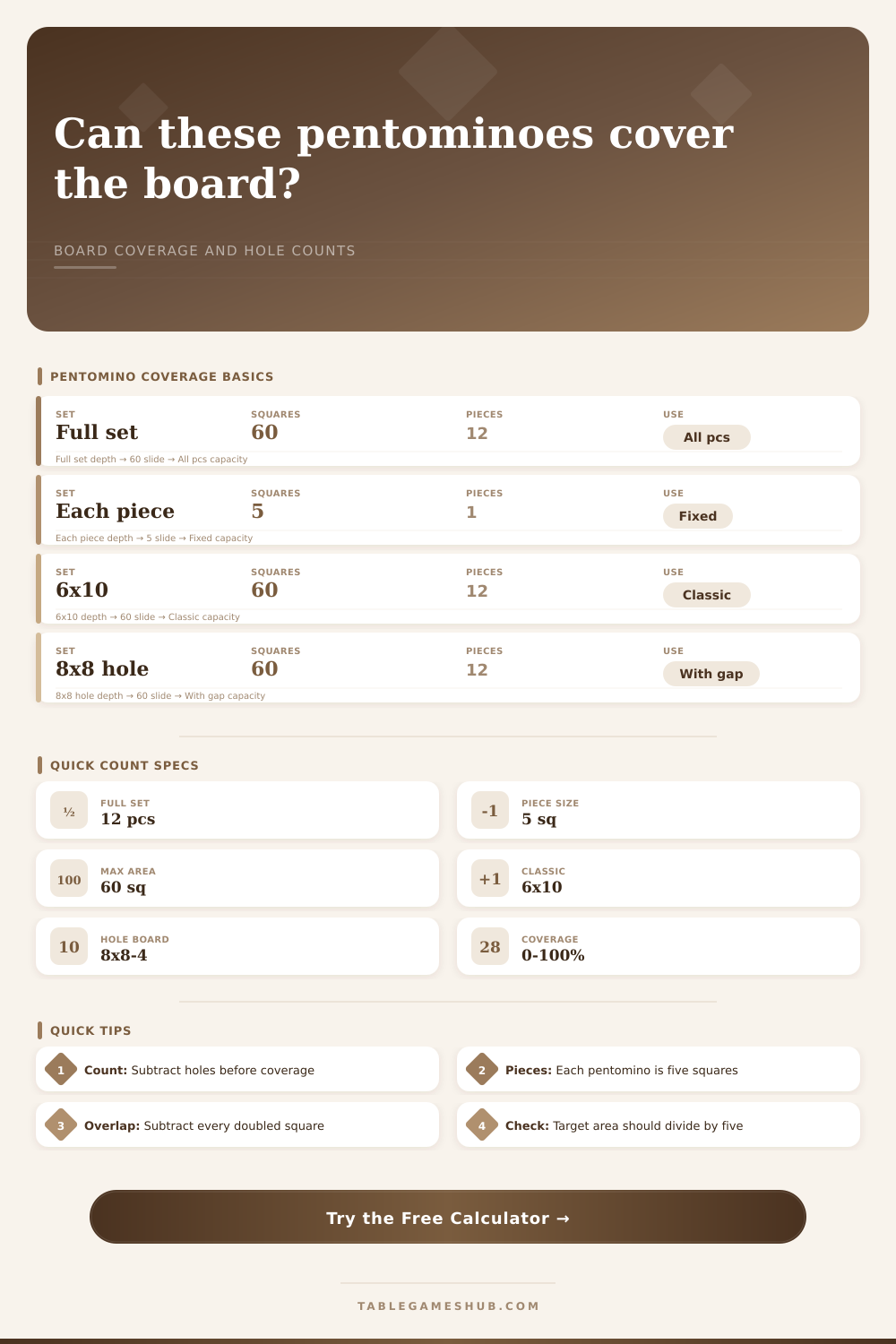
Board frame is larger than 60 squares, with removed holes making the target area match the set.
Partial cover
Placed pentominoes cover part of a target region, so the remaining-square count matters most.
Audit count
Overlaps and clipped squares are subtracted to estimate unique covered cells after a rough placement.
| Board frame | Frame area | Hole squares | Target area | Pieces for cover |
|---|---|---|---|---|
| 6×10 rectangle | 60 | 0 | 60 | 12 pentominoes |
| 5×12 rectangle | 60 | 0 | 60 | 12 pentominoes |
| 4×15 rectangle | 60 | 0 | 60 | 12 pentominoes |
| 3×20 rectangle | 60 | 0 | 60 | 12 pentominoes |
| 8×8 with four holes | 64 | 4 | 60 | 12 pentominoes |
| Pieces placed | Raw squares | Share of set | Squares left in set | Common use |
|---|---|---|---|---|
| 3 | 15 | 25.0% | 45 | Opening shape test |
| 6 | 30 | 50.0% | 30 | Half-board check |
| 9 | 45 | 75.0% | 15 | Late placement audit |
| 10 | 50 | 83.3% | 10 | Missing two pieces |
| 12 | 60 | 100.0% | 0 | Full-set rectangle |
| Check | Formula | Clean result | What it flags |
|---|---|---|---|
| Target area | rows × columns - holes | Positive integer | Bad frame or too many holes |
| Raw piece area | pieces placed × 5 | 0 to 60 | More than one standard set |
| Unique cover | raw - overlap - clipped | At most target area | Doubled or outside squares |
| Exact-cover fit | target area mod 5 | 0 remainder | Area cannot use whole pentominoes |
| Preset | Rows | Columns | Holes | Count focus |
|---|---|---|---|---|
| Classic 6×10 | 6 | 10 | 0 | Full-set exact cover |
| 8×8 with holes | 8 | 8 | 4 | Hole subtraction |
| Half-set board | 5 | 6 | 0 | Six pieces, 30 squares |
| Overlap audit | 6 | 10 | 0 | Subtract doubled cells |
You have a dozen oddly shaped pieces consisting of five squares apiece. Your task is to place them in a rectangle with no overlap and no gaps between them. It seems like a basic problem in geometry.
Anyone who’s attempted to muscle that obnoxious F piece into a cramped corner can tell you it isn’t. And while the shapes aren’t usually the source of the frustration, the math are. Before you’ve begun sliding bits of paper or plastic around, it will often betray you.
Check the Math Before You Start
You’ll sit staring at a board for an hour, certain there must be a way, before realizing the available space just doesn’t divide evenly by the shape. That’s the quiet killer of pentomino puzzles.
Most people go directly into trial and error mode. “I’ll stick this piece here,” they say, “and then I’ll put this one there, and then… oh no, those last three pieces doesn’t work.”
But the more intelligent solution is to audit the board instead. Before committing to a strategy, you have to know how much space there actualy is to play. What’s the total number of playable squares? To answer that question, take the raw dimensions of the grid, minus all the squares that are missing or otherwise out-of-bounds.
Once you input your piece count and board size into the calculator above, the math gets done for you… Saving you from the risk of math mistakes that throw off a complex layout.
Is the target area thirty squares? You’re dealing with half the set. Is it sixty? It is a full set. That’s what the numbers tells you.
Perfect coverage is the secret sauce of the classic puzzles. Twelve pentominoes will cover precisely sixty unit square. That’s a hard-and-fast rule. No wiggle room there.
An eight-by-eight grid contains sixty-four squares. Unless you take away four, that’s not enough space for all twelve. When you do, those removed squares is no longer included in the total count. From then on you must deduct those holes from your total when calculating the real goal area. Fail to account for the holes and the math tells you that you need more space than exists.
The page reference table spells it out for typical board dimensions: a 6×10 rectangle has just the right amount of space for the entire set whereas a 5×12 is similarly tight. Understanding the balance between the two are what keeps you from going down dead-end alleys.
But it is not always perfect. You’re not necessarily trying to find the best possible fit. Perhaps you’re learning a technique or creating an incomplete design. For that, it’s more about percent covered rather than perfectly fitting.
How many squares do I have covered? How many don’t I? What if there are multiple pieces? You can drop them and figure out how many squares they cover in total, but overlaps makes it hard to count correctly. Pieces might overlap another, doubling their coverage in certain squares. That’s wasted potential.
Our tool counts those double squares, giving you a realistic sense of unique coverage. It removes the illusion of having stacked pieces. You now understand what is covered and what isn’t. That makes it important when auditing a rough attempt or refining a first draft.
This is the divisibility rule. A Pentomino covers exactly five squares. Thus, the number of squares in the area you wish to fully cover should also be divisible by five. For example, on a 49 square board, no matter how hard you try, there’s just no way for you to get a full cover.
This simple arithmetic check removes unworkable puzzles immediately. Hours of fruitless work. No need to try all rotations if the total doesn’t divide evenly. The calculator handles that test for you and flags if the goal area has a remainder.
It is a small feature. Yes. But it catches the rookie error quickly.
However, using constraints is as much an art form as puzzle solving. Math is just as important as imagination, and the grid requires mathematical exactness while the shapes themselves begs for artistic design.
No matter how good your gut feeling might be, sixty squares are not going to squeeze into fifty-nine spaces. That’s where these come into play. These tools turn your real-world efforts into concrete information. You get a picture of what fits and doesn’t fit, where overlaps occur, and the gaps remains.
That information helps you concentrate less on counting and more on placing. Less wondering if you’ve got enough, and more knowing exactly where they belong. A board turns from a mysterious maze to something you can understand.
In the end, the best solution to a pentomino puzzle feels like the only one possible. The pieces click into place in a way that feels satisfyingly final.
But it’s typically after much careful planning that it becomes that way. When you get to understand the overlap penalties, the holes, and the area, you position yourself to succeed. Chaotic trial and error turns into structured problem solving.
Math backs the art. When that final piece falls into place, you’ll know exactly how it happened. That’s something worth more than the puzzle itself.