Paladins Virtue Track Calculator
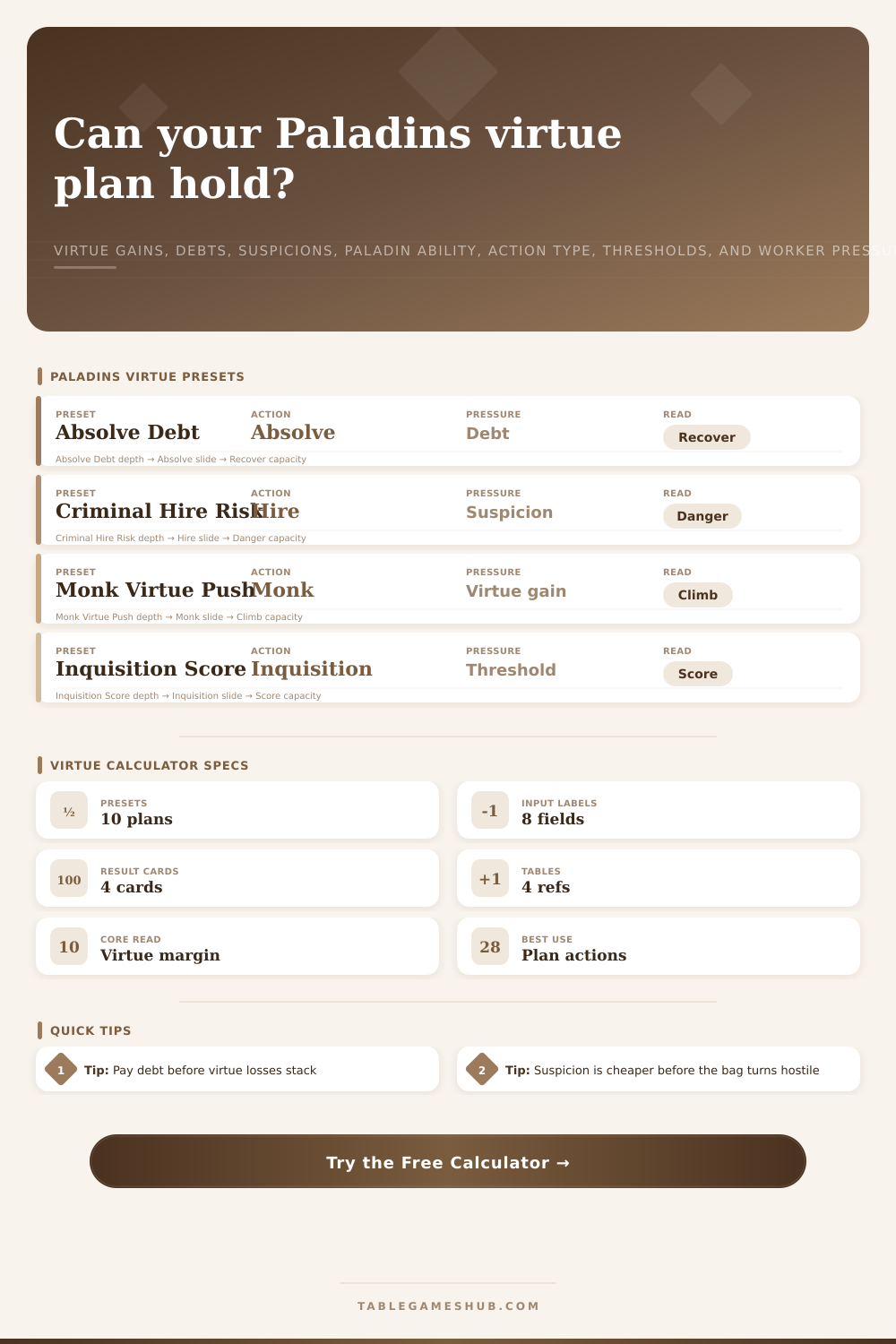
Compare virtue climbs, criminal shortcuts, debt cleanup, suspicion pressure, paladin ability timing, and worker strain before you commit the action.
1Presets
2Virtue Inputs
3Reference Tables
| Final Virtue | Read | Use |
|---|---|---|
| 0-3 | Danger | Debt and suspicion can overwhelm the score line. |
| 4-7 | Workable | Shortcuts are live, but plan cleanup soon. |
| 8-11 | Stable | Good scoring position with room for one risky turn. |
| 12+ | Premium | Protect the track and convert actions into points. |
| Action | Virtue Shape | Calculator Bias |
|---|---|---|
| Absolve | Debt relief | Lowers risk and often adds virtue tempo. |
| Hire | Criminal speed | Boosts workers but raises suspicion risk. |
| Monk | Virtue climb | Rewards low debt and clean worker supply. |
| Tax | Resource burst | Good only when threshold margin is healthy. |
| Risk Load | Pressure | Response |
|---|---|---|
| 0-2 | Light | Push score or develop the board. |
| 3-5 | Medium | Clean up if the threshold gap is negative. |
| 6-8 | Heavy | Favor Absolve or Inquisition control. |
| 9+ | Severe | Stop adding suspicion unless it wins immediately. |
| Workers | Tempo | Plan Read |
|---|---|---|
| 0-3 | Tight | Pick one efficient cleanup or scoring action. |
| 4-6 | Balanced | Most virtue routes remain available. |
| 7-9 | Strong | Can afford support actions or combo turns. |
| 10+ | Flooded | Convert worker depth before virtue drops. |
4Spec Grid
5Tips
Virtue works as currency and a score. It’s a tough game to play because the West Kingdom is a beautiful trap. Paladin tokens exist. You might look at them and think doing good things will earn you points to win, but instead they lead to suspicion cards and debt traps. Sure, criminal acts gets you points because they’re efficient, but that efficiency often comes with a hidden tax in lost virtue. That’s what makes it such an interesting game, but most people lose sight of this very early on.
This is why the calculator does all the math for you. No mental math while your friend drops their worker down. First, take stock of your own virtue marker. Treat this as a source of life rather than something you can simply max out. Your marker is four? Five? There’s room there to move. Three? Two? Then things get ugly on the board in a hurry.
How to Use the Calculator
Input fields prompt you to enter a rough guess about how much a planned action will shift the marker up or down. A monk card adds a couple point; paying a criminal costs a point. Sometimes those printed numbers arent the whole story. Take into account indirect consequences like gaining suspicion tokens, or getting a debt penalty.
You have two other big dangers: debt and suspicion. Debt adds to your risk level when tool takes it into account. It does this using pressure bands, as shown in the reference table. If debt is light on you, go for the points; if it’s heavy, pay off some debt rather than adding more weight to your position. Too many people neglect this warning until after their virtue hits zero. By then it’s too late. Watch how much debt you accrue, not afterwards.
The same applies with suspicion, except that its effects come sooner in the game: A criminal worker is cheap to acquire today, but becomes a huge loss of virtue should that bag turn on you. To model this, the calculator lets you estimate how many suspicion cards you expect. For example, if you’re taking two suspicions for a minor resource payoff, the calculator will probably highlight the deal as risky. This provides useful feedback making you consider present against the long term.
The risk equation changes with Paladin abilities. Taking a move that is usually risky becomes safe with an absolver support or a shield. The risk profile is much more different if you have the right paladin help picked in the dropdown. It mirrors the dynamic of actualy playing and picking the right leader ability which shields you against mistakes. Without it, what may appear viable on paper could fall through in practice because you didn’t consider how your paladin will protect you.
And then there’s worker pressure: Virtue might be ideal for your playstyle, but what good does it do when you don’t have enough workers to pull it off? The calculator balances your number of available workers against which actions you’re performing. For example, building fortifications require a solid supply of workers. The inquiry calls for accuracy. If you aren’t working with many bodies, the calculator will recommend scaling back and/or taking easier actions. This helps avoid mistake of going all-in on a seemingly great-looking turn, only to find it’s too expensive in terms of what you give up.
But how do we decide when we’ve won? Your threshold input defines that end game and you get to choose what winning looks like for you: maybe it’s eight virtue to make second place, or twelve to have a shot at first. Every other decision hinges based off that number. One point ahead? You make different decisions then if you were three points ahead. How do you know which way to go? That’s where the results from reading the plan come in.
Based on all those inputs, it says Hold Up! Push Here! Clean Up! Repair This! It doesn’t lie. If you follow the plan, it makes it easy to eliminate guesswork around complex turns.
The art of virtue management isn’t so much goodness, but staying above the line. As long as you don’t cross it, you can get away with ruthlessness. The trick is to know how much that will cost beforehand, which is where the tool could of come in. Weigh up the debt and the resulting suspicion load to balance them against the gain. This helps you keep from suddenly tumbling off the tracks and ending your game early. It transforms a messy series of events into a ledger that you can manage. When you begin to grasp its pressure points, the West Kingdom no longer feels like a trap; it looks like a puzzle for you to work out.