Triominoes Bridge Bonus Calculator
Total a Triominoes turn from tile pip values, matching sides, bridge and hexagon bonuses, draw penalties, hand tiles, rack pips, and the new score after the play.
▣Bridge Bonus Presets
Load a common Triominoes scoring situation, then adjust the tile pips, matching sides, hand count, rack points, draws, and scoring formation.
⚙Turn Inputs
◈Triominoes Setup Grid
☰Reference Tables
| Score Event | Bonus | What to Verify | Turn Formula |
|---|---|---|---|
| Normal placement | 0 | At least one side legally matches the board. | Tile pips - draw penalties |
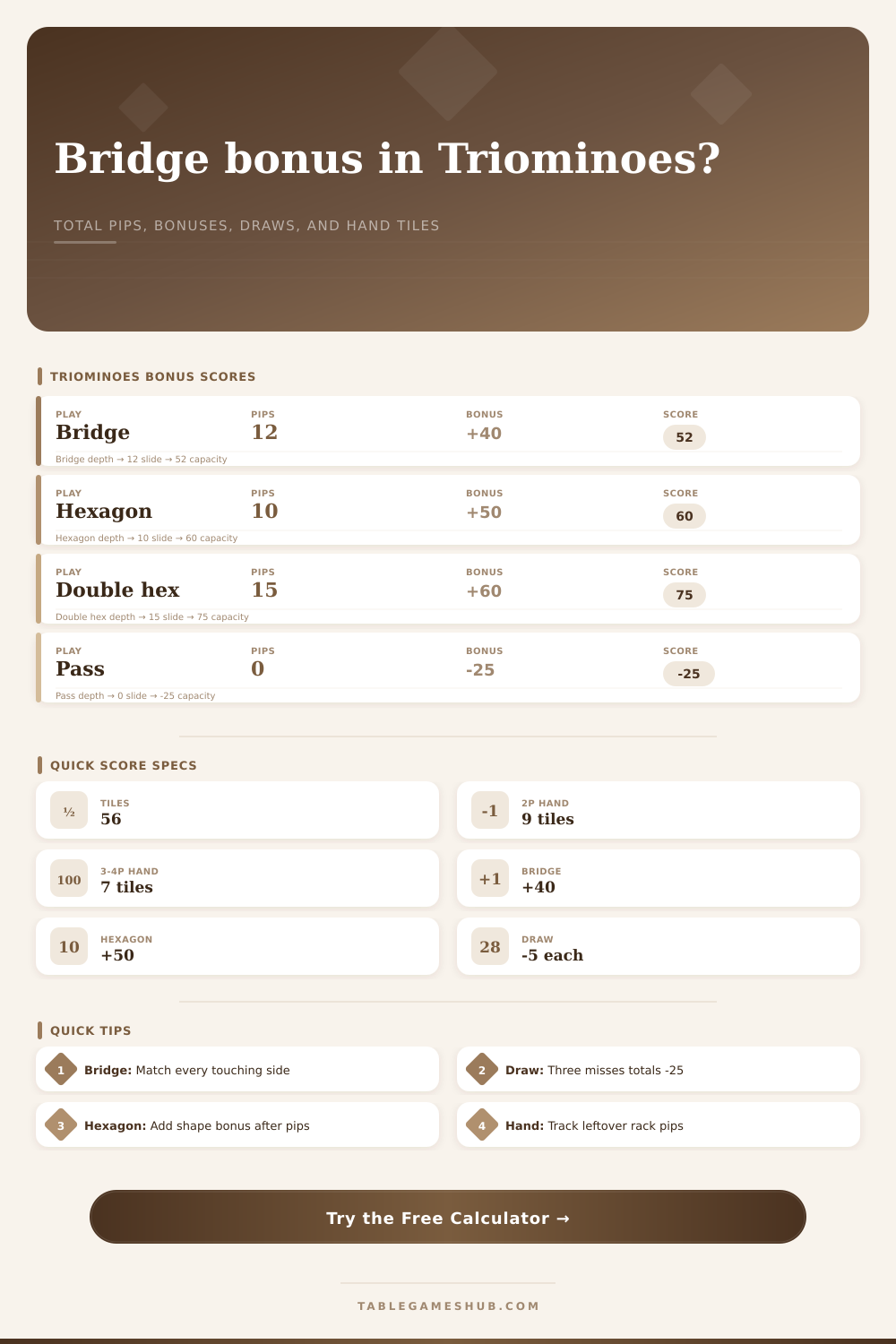
| Bridge | +40 | The placed tile bridges separated groups and all touching sides match. | Tile pips + 40 - draw penalties |
| Hexagon | +50 | The play completes a single six-sided enclosure. | Tile pips + 50 - draw penalties |
| Double hexagon | +60 | The play completes two hexagon shapes at once. | Tile pips + 60 - draw penalties |
| Triple hexagon | +70 | The play completes three hexagon shapes at once. | Tile pips + 70 - draw penalties |
| Turn Situation | Draws | Extra Pass | Penalty Total |
|---|---|---|---|
| Placed without drawing | 0 | No | 0 |
| Drew one, then placed | 1 | No | -5 |
| Drew two, then placed | 2 | No | -10 |
| Drew three, then placed if allowed | 3 | No | -15 |
| Drew three and still passed | 3 | Yes | -25 |
| Tile | Pip Sum | Bridge Turn | Hexagon Turn |
|---|---|---|---|
| 0-1-3 | 4 | 44 before penalties | 54 before penalties |
| 2-2-4 | 8 | 48 before penalties | 58 before penalties |
| 3-4-5 | 12 | 52 before penalties | 62 before penalties |
| 4-5-5 | 14 | 54 before penalties | 64 before penalties |
| 5-5-5 | 15 | 55 before penalties | 65 before penalties |
| Players | Common Starting Hand | Board Effect | Scoring Note |
|---|---|---|---|
| 2 players | 9 tiles each | More hand options, fewer early draw turns. | Track rack pip totals carefully near round end. |
| 3 players | 7 tiles each | Balanced spare pile and faster board spread. | Bridge chances often rise after the opening cluster. |
| 4 players | 7 tiles each | More blocked turns and higher draw pressure. | Draw penalties can erase small tile scores. |
| Late round | 0-4 tiles each | Open spots matter more than raw pip value. | Empty rack scoring may swing the round. |
▦Bonus Comparison Grid
Normal Place
Use when the tile legally matches the board but creates no bridge or hexagon shape.
Bridge
Best for quick high-value turns because even a low-pip tile can score strongly.
Hexagon
Usually beats a bridge by ten points before any draw penalties are applied.
Multi-Hex
Use for double or triple hexagon closures where one tile completes multiple shapes.
ℹScoring Tips
Match before scoring: A bridge or hexagon score should still satisfy normal Triominoes side matching on every edge it touches.
Apply pips first: Total the three numbers on the placed tile, then add the bridge or hexagon bonus, then subtract draw and pass penalties.
Watch small bridges: A 0-1-2 bridge is still worth 43 before penalties, which can be better than a high-pip normal placement.
Track rack pips: Hand tiles are not part of a normal turn score, but leftover rack pips matter when a player goes out or the round is blocked.
Triominoes’ most poorly understood mechanism is the bridge bonus. On paper it appears straightforward: Connect two distinct sets of tile and receive an additional forty points. In reality, people will miss it completely; because they don’t see the board as a graph, or declare it even though not all touching sides are paired up.
This disconnect between visual recognition and hard rules is where the game exist. Before you begin to count pips, you have to understand exactly what you’ve done. Plug in your tile values for the chosen formation and let the calculator do the math. This takes the mental work of remembering penalties off your mind. That way, when you’re thinking three moves ahead, you don’t have to remember anything besides what tiles you have available.
The Bridge Bonus Explained
It breaks down the total pip sum into separate components (the number of points plus the bonus structure) to make you realize that the form of the play is equally important to the numbers on the tiles themselves. Twelve points for having a 3-4-5? Sure. But 52 points if that same tile completes a gap and matches both ends? Not just arithmetic but also strategy.
The other thing most newbies do is concentrate only on high-pip tiles (i.e., 5-5-5), thinking they’ll always take the fifteen points and win the turn. But they don’t realize that a 0-1-2 played as a bridge score forty-three… Almost three times as many points than any normal placement gets. And that’s it: most of the trick is realizing what you’re really measuring. Is this about getting points from the ink on the tile? Or from the geometry on the board? A 1-1-1 played as a bridge scores forty-one; a 5-5-5 in its normal spot earns fifteen. Geometry take precedence.
Train yourself to see the spaces between clusters of tiles first, before examining your hand. It’s laid out clearly on the page in the bonus table. Fifty points for a hexagon closure. Sixty for a double hexagon. They’re rare events. That is why they feel so good when you get them.
But it takes precision to create one. If the surrounding tiles aren’t aligned just right, you can’t force a hexagon. Usually trying will mean drawing tiles (which cost five points apiece). Draw three and pass and its a twenty-five point penalty. That’s a devastating swing. It will wipe out a bridge and then some.
But there is risk in reaching for that bonus, draw costs money, but drawing once to obtain a bonus will cost you five points. The bonus has thirty-five above what you would normally score, which means that even though you paid five points for it, you’re still up by thirty. Now, however, you’ve drawn twice, and you still didn’t get it. You’ve lost ten points. Now the bonus only scores twenty-five more then a normal high-pip play. The gap closes quickly.
That’s where keeping track of how many times you drew comes into play. It’s not just “getting that tile out,” it’s also making sure that you got the most bang for your buck on that turn. And then there’s hand management. In a two-player game, you start with nine tiles. With four players, it’s down to seven. That means fewer opportunities to make up mistake. Every pip left in your hand at the end of a round is points you didn’t score. They add up: each time you have pips remaining at the end of a round, you’ve lost points.
Your rack pip count are added to the calculator. This reminds you that when you leave something like a triple five-five-five lying around, you paid more than just that moment for it. That bridge may net you fifty points this round, but it might cost you the round by leaving you with three useless 5-5-5s. You can’t forget to consider the end game so much as the moment itself.
It’s a game that requires spatial awareness. It requires patience. It’s a game that punishes greed. A bridge might look good, but if it costs you several draws and blocks your opponent’s only move, it’s a bad play. The score isn’t everything. Your goal is to get rid of your cards before your opponent does, while not letting them do the same. At times a riskier, bigger move isn’t as good as something safe and smaller.
The calculator tells you how many points its worth. It doesn’t tell you if your opponent’s going out next. That requires watching the board. Triominoes is all about control. It is about control over how the game plays out. What pieces you’ll get. When you’ll take the risk of reaching for bonus cards or whether to simply go for points.
And the ultimate control move, which transforms the whole board into a different game, is that bridge. It closes off sections and opens up new ones. After a while you begin looking at the board not just as an arrangement of tiles but as a series of possible bridges. Then it’s no longer about what tiles you have in your hand but where you play those tiles. This creates some really high scores.