Dice Sum Probability Calculator
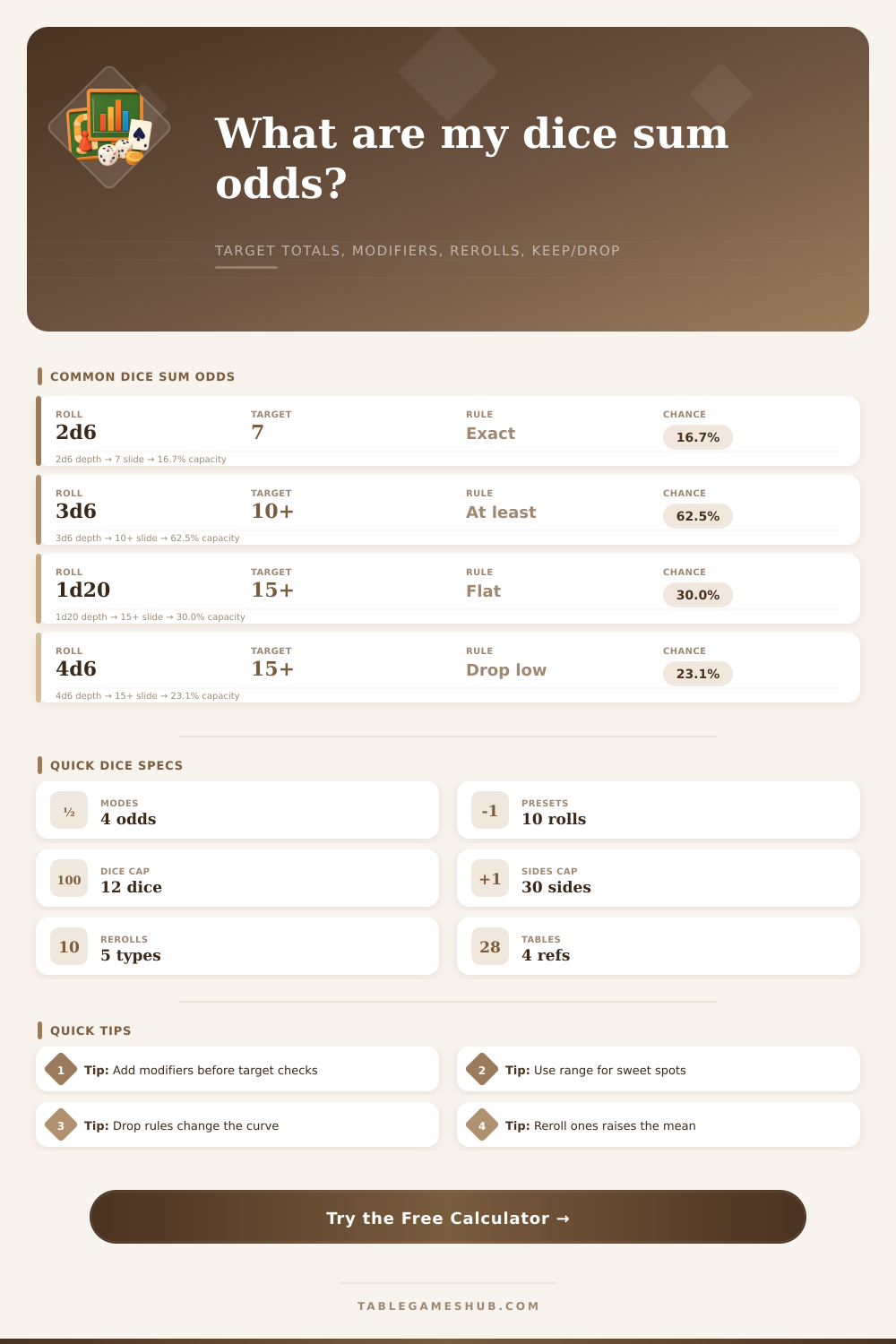
Calculate dice pool totals with exact, at least, at most, or range targets, plus modifiers, keep/drop rules, reroll rules, and a full sum distribution.
| Final Sum | Ways / Weight | Probability | Cumulative At Most | Distribution Bar |
|---|---|---|---|---|
| 7 | 6 | 16.67% | 58.33% | Calculate to refresh |
| Dice Pool | Minimum Sum | Maximum Sum | Average Sum | Common Use |
|---|---|---|---|---|
| 1d20 | 1 | 20 | 10.5 | Flat checks and saving throws |
| 2d6 | 2 | 12 | 7.0 | Board game movement and reaction rolls |
| 3d6 | 3 | 18 | 10.5 | Bell curve checks and attributes |
| 4d6 drop lowest | 3 | 18 | 12.24 | Ability score generation |
| Mode | Target Handling | Best Fit | Example | What Gets Added |
|---|---|---|---|---|
| Exactly | One final sum | Precise board game triggers | 2d6 equals 7 | Only the selected total |
| At least | Target through maximum | Difficulty checks | d20 + 5 reaches 15 | All totals at or above target |
| At most | Minimum through target | Low-roll success systems | 3d6 at most 9 | All totals at or below target |
| Range | Inclusive low to high | Sweet spot outcomes | 5d6 from 18 to 22 | All totals inside the band |
| Keep / Drop Rule | Curve Effect | Typical Pool | Target Impact | Example Use |
|---|---|---|---|---|
| Keep highest | Raises totals | Roll 5 keep 3 | Higher target becomes reachable | Skill pools and boosted checks |
| Keep lowest | Lowers totals | Roll 3 keep 2 | Low totals become common | Risk, burden, or penalty systems |
| Drop lowest | Trims weak dice | 4d6 drop 1 | Improves expected total | Attribute generation |
| Drop highest | Trims strong dice | 3d6 drop 1 | Reduces peak outcomes | Disadvantage variants |
| Reroll Rule | Die-Level Effect | Average Shift | Good For | Calculator Note |
|---|---|---|---|---|
| No reroll | Uniform faces | Baseline | Standard dice pools | Uses normal 1 through sides odds |
| Reroll ones once | One is less likely | Moderate increase | Damage dice and house rules | Second roll may still be a one |
| Reroll low half once | Low faces shrink | Strong increase | Reliable damage or checks | Threshold is floor(sides / 2) |
| Roll twice keep high | High faces cluster | Advantage curve | Advantage-style systems | Applied to every die separately |
Dice follows a specific mathematical pattern of probabilities distributions. The mathematical pattern that represents a twenty-sided die is a flat line because each number on the die have the same chance of being rolled. However, if you uses multiple twenty-sided dice, the mathematical pattern shifts to show that there is more combinations of the numbers in the middle of the die than there are combinations of the extreme value on the die.
This form what is known as a bell curve. Many game system use a single large die to obtain an unpredictable result of the roll of the die. However, many other game system use multiple smaller dice to ensure that the results obtained are consistent and lie within the middle of the bell curve.
How Dice Probabilities Work
The dice calculator tool allow users to visualize the bell curve from the dice rolls by changing the number of dice that is rolled and the number of sides on each die. The target mode allow for the selection of the type of target that are to be obtained from the dice rolls. For example, a precision strike target require that the result of the dice roll is the same as the number that is selected.
On the other hand, a threshold check only require that the result of the dice roll is higher then a selected number. It is important to understand the difference between these two mode as they have different probability of being rolled. Many game system use keep and drop rule on the dice rolls.
For instance, if a game system state that the game system is to drop the lowest die after rolling multiple dice, then low number on the dice will be dropped and the result will skew towards higher number. This rule will make it less likely for the result to fail. By using the keep and drop setting on the dice calculator, it is possible to understand how the total of the dice will increase with the use of such rule.
The use of such rule create a sense of reliability within the player regarding the character create within the game. Rerolls are another method of adjusting the probability of the roll of the dice. For instance, if a game rule state that any rolled number of one is to be rerolled, then this is a small change to the probability.
However, if a game rule state that the player will roll two dice and keep the highest of the two, then this is a large change to the probability. This type of roll will create a weighted distribution of the dice, mimicking the effect of the use of a high game modifier. However, the maximum roll of the dice will remain the same.
The use of rerolls change how the player perceive the risk that they are taking in the game. Dice calculator also allow for the addition of modifier to the total roll of the dice. The modifier do not change the bell curve that is create by the dice rolls; however, they do change the position of that curve on the probability distribution table.
For instance, if a plus five modifier is added to the dice rolls, then any total roll of the dice that is most likely to occur will shift up the distribution table by five unit. If the most likely roll of two dice is seven, then with a plus five modifier the most likely roll will be twelve. The addition of modifier move the target total roll of the dice from a rare roll to a common roll.
Thus, it increase the chance of rolling such a total. When you must roll the dice multiple time, each roll is independent of the other roll. The probability of one roll succeeding is not the same as rolling the dice multiple time.
When rolling the dice multiple time, the probability of success at least once increase. The dice calculator tool determine the probability of success at least once by determining the probability of failing each roll and subtracting that number from one. The distribution table associate with the dice calculator allow players to view the possible outcome from rolling the dice.
Many player only consider the minimum roll of the dice that will result in success for the roll. However, players should also consider the range of number that have a high chance of being rolled. By knowing the range of number that are likely to be rolled, players can better plan for the likely roll of the dice rather than planning for their best outcome.
By understanding the probability of the roll of the dice, players can transform a gamble on the dice into a calculated risk.