Marvel Crisis Protocol Dice Calculator
Estimate MCP-style attack and defense rolls with hit, wild, critical, block, blank, and skull symbols, including rerolls, crit expansion, cover, Pierce, and damage odds.
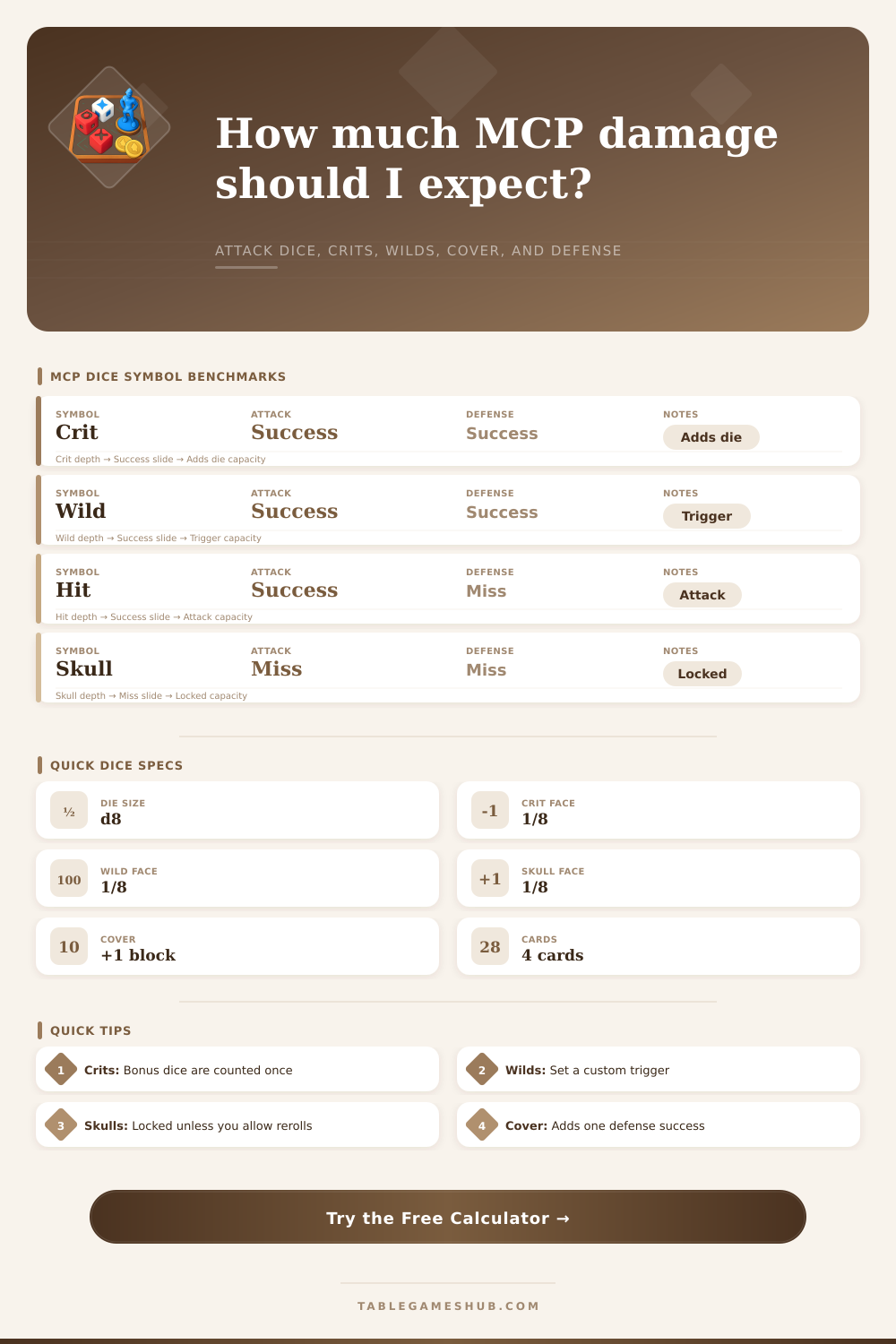
| Symbol | Attack Use | Defense Use | Per Die Chance | Calculator Treatment |
|---|---|---|---|---|
| Critical | Attack success | Defense success | 1 of 8 | Adds one bonus attack die when expansion is active |
| Wild | Attack success | Defense success | 1 of 8 | Counts as success and can trigger one selected bonus |
| Hit | Attack success | No defense success | 2 of 8 | Normal attack output |
| Block | No attack success | Defense success | 2 of 8 | Normal defense output |
| Skull | No success | No success | 1 of 8 | Locked from rerolls unless allowed in settings |
| Blank | No success | No success | 1 of 8 | First reroll target when rerolls are available |
| Input | What It Changes | When Applied | Good Use Case | Result Impact |
|---|---|---|---|---|
| Attack rerolls | Rerolls failed attack dice | Before critical expansion | Innate reroll powers or support effects | Raises hits, wilds, and crits |
| Defense rerolls | Rerolls failed defense dice | Before cover | Defensive tech and reroll auras | Raises blocks, wilds, and crits |
| Critical expansion | Adds bonus attack dice | After base attack roll and rerolls | Comparing big dice pools | Raises expected attack symbols |
| Cover | Adds one defense success | After defense dice are counted | Checking covered target durability | Reduces final damage by up to one |
| Dice Pool | Base Attack Success EV | Base Crit EV | Base Wild EV | Typical Check |
|---|---|---|---|---|
| 4 attack dice | 2.00 | 0.50 | 0.50 | Small builder attack |
| 5 attack dice | 2.50 | 0.63 | 0.63 | Common spender or boosted builder |
| 6 attack dice | 3.00 | 0.75 | 0.75 | Strong focused attack |
| 8 attack dice | 4.00 | 1.00 | 1.00 | High-threat spike test |
| Defense Profile | Base Success EV | With Cover EV | With 1 Reroll EV | Use In Calculator |
|---|---|---|---|---|
| 3 defense dice | 1.50 | 2.50 | 1.88 | Average low defense target |
| 4 defense dice | 2.00 | 3.00 | 2.38 | Sturdy character check |
| 5 defense dice | 2.50 | 3.50 | 2.88 | High defense profile |
| 0 defense dice | 0.00 | 0.00 | 0.00 | Unopposed or custom scenario |
Marvel Crisis Protocol are a tabletop game that uses eight-sided dice, or d8 dice, to determine the successes of an attack or defense. Eight-sided dice has the potential to provide a variety of result for an attack or defense. While player use there intuition to determine the probability of success with an attack or defense, that intuition is likely to be inaccurate.
Intuition does not account for the various mathematical modifier of the game, such as Pierce abilities that allow attacks to ignore defense success, or critical expansion that allow for additional dice roll after a successful critical attack roll. By using a calculator that account for these different variables, players can make decisions based off the statistical probabilities of an outcome rather than using intuition. Critical expansion allow for additional dice rolls for an attack due to the critical symbol on the dice.
How to Use a Damage Calculator in Marvel Crisis Protocol
These additional dice rolls can also feature critical symbols, leading to further rolls. Due to this “snowball” effect of critical expansion, an attack pool with more dice is more dangerous than an attack pool with fewer dice. The damage probability calculator can show this relationship between the size of an attack pool and the likelihood of critical expansion to compare the damage potential of attack pools of different size.
Aside from damage rolls, the eight-sided dice also feature “wild” symbol. These symbols always count as a successful damage roll, but many character feature abilities that is triggered by rolling a wild symbol. These abilities may provide extra damage or successes for an attack that feature a wild symbol.
By inputting these features into the damage probability calculator, the player can determine the maximum potential power of that character. Defense in the game is used to prevent damage being done to models. Defense scenario often use the concept of cover.
Cover provides defense successes that must be overcome to allow damage to be done to a model. Defense successes prevent models from entering a daze or knockout state. Because of the ability of a defense success to prevent a model from entering these states, cover is a significant factor in the game.
A high degree of defense and cover can be difficult for an attacking player to overcome. The reference table allow players to easily determine if using a power card to move a model out of a defensive position is worth the effort. Rerolls are used to roll a die again to get a better result for the attack.
Rerolls can change blank results to successes, or skull results to other symbols if the character allow it. The damage probability calculator account for the use of rerolls by indicating that the player should reroll the least useful dice to mimic the skill of the player in managing their dice pool. Using a reroll will increase the reliability of an attack.
In addition to the damage value indicated by the damage probability calculator, the calculator also provide the probability of causing a model to reach a daze or knockout state. Rolling enough damage to change a model’s status can cause a daze state. A knockout state can be rolled if an attack do enough damage to remove the model from the game.
Causing a model to reach a daze state is important because a dazed model is less effective in the game. By calculating the damage an attack will deal and the remaining stamina of the model to be attacked, a player can determine if an attack is a calculated risk or a waste of a turn. By understanding the statistical probabilities of an outcome, a player can focus on other aspect of the game to formulate an attack strategy.