Mandala Score Calculator
Total your Cup cards by the value of each color in your River, compare your opponent, and check the official fewer-Cup-cards tiebreaker.
| Sand Color | River Slot | Cup Cards | Formula | Points |
|---|
Used only when scores are tied; the tied player with fewer Cup cards wins.
Choose each color once in the River. A blank River slot means that color has not been claimed into your River and matching Cup cards score 0.
| River Slot | Point Value | What Scores | Calculator Formula |
|---|---|---|---|
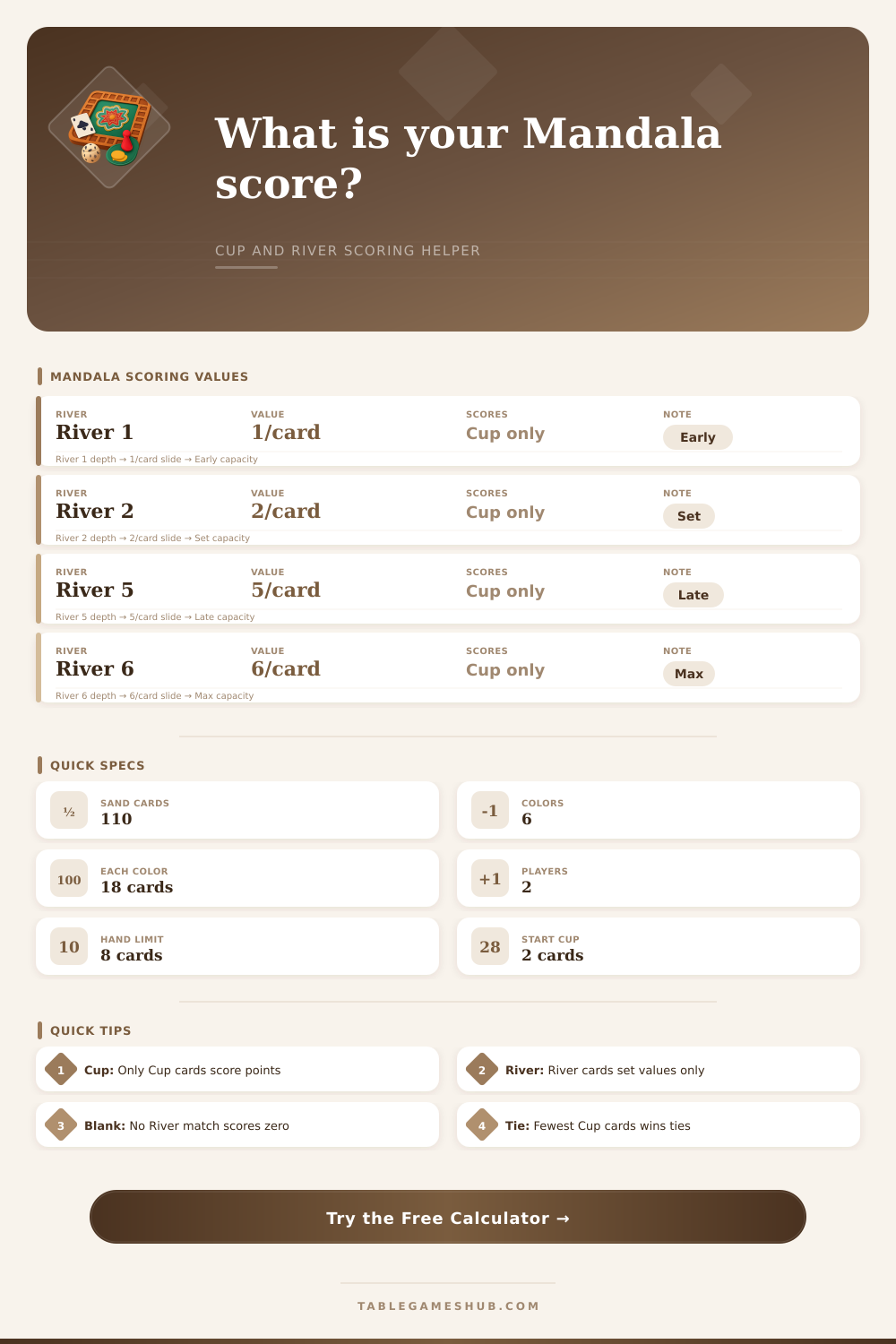
| First color in River | 1 point per card | Matching Cup cards only | Cup count × 1 |
| Second color in River | 2 points per card | Matching Cup cards only | Cup count × 2 |
| Third color in River | 3 points per card | Matching Cup cards only | Cup count × 3 |
| Fourth color in River | 4 points per card | Matching Cup cards only | Cup count × 4 |
| Fifth color in River | 5 points per card | Matching Cup cards only | Cup count × 5 |
| Sixth color in River | 6 points per card | Matching Cup cards only | Cup count × 6 |
| Situation | What Happens | Cards Added | Scoring Effect |
|---|---|---|---|
| Sixth River color added | Resolve that completed Mandala | Claimed Mountain cards | Then score Cups |
| Deck exhausted | Reshuffle discard, continue to next completion | Last Mountain claims | Score after destruction |
| Cards in hand | Discard at final scoring | None | Score 0 |
| Incomplete Mandala cards | Discard at final scoring | None | Score 0 |
| Tied final score | Compare Cup card totals | No new cards | Fewer Cup cards wins |
| Claimed Mountain Color | If New to River | If Already in River | If No Field Cards |
|---|---|---|---|
| One card claimed | 1 card to River | 1 card to Cup | Discard instead |
| Two cards claimed | 1 River, 1 Cup | 2 cards to Cup | Discard instead |
| Three cards claimed | 1 River, 2 Cup | 3 cards to Cup | Discard instead |
| Four or more claimed | 1 River, rest Cup | All cards to Cup | Discard instead |
| Cup Pattern | River Value | Matched Cards | Point Result |
|---|---|---|---|
| 4 cards in slot 1 color | 1 | 4 | 4 points |
| 5 cards in slot 2 color | 2 | 5 | 10 points |
| 6 cards in slot 3 color | 3 | 6 | 18 points |
| 3 cards in slot 5 color | 5 | 3 | 15 points |
| 1 card in slot 6 color | 6 | 1 | 6 points |
| Any color not in River | 0 | Any count | 0 points |
Until it’s time to score, that is. And it can look deceptively simple. You claim mountains, race toward full-color glory, and fill your River slot by slot. And then that sixth color locks into place, and the deck runs out. Oh oh, here you go. A stack of secret Cup cards stares you down, and what color earned me one? What color earned me six? Whoopsie, there it goes… Now that’s how you mess up.
Let the calculator do the math for you; focus on whether your strategy worked instead of fighting about multiplication tables. That’s where Mandala comes in. It boils down to depth vs. Width: Do you cast wide with many colors in hopes of getting some early River spots? Or do you hold cards in a single color, gambling that it will become valuable later?
Why You Need This Tool
With Mandala, you can assign values to all six of your River slots based off the order in which you obtained the corresponding color. Cards from first color are inexpensive, while cards from the final color is expensive. You input the number of cards of every sand color you’ve managed to move into your Cup. The system multiplies accordingly and informs you whether it was worthwhile to take such a big risk with your other colors in hopes of a big late-game push for high-value slots.
The midgame can be a trap for a lot of players. You see that other player grab a massive collection of blue cards. You suddenly feel compelled to do something in blue, too. After all, they’re going strong, so you feel like you should chase them. This is almost never a sound strategy. Look at your own board state instead of chasing someone else’s momentum.
The color-matching point reference table provided with the calculator show precisely where Cup cards net points relative to various River slots. Unmatched color cards net no points, period. If you can’t match what the other person is doing, a couple of card in a low-value spot may be better than having none in a high-value spot.
Games are really decided by the tiebreaker rule. In case the points match between players, whoever has fewer Cup cards win. That’s the part that encourages efficiency over volume. You don’t want a pile of low-value matches; you’d prefer a smaller collection of high-value ones. You’ll win with style. The calculator will check this condition automatically as it compares scores for both players. No need for counting each individual tile by hand if you’re exhausted after a lengthy game.
But it’s more than counting: it’s knowing when to stop going for another River color and when to start hoarding what you have. Grabbing new colors for River early in the game is crucial because each slot multiply all further claims of that kind. Late in the game, those same spots are a liability if you can’t fill them sufficiently to outpace your opponent.
The tool offers presets for various late-game scenarios: from last minute surge colors to completely exhausted decks. These illustrate impact one decision five turns ago has on the final math. Also, you ought to think about which cards remain in the deck before making your moves. For example, if purple is almost depleted, then maybe that River slot can’t be filled; any investment would of been wasted effort. To correctly score these zero-contributions, the calculator lets you input zero for colors that didn’t make it into your River.
That means you’re forced to take randomness and scarcity into consideration beyond just how well or poorly you manage your hand. Adapting to what’s offered by the deck is good play. It is also good not to force a predetermined plan. As cards move from Mountain to River to Cup, their geometric patterns emerge spontaneously. The way cards are chosen matter; scoring reveals the hidden logic behind those decisions. People play for safe spreads or take chances with one strong color; both is right, provided you know which cards are really worth what they’re worth.
The key is knowing exactly what each card is worth before you commit it to your collection. After each event, run an audit on your games with the tool. Input the final Cup count and River order to find out how much ground you made up (or lost). Eventually, it’ll paint a picture of how you play. Do you always overrate the early positions? Or do you blow off late-game chances? Knowing yourself is better than knowing what to do in one specific situation.
Your memory of the game can be wrong. The math won’t. In the end, that’s what Mandala is all about: precision and patience. Every Cup card adds up to something. Every River slot changes the value of everything around it. Each claim are important. If you get the number correct, then you’ll be able to move on to the following game confident in your performance.
That’s why this little tool does the math for you. You can take pride in victory or gain knowledge from defeat without having to distract yourself by worrying about manual errors.