Daggerheart Damage Calculator
Calculate damage dice by proficiency, compare the roll against Major and Severe thresholds, apply resistance, and estimate how Armor Slots change HP loss.
Presets are editable examples. The calculator treats Daggerheart damage as a roll total first, then applies resistance or vulnerability, compares the adjusted damage to thresholds, and optionally marks Armor Slots to step the wound down.
| Outcome | Before Armor | After Armor Plan | HP Marked |
|---|---|---|---|
| None | --- | --- | 0 |
| Minor | --- | --- | 1 |
| Major | --- | --- | 2 |
| Severe | --- | --- | 3 |
| Hits | Expected HP No Armor | Expected Slot Demand | Expected HP With Slots |
|---|---|---|---|
| 1 | --- | --- | --- |
| 2 | --- | --- | --- |
| 3 | --- | --- | --- |
| 5 | --- | --- | --- |
| Adjusted damage | Classification | HP marked | One Armor Slot changes to |
|---|---|---|---|
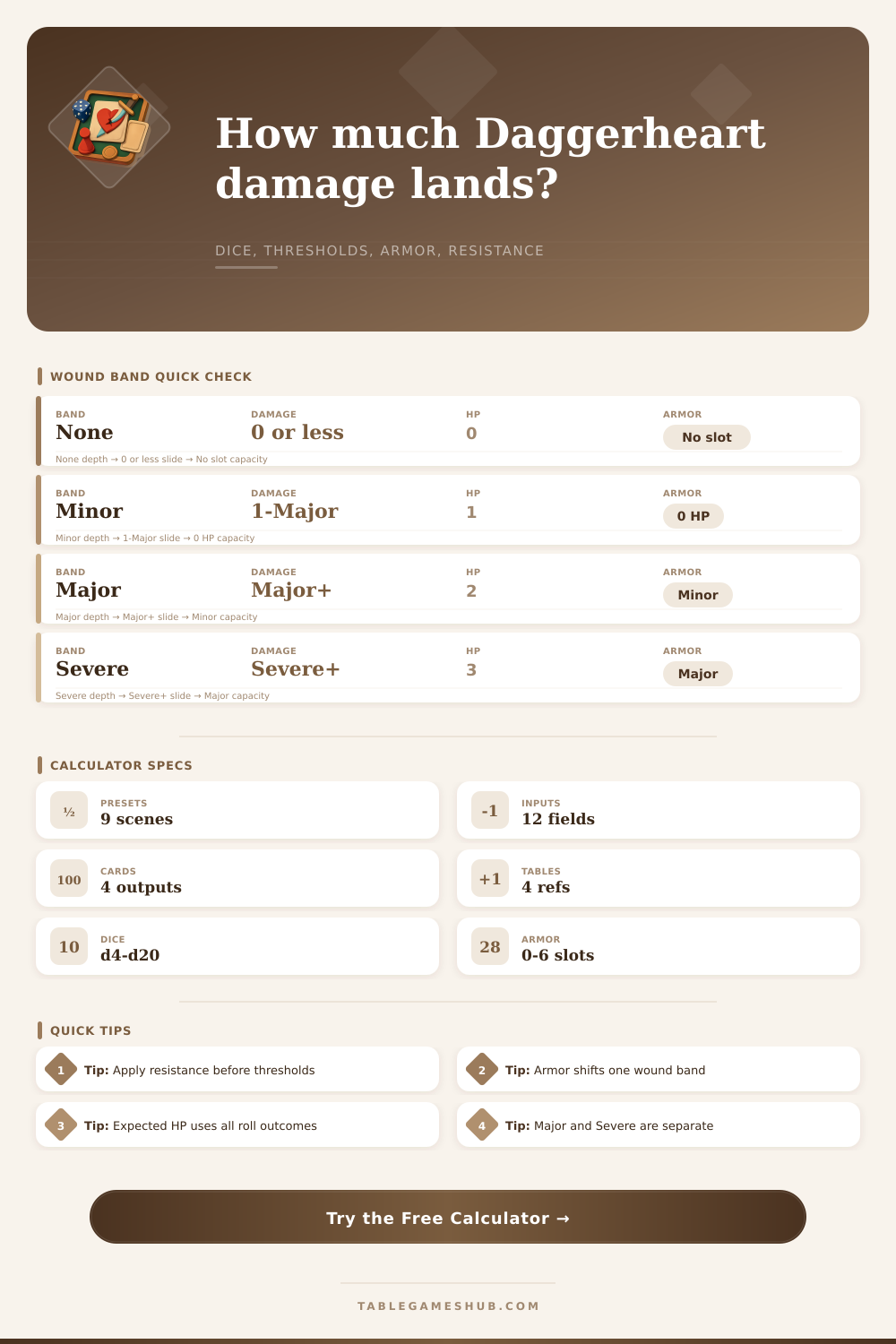
| 0 or less | No HP | 0 | No slot needed |
| 1 to below Major | Minor | 1 | 0 HP |
| Major to below Severe | Major | 2 | Minor, 1 HP |
| Severe or higher | Severe | 3 | Major, 2 HP |
| Proficiency | d6 average | d8 average | d10 average | d12 average |
|---|---|---|---|---|
| 1 die | 3.5 | 4.5 | 5.5 | 6.5 |
| 2 dice | 7.0 | 9.0 | 11.0 | 13.0 |
| 3 dice | 10.5 | 13.5 | 16.5 | 19.5 |
| 4 dice | 14.0 | 18.0 | 22.0 | 26.0 |
The damage value for Daggerheart dont allow for an simple subtraction of a value from the health bar for character. Instead, the game use a system of threshold and bands for damage. If damage does not reach the Major threshold, the wound are considered to be of a minor nature.
If damage reaches the Major threshold, the wound is of a Major nature. If damage reaches the Severe threshold, the wound is of a Severe nature. Thus, damage threshold are used to indicate the severity of the wounds that a character take.
How Damage, Armor, and Resistance Affect Wounds
In order to calculate the damage that is dealt, there is several values that must be accounted for. The character’s strike proficiency will impact the number of dice that are rolled. Additionally, there are bonuses to damage that can be recieved from specific ability or strikes.
Once the player rolls the number of dice, the damage can be reduced due to the resistance of the creature that is being attacked; halving the damage total will reduce damage from Severe to Major thresholds, for instance. Thus, resistance to damage can alter the damage total that is dealt, and the severity of those wounds. Armor dont reduce the damage total that is rolled.
Armor will reduce the severity of the wound category. For instance, armor slot can reduce damage from Severe wounds to Major wounds, or reduce Major wounds to Minor wounds. Thus, armor does not reduce damage total, but alters the wound category into one of less severe.
Armor can be used for resource management to decide whether it is better to spend armor slots on future attacks or during current attacks. Some weapon will result in damage that consistently hits certain thresholds. Weapons that are design to hit consistent damage will hit the Minor threshold, for instance.
Other weapons will have high variance in the damage that can be dealt. Weapons with high variance can result in very low damage or very high damage. Thus, expected health loss per hit can be calculated to determine how many rounds of fights a character can survive.
Proficiency will impact the number of dice that are rolled, which will increase the maximum damage that can be hit. Additionally, flat modifier will impact the damage total. High flat damage modifiers will result in higher damage, even if the number of dice are low.
Thus, flat modifiers increase the consistency of damage that is dealt. Armor should of been used in different situation based off the type of enemy that are being fought. If weak enemies are faced, armor slot can be saved because damage will not reach Major thresholds.
However, if one strong enemy is faced, armor slots may be purchased for one hit in order to avoid a Severe wound. Thus, armor can be used to manage resource in the face of different enemies.