Le Havre Building Rent Calculator
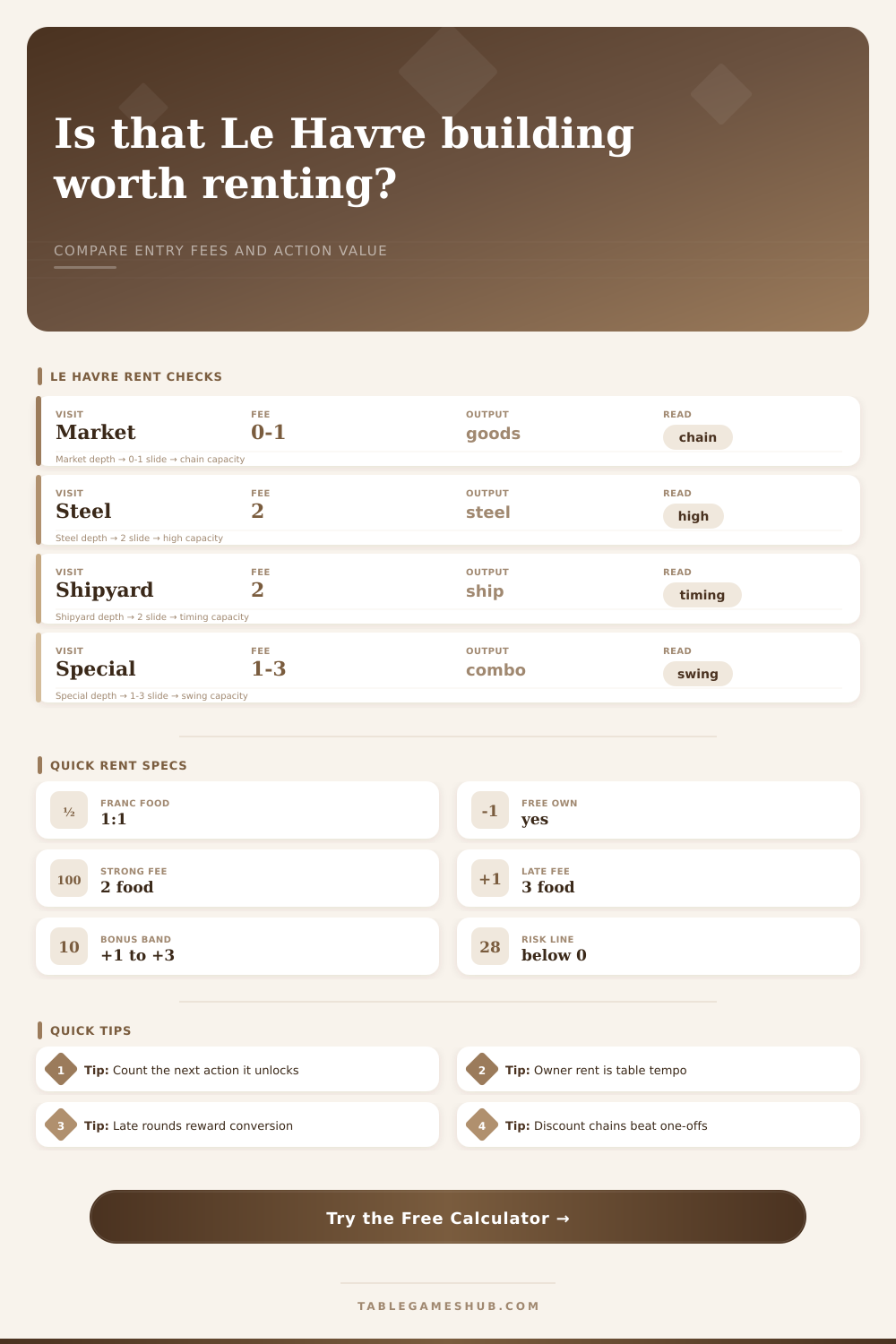
Compare a building visit against its entry fee, owner payment, conversion output, round timing, and follow-up action value.
Use rent as a tempo question: what does the building make now, what does it unlock next, and how much food or francs leave your hand when another player owns it?
⚓ Le Havre Rent Presets
🏗 Rent Inputs
🧮 Component and Spec Grid
📋 Building Rent Reference
| Building visit | Typical fee check | Best reason to pay | Rent warning |
|---|---|---|---|
| Marketplace or market chain | 0 to 1 food | Fills missing goods and sets up multiple future actions | Weak if it only replaces a standard offer space |
| Smokehouse, bakehouse, abattoir | 1 to 2 food | Turns raw goods into feeding cover without spending another action | Overpaying can erase the feeding gain |
| Cokery, ironworks, steel mill | 2 food or more | Converts fuel and iron into scarce late-game industrial output | Bad if the converted goods cannot be used before game end |
| Wharf, shipping line, shipyard | 2 to 3 food | Unlocks ships, shipping, food stability, or final point conversion | Timing matters more than printed rent |
| Special building combo | 1 to 3 food | Combines discounts, extra actions, or unusual conversion rates | Only worth it when the combo is immediate |
| Output type | Suggested action value | Round premium | Calculator use |
|---|---|---|---|
| Food conversion | Equal to net food gained | Higher before harvest feeding | Use for bakehouse, smokehouse, and abattoir visits |
| Goods upgrade | Raw goods plus upgraded scarcity | Higher when ships or building costs are near | Use for coke, iron, steel, leather, and bricks |
| Ship action | Food stability plus victory point tempo | Highest in late or final windows | Use for wharf, shipping line, and shipyard decisions |
| Market bundle | Missing goods plus saved action value | Stable through most of the game | Use when one visit completes several requirements |
| Preset | Building type | Rent posture | Expected read |
|---|---|---|---|
| Market Rent Chain | Market or offer chain | Low fee, high setup value | Usually strong if it completes two requirements |
| Steel Mill Visit | Industrial converter | High fee, high scarcity output | Strong only when steel has an immediate use |
| Shipyard Timing | Ship or shipyard action | Fee accepted for late stability | Often worth it when it secures feeding |
| Special Building Combo | Special building combo | Fee offset by discount or saved action | Strong when the bonus is not theoretical |
| Net value band | Rent result | Table meaning | Action note |
|---|---|---|---|
| Less than 0 | Bad rent | The visit feeds an opponent more than it helps you | Look for an offer space or wait |
| 0 to 2.9 | Thin rent | The visit is acceptable only if timing is urgent | Check whether the owner payout matters |
| 3 to 6.9 | Good rent | The fee is covered by output and tempo | Take it when alternatives are slower |
| 7 or more | Excellent rent | The building creates a large conversion or ship swing | Prioritize unless it gives a rival the game |
✦ Rent Timing Tips
When most players come to Le Havre, it’s all about production. Build up an engine. Stockpile some goods. Wait for the perfect moment to turn it all into points.
That’s fine until you get a player who grasp the concept of rent. In this game, it isn’t just about what you produce. It’s also about what you pay other people so that they can use their buildings while you’re using yours.
Why Rent Is Important in Le Havre
Every time you go to a rival’s market, every time you drop in at a rival’s shipyard, you hand him tempo. Run the math yourself with calculator above, but understanding the logic of the numbers makes you play the whole game different than before.
First, remember: Rent is a tax on inefficiency. Nothing cost you anything to enter building if you’re the owner. Everything costs you either francs or food if your opponent is the owner. And that’s not an entry fee; that’s a straight resource transfer. Every time you go into a smokehouse owned by your primary rival, you are directly giving them the ability to upgrade their city or feed their worker while you use up one of your actions.
In the short term, this doesn’t seem like much. A small amount of food isn’t much. But over the course of twenty rounds, those little leaks will suck more resources out of your economy than any bad harvest ever could.
That’s where timing matters. Engines are brittle early on; they don’t visit much. You’re desperate for a certain good and a rent payment may be worthwhile. Later on, every move is precious, either advancing your VP total or boosting your final round of feeding stability. Visit someone else’s steel mill in turn 18? It’s risky. You’re handing over some of your resources to them at the very moment the game will tip one way or another. They score the VP, you get the goods. Unless the goods translate immediately into something valuable, you lose the deal.
Adjusting for stage timing allows tool to show how high the risk premium is for late-game visits. The owner makes a huge difference. Paying rent to a guy who aggressively charges extra fees is different than paying rent to a casual player. If one of your rivals has created a row of cheap markets for the sole purpose of bleeding you dry, each visit reinforces his edge over yours. This is reflected in the calculator: You can change the percentage of payouts to the owner.
And while yes, it’s about what leaves your pile of food, it’s also about keeping that food out of your opponent’s hands so he cannot use it well. In some cases, buying from a market space or taking a slower action is preferable to funding your opponent’s engine.
Consider the chain value of the visit as well. One entry doesn’t stand by itself. Entering this wharf doesn’t just mean I can load that ship, but I get fed next round too. Visiting this baker lets me feed three workers all at once. If the visit opens up multiple actions to take in the future, then its rent costs drop greatly (in relative terms).
The value of the output is not just what sits on the table when your turn ends. It’s what you carry over into the next turn. If a two-food rent saves you three actions later, it is cheap. If it only provides you with a brick you can do nothing else with, it is expensive.
It’s all spelled out nicely on the page with a reference table which breaks down these costs and gives the strategic warnings of what you should expect for each one. Remember, shipyard buildings is high fee ones and need some serious justification. Pay high rent if it results in an instant swing in your stability/points. Otherwise, don’t bother. Wait until the next player has to do so. Force them to earn that fee every time.
Le Havre is ultimately a game where the player who calculates more and is patient wins out over raw speed. It is possible to lose multiple actions. Just don’t let the value you gain be less than what it costs you. Understanding how to weigh risk/reward isn’t just important for you, but also for your opponent. Every time you pay them rent, you’re making them stronger. Every time you deny their rent request, you make them weaker.
Once you stop thinking of rent as merely money changing hands and instead realize it’s a tempo battle, you’ll open the game up. You’ll start to play the board rather than simply your hand. And this is what distinguishes a good player from a great one. It would of been much easier if things were different.